Why WhatsApp Coexistence Is the Missing Link Between AI Agents and Better Customer Conversations
Explore WhatsApp Coexistence and combine the Business app with Cloud API automation, shared customer communication, CRM workflows and scalable engagement.
Imagine this. A customer discovers your business through an Instagram ad. They click the WhatsApp button to ask about pricing. Later, they continue the conversation from the WhatsApp Business app while commuting. The next morning, they message again, expecting an update on their order.
Meanwhile, your sales team is using one tool, your support team is using another, and your CRM is only part of the conversation. The customer thinks they're talking to one business. Your business behaves like three different teams. This isn't a WhatsApp problem. It's a conversation continuity problem.
For years, businesses had to choose between the simplicity of the WhatsApp Business App and the scalability of the WhatsApp Business Platform. Moving to the API often meant changing workflows, retraining teams, or giving up the familiar mobile experience that employees relied on every day.
That trade-off slowed digital transformation for thousands of growing businesses. Today, that limitation is disappearing.
With WhatsApp Coexistence, businesses can use the same business phone number across the WhatsApp Business App and the WhatsApp Business Platform, enabling employees to continue using the app while unlocking enterprise capabilities such as AI automation, CRM integrations, shared team collaboration, analytics, and workflow orchestration. This evolution significantly reduces migration friction and helps organizations modernize customer engagement without disrupting existing operations.
But the real transformation goes far beyond using two products together. WhatsApp Coexistence is changing how enterprises think about customer conversations.
Instead of treating WhatsApp as another messaging channel, leading organizations are using it as the central layer where people, AI, and business systems collaborate to deliver faster, smarter, and more personalized customer experiences. That shift is redefining modern customer engagement.
The Biggest Shift Isn't WhatsApp. It's How Businesses Manage Conversations.
For years, customer communication has been built around channels. Email handled support. Voice handled urgent issues. WhatsApp handled quick questions. Live chat captured website visitors. Each channel worked independently. Each department owned a different part of the customer journey.
The result was fragmented conversations, duplicated work, inconsistent customer experiences, and lost business opportunities. Today's customers don't think in channels. They think in conversations. They expect businesses to remember previous interactions, understand context instantly, and continue helping them regardless of where the conversation started. This expectation has accelerated the adoption of WhatsApp Coexistence.
Combined with the WhatsApp Business Platform, businesses can now centralize conversations, connect CRM systems, automate repetitive tasks, introduce AI-powered assistants, and seamlessly hand over conversations to human agents without losing context.
The conversation no longer belongs to an individual employee. It becomes an enterprise asset. And that's exactly why WhatsApp Coexistence matters in 2026. It doesn't simply improve messaging. It creates the foundation for intelligent, connected, and scalable customer engagement where every conversation contributes to better customer experiences, faster business decisions, and stronger operational efficiency.
In the next section, we'll explore why WhatsApp Coexistence is becoming the operational backbone for Agentic AI-powered customer engagement, introduce a practical framework for evaluating conversational maturity, and explain how forward-looking organizations are turning WhatsApp from a messaging app into a business growth engine.
Why WhatsApp Coexistence Is More Than a Product Update
Most businesses think WhatsApp Coexistence is a technical feature. It isn't. It's a strategic shift in how enterprises adopt Agentic AI-powered customer engagement. For years, organizations have faced an uncomfortable decision. They could continue using the familiar WhatsApp Business App, where conversations were simple to manage but difficult to scale.
Or they could migrate to the WhatsApp Business Platform, gaining automation, CRM integrations, analytics, and Agentic AI capabilities while changing established workflows for employees.
For many growing businesses, migration itself became the biggest obstacle. Sales teams preferred the simplicity of the mobile app. Support teams wanted shared inboxes. Marketing teams needed broadcast capabilities. Operations require CRM integration. Every department had different priorities. As a result, many businesses delayed modernization altogether. WhatsApp Coexistence removes that trade-off.
Teams can continue using the WhatsApp Business App they already know while simultaneously unlocking the capabilities of the WhatsApp Business Platform, including AI automation, shared team collaboration, workflow orchestration, analytics, and enterprise integrations. Instead of forcing people to change the way they work overnight, businesses can modernize customer engagement incrementally while maintaining operational continuity.
This is one of the most significant changes Meta has introduced to the WhatsApp Business ecosystem because it lowers the barrier to enterprise adoption and accelerates digital transformation without disrupting day-to-day communication.
The New Customer Journey Doesn't Happen on One Channel
Customer journeys no longer follow a straight line. A prospect might discover your business through Google Search, click a Click-to-WhatsApp advertisement on Instagram, continue the conversation on WhatsApp, receive product recommendations from an AI agent, complete payment through an integrated business workflow, and later contact customer support through a voice call.
To the customer, this feels like one continuous conversation.
Behind the scenes, it involves multiple systems, multiple teams, and multiple business processes. Without connected conversations, every transition introduces friction. Customers repeat information. Agents lose context. Sales opportunities disappear. Support costs increase. This is exactly where WhatsApp Coexistence creates business value.
When combined with CRM systems, enterprise applications, and AI-powered automation, every interaction contributes to a unified customer profile that can be accessed by sales representatives, support teams, marketing specialists, and AI agents alike. The result is not simply faster messaging. It is faster decision-making.
The Conversation Continuity Framework
Every successful customer conversation depends on three capabilities working together.
Continuity
Customers should never have to repeat information simply because they switch devices, departments, or communication channels. Conversation history and customer context should travel with them.
Collaboration
Customer conversations should not belong to one employee. Sales, marketing, customer support, and AI agents should collaborate from the same conversation while maintaining complete visibility into previous interactions. This reduces duplicate work and improves customer confidence.
Intelligence
Every conversation generates valuable business signals.
Purchase intent.
Customer sentiment.
Service quality.
Product feedback.
Expansion opportunities.
Modern businesses use these insights to improve future interactions, automate repetitive processes, and personalize engagement at scale. This is where WhatsApp Coexistence becomes significantly more valuable than a messaging capability. It becomes the operational layer that connects customers, employees, AI, and enterprise systems into a single conversational ecosystem.
Why Agentic AI Makes WhatsApp Coexistence Even More Powerful
The next evolution of business messaging is not more automation. It is an autonomous execution. Modern AI agents can understand customer intent, retrieving knowledge, completing workflows, escalating complex conversations, scheduling appointments, qualifying leads, processing service requests, and triggering enterprise actions without requiring customers to navigate multiple systems.
When these AI capabilities operate within WhatsApp Coexistence, organizations gain something far more valuable than automation. They gain continuity. A customer may begin speaking with an AI agent at midnight. Continue the discussion with a sales executive the following morning. Receive order updates through automated notifications. Request support several days later.
Throughout the journey, every participant, whether human or Agentic AI, works from the same customer context. The customer experiences one conversation. The business delivers one connected experience. That is the true value of WhatsApp Coexistence in 2026. It is no longer about managing messages. It is about orchestrating intelligent customer relationships at an enterprise scale.
From Messaging to Business Outcomes: How Leading Enterprises Use WhatsApp Coexistence
The organizations seeing the greatest return from WhatsApp Coexistence are not simply responding to customer messages faster. They are redesigning how customer conversations drive business outcomes.
Instead of treating WhatsApp as a standalone communication channel, they connect it with Agentic AI, CRM platforms, payment systems, customer data, and business workflows to create one intelligent engagement ecosystem. Every conversation becomes an opportunity to sell, support, retain, and learn. That is the difference between communication and customer engagement.
Four Principles That Separate High-Performing Businesses
As enterprise adoption of Agentic AI accelerates, successful organizations consistently follow four principles when implementing WhatsApp Coexistence.
1. Build One Customer Memory, Not Multiple Conversation Histories
Customers expect businesses to remember previous interactions regardless of who responds or which channel they use. A returning customer should never have to explain the same issue to sales, support, and billing. By integrating WhatsApp Coexistence with CRM systems and customer data platforms, every conversation contributes to a unified customer profile.
This enables employees and AI agents to personalize interactions using complete historical context instead of isolated chat histories. The result is faster resolutions, stronger customer relationships, and fewer repetitive conversations.
2. Let Agentic AI Handle Repetition. Let Humans Handle Relationships.
Not every conversation requires human intervention. Routine questions about order status, appointment scheduling, delivery updates, account verification, FAQs, and lead qualification can be managed efficiently by Agentic AI.
Human teams create the most value when they focus on complex decisions, negotiations, consultative selling, and emotionally sensitive conversations. This collaborative model allows organizations to improve productivity without compromising customer experience.
3. Turn Every Conversation into Action
A customer's conversation should never end with a response alone. It should move the customer's journey forward. For example, after a customer requests a product demo, the next steps can happen automatically:
• Create a lead in the CRM.
• Assign the opportunity to the appropriate sales representative.
• Schedule a meeting.
• Send a confirmation on WhatsApp.
• Trigger follow-up reminders.
• Notify internal teams.
This is where conversational & Agentic AI creates measurable business value. Every interaction becomes a completed business process rather than an isolated exchange of messages.
4. Measure Outcomes, Not Message Volume
Many businesses still evaluate messaging performance using metrics such as response time or the number of conversations handled. While these metrics remain useful, they do not reveal business impact. Modern customer engagement leaders measure outcomes such as:
Lead-to-customer conversion rate
First-contact resolution
Customer Satisfaction (CSAT)
Customer Lifetime Value (CLV)
Revenue influenced by WhatsApp
AI resolution rate
Time saved through automation
These metrics demonstrate whether customer conversations are creating measurable value for both customers and the business.
Common Mistakes Businesses Make When Implementing WhatsApp Coexistence
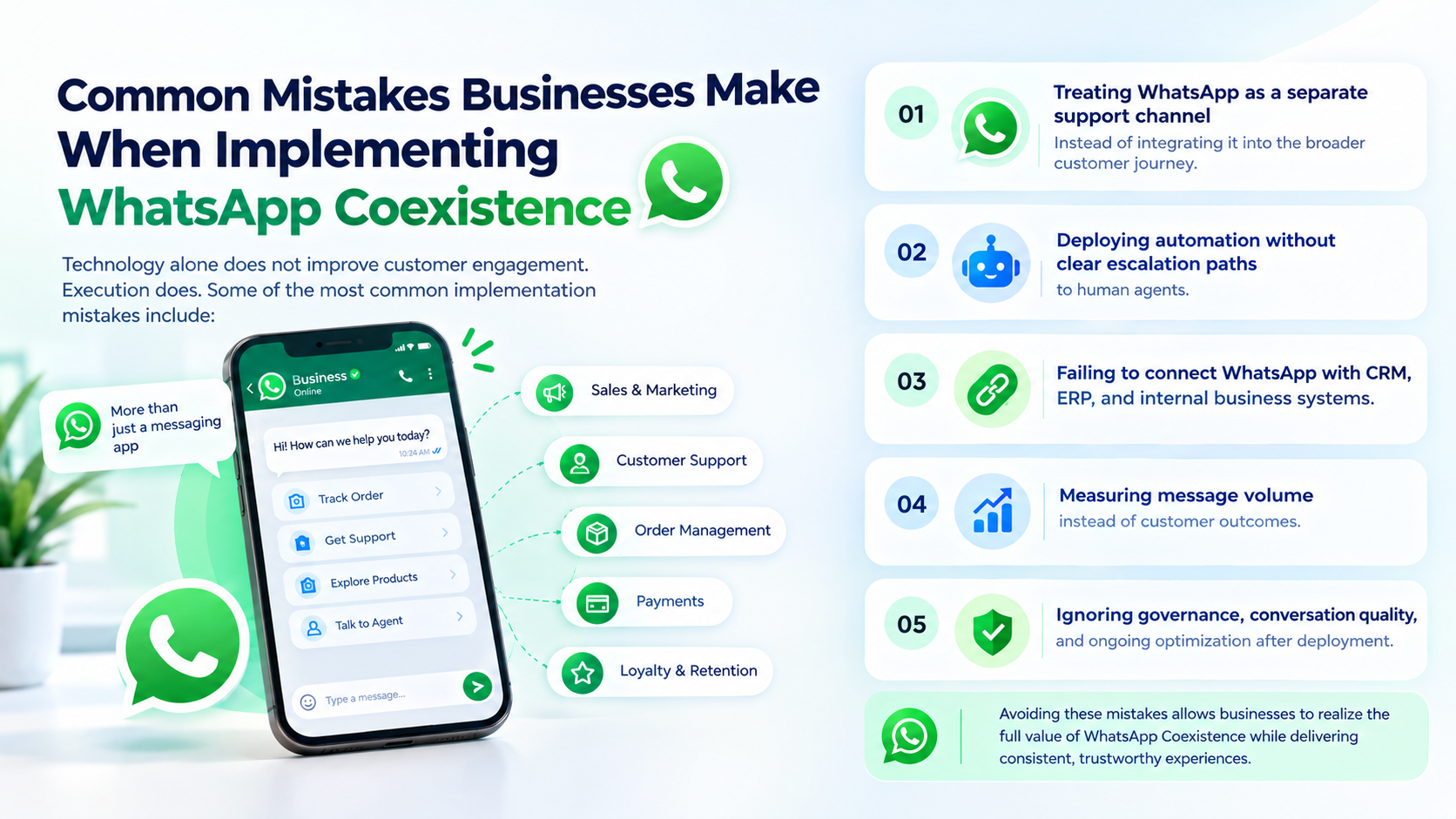
Technology alone does not improve customer engagement. Execution does. Some of the most common implementation mistakes include:
Treating WhatsApp as a separate support channel instead of integrating it into the broader customer journey.
Deploying automation without clear escalation paths to human agents.
Failing to connect WhatsApp with CRM, ERP, and internal business systems.
Measuring message volume instead of customer outcomes.
Ignoring governance, conversation quality, and ongoing optimization after deployment.
Avoiding these mistakes allows businesses to realize the full value of WhatsApp Coexistence while delivering consistent, trustworthy experiences.
The Future of WhatsApp Coexistence
Business messaging is evolving rapidly. Customers increasingly expect every interaction to be immediate, personalized, and intelligent, regardless of whether they begin with a human employee or an AI agent. Over the next few years, WhatsApp Coexistence will become the operational foundation for Agentic AI-powered customer engagement.
AI agents will not only answer questions but also complete transactions, coordinate business workflows, collaborate with employees, and maintain conversation continuity across every stage of the customer journey. The companies that succeed will not be the ones sending the most WhatsApp messages. They will be the ones creating the most connected customer experiences.
Conclusion
The future of customer engagement will not be defined by the number of communication channels a business offers.
It will be defined by how seamlessly those channels work together. WhatsApp Coexistence represents far more than the ability to use the WhatsApp Business App and the WhatsApp Business Platform with the same number. It enables businesses to preserve familiar workflows while unlocking AI-powered automation, enterprise integrations, and scalable collaboration.
When combined with intelligent automation, connected data, and customer-centric processes, WhatsApp Coexistence becomes the foundation for continuous, context-aware engagement.
For forward-thinking organizations, every conversation is more than a message. It is an opportunity to strengthen relationships, accelerate decisions, and create lasting business value.
Frequently asked questions
Yes. With WhatsApp Coexistence, eligible businesses can use the same business phone number on both the WhatsApp Business App and the WhatsApp Business Platform simultaneously. This allows employees to continue using the familiar mobile app while the business gains access to enterprise capabilities such as AI automation, CRM integrations, analytics, and multi-agent collaboration.