From WhatsApp to AI Shopping Agents: Is Your Store Ready for the Next Buying Shift?

Discover the 5 product data mistakes that can make AI overlook your products. Learn how accurate pricing, complete product details, clear descriptions, trust information, and consistent product catalogs help AI shopping agents understand your products and deliver more relevant recommendations.
Imagine a customer asking an AI assistant to find the best skincare product under ₹1,500 for sensitive skin. Instead of visiting multiple websites, the customer receives a shortlist based on ingredients, price, suitability, and availability. Your product might be the better choice, but if its information is incomplete, a competitor could get the recommendation.
This is the emerging challenge for retailers as AI agents in shopping to reshape product discovery and purchasing decisions. The next competitive advantage will not come from attracting clicks alone. Retailers must make their products understandable to AI systems, connect their commerce operations, and deliver consistent shopping experiences across channels such as WhatsApp.
The shift toward AI-assisted shopping is already visible in consumer research and retail traffic data. According to NIQ’s Agentic Commerce India 2026 report, 92% of surveyed consumers had used AI while shopping, while 96% were open to AI-powered shopping tools.
The US holiday shopping season provides another important signal. Adobe Analytics reported that generative AI referral traffic to US retail websites increased by 693.4% year over year during November and December 2025. Its analysis covered more than one trillion visits to US retail websites.
Adobe also projected in September 2026 that US online holiday spending would reach $275.1 billion between November 1 and December 31, 2026. This is a forecast, not a final sales figure. Together, these AI shopping trends highlight why retailers should prepare for changing product discovery before peak shopping periods.
These figures do not mean AI agents already control every purchase. They show that AI-assisted research is becoming another route to retail websites, making product information and customer experience increasingly important.
Why AI Agents in Shopping Need Better Product Data
AI shopping systems need reliable information to determine whether a product matches a customer's requirements. A product page may look attractive but still fail to explain its specifications, suitability, availability, or advantages over alternatives.
Consider a retailer selling running shoes. A description such as “premium shoes for everyday comfort” offers little information about cushioning, weight, running surface, or intended use. Detailed, accurate attributes help customers and AI systems understand which product fits a particular need.
Your product does not necessarily lose because it is inferior. It may lose because its information does not clearly explain why it is the right choice.
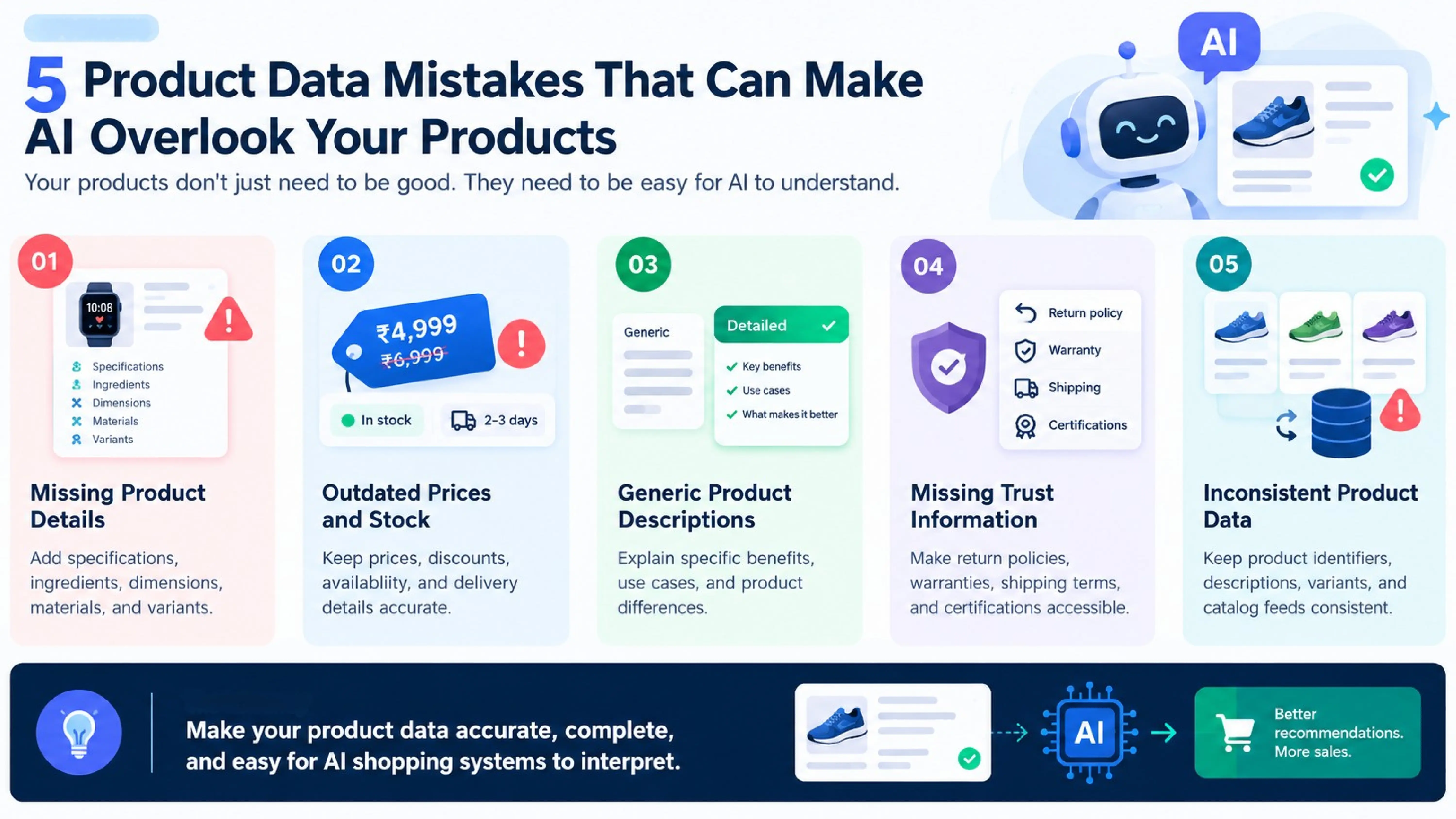
Retailers preparing for AI agents in shopping should address five product-data gaps:
Missing attributes: Add relevant specifications, dimensions, ingredients, materials, compatibility, and variants.
Inaccurate availability: Keep prices, discounts, stock levels, and delivery information current.
Generic descriptions: Explain specific benefits, use cases, and differences between competing products.
Weak trust information: Make return policies, warranties, shipping terms, and relevant certifications accessible.
Inconsistent product feeds: Maintain accurate identifiers and use appropriate structured product data where supported.
Start with your best-selling products and priority categories. Correct missing specifications and conflicting prices before investing in more advanced automation.
WhatsApp Can Turn Shopping Questions Into Purchase Opportunities
AI shopping trends are not limited to search engines or standalone AI assistants. Customers often discover products on social media, ask questions through WhatsApp, compare options on a website, and complete purchases through an ecommerce checkout.
When these interactions operate independently, retailers may lose the context needed to answer questions consistently or guide customers toward suitable products. Connecting messaging with commerce systems can help bridge that gap.
A February 2026 report from Meta and the Retailers Association of India reported that omnichannel shoppers spend 2.5 times more than single-channel shoppers. This finding supports the value of connected retail experiences, although individual business results will vary.
Consider a customer asking for a laptop under ₹60,000 on WhatsApp. An AI agent connected to the product catalog can identify the budget, compare specifications, check availability, and recommend suitable options. It can then guide the customer toward checkout, subject to the capabilities and permissions of the connected systems.
This is where AI agents in shopping can extend the value of WhatsApp. Rather than answering isolated questions, an agent can help customers progress from product discovery to a relevant next action.
However, recommendations must remain grounded in reliable information. If a product is unavailable or does not meet a customer's requirements, the agent should explain the limitation instead of inventing details or making unsupported promises.
Five Ways Retailers Can Prepare for AI Shopping Trends
1. Make product information easy to interpret. Audit product pages, catalogs, marketplace listings, and messaging feeds. Resolve inconsistencies in descriptions, specifications, variants, and prices.
2. Connect the systems behind your storefront. AI agents need appropriate access to product catalogs, inventory, CRM, and order-management systems to provide useful answers. Use secure integrations and limit access to the information and actions each agent requires.
3. Design for conversational shopping. Test questions customers actually ask, including product comparisons, budgets, delivery times, availability, and returns. When a request is complex or the answer is uncertain, provide a clear route to human assistance.
4. Build safeguards into purchasing workflows. Checking a product price is different from initiating a payment or modifying an order. Establish authorization, customer confirmation, data-protection controls, and transaction limits before enabling sensitive actions.
5. Measure business outcomes. Track recommendation engagement, assisted conversions, cart abandonment, average order value, customer satisfaction, and repeat purchases. Where attribution is available, connect AI interactions with completed transactions and compare revenue against implementation and operating costs.
These steps help retailers identify whether their biggest barrier is poor product data, disconnected systems, inconsistent customer experiences, or limited operational safeguards. They also make AI shopping trends easier to evaluate through measurable business results rather than hype.
What Retailers Should Fix Before the Next Peak Season
The US festive season demonstrates why preparation matters. When shopping demand rises, inaccurate inventory, unclear product information, and disconnected customer conversations can create friction precisely when retailers need reliable customer experiences.
Businesses should therefore assess their most important product categories, verify pricing and stock information, test connected shopping journeys, and identify where AI assistance could remove customer friction. Retailers using WhatsApp should also ensure that product recommendations, order information, and support responses remain consistent with their actual business systems.
The objective is not to automate every interaction. It is to make each AI-assisted interaction accurate, useful, and capable of moving the customer toward a suitable outcome.
Conclusion: The Next Retail Advantage Starts Before the Customer Clicks
AI agents in shopping will not automatically replace ecommerce websites, search engines, marketplaces, or human sales teams. Their capabilities vary across platforms, and autonomous purchasing is not available in every environment. However, growing AI-referred retail traffic shows why businesses should prepare for new discovery and buying experiences.
Retailers that improve product information, connect to commerce systems, and deliver consistent customer experiences across WhatsApp and other channels will be better positioned to adapt. The same foundations can support more relevant recommendations, smoother purchasing journeys, and better-informed customer interactions.
The real opportunity is not simply to use AI. It is to make your products easier to understand, your business easier to connect with, and your customer journey easier to complete. Explore Chat360’s enterprise Agentic AI Platform to see how AI agents can support connected customer conversations and automated journeys across WhatsApp and other customer channels.
Frequently asked questions
AI agents in shopping are AI-powered systems that interpret shopping goals, retrieve relevant information, and perform authorized tasks through connected tools. Depending on their capabilities, they can help customers discover products, compare options, check availability, and navigate purchase or support workflows.