₹1.5 Lakh Crore Diwali Rush: Why Smart Brands Are Moving Beyond SMS
India's festive e-commerce market is projected to generate nearly 966 million orders in 2026. Here's how brands can recover lost sales, reduce wasted campaign spend and turn RCS messaging into a measurable revenue channel.
Your festive campaign reaches 100,000 customers. The delivery report looks healthy. Clicks come in. But sales remain below target, abandoned carts pile up, and your team starts considering another discount.
The problem may not be your offer. It may be what happens after the message reaches the customer. A shopper wants to know whether the product is in stock, whether it will arrive before Diwali, whether a better bundle exists, or whether an offer applies to their preferred product. A conventional SMS can communicate with a promotion, but it cannot always support the next decision in the same interaction.
That gap matters during festive marketing, when shoppers compare options, wait for the right offer and switch retailers if the buying process becomes difficult.
Turn Every Customer Conversation Into Action with Chat360 AI Agents Move beyond basic chatbots with Chat360 AI Agents, built to understand customer intent, deliver contextual responses, qualify leads, automate follow-ups, and execute workflows across WhatsApp, RCS, Voice, and other customer channels. Connect conversations with your business systems to create seamless customer journeys and drive measurable outcomes.
Ready to turn conversations into conversions? Explore Chat360 AI Agents
Datum Intelligence forecasts that India’s online festive sales will reach ₹1.50–1.55 lakh crore in 2026, up from ₹1.20 lakh crore in 2025. Its forecast also points to growth driven by more orders rather than larger average baskets. For marketers, this changes the priority. Winning does not simply mean reaching more people. It means converting more of the demand already being generated.
The challenge is amplified by how people shop. Google’s October 2026 festive research says shoppers average more than eight online searches and nearly eight videos during product research. Its study also reports that 51% of festive shoppers say AI helps them make better decisions.
Your customer may discover a product on social media, compare it on Search, watch a review, check delivery timelines, and only then decide to buy. A single promotional message cannot resolve every question along that journey.
This is where a better festive marketing system matters: use each message to move a shopper toward a useful next step, not just to announce another sale.
The Real Problem with SMS Marketing Is What Happens Next
SMS marketing still has a role. It is useful for concise alerts, delivery updates, reminders and offers that need a direct call to action. The mistake is expecting every message to do the work of a complete customer journey.
Consider a shopper who clicks on a festive offer but does not purchase. The campaign report may record a click. Your business still has unanswered questions:
Did the shopper abandon the checkout because delivery was too slow?
Was the product unavailable in their PIN code?
Did they need a different size, color or price point?
Were they comparing products and waiting for reassurance?
Did they purchase from another channel after clicking?
If every non-converting click receives the same discount reminder, your brand may increase message volume without fixing the reason for lost sales.
A more effective approach combines SMS marketing with interactive messaging, reliable customer data, relevant follow-ups, and clear conversion measurement. RCS can support this approach where the customer’s device, carrier, and messaging setup support it. It should be introduced to solve a specific friction point, not simply because it offers richer creative formats.
Six Festive Marketing Problems You Can Actually Fix
1. Recover abandoned carts without discounting every shopper
The problem: A shopper adds a product to the cart but leaves before paying. Your default automation sends a coupon to everyone.
That can reward customers who would have purchased anyway, while failing to address shoppers who need information rather than a price cut.
A better workflow:
Wait for a defined period after abandonment, subject to consent and campaign rules.
Check whether the order was completed on another device or channel.
Confirm that the product is still available and the price has not changed.
Send a relevant reminder with the product name, a direct checkout route, and a clear benefit.
If supported, use RCS rich cards or suggested actions to let shoppers revisit the product or explore a relevant alternative.
Offer a discount only to eligible segments where price is the likely barrier, and the margin supports it.
Example: A customer abandons a ₹3,999 festive gift. Instead of immediately sending “Get 10% off”, the follow-up confirms availability and highlights the delivery estimate. A discount can be tested later against a control group.
Measure: Recovered orders, incremental gross margin, checkout completion, and discount cost per incremental order.
2. Stop promoting products that cannot arrive before Diwali
The problem: Your campaign generates demand for a product that is out of stock or cannot reach the customer before the occasion.
The message may be delivered successfully, but the customer experience fails at the point of purchase.
A better workflow:
Connect campaign eligibility to inventory, fulfilment and delivery estimates.
Segment by PIN code or serviceable region where the data is reliable.
Suppress unavailable products and expired offers.
Recommend a genuinely comparable, available alternative.
Update campaign audiences as stock and delivery capacity change.
For festive marketing, availability can be more persuasive than another generic discount. If a customer needs a gift before a specific date, certainty about delivery is part of the offer.
Measure: Out-of-stock clicks, failed checkouts, cancellation rates, on-time delivery and conversion by serviceable region.
3. Increase average order value with relevant bundles
The problem: Your campaign generates orders, but each order is too small to support acquisition costs and discounts.
A blanket offer may increase basket size, but it can also erode margin.
A better workflow:
Use previous purchases, product compatibility, and browsing behavior to identify relevant add-ons.
Recommend complementary products instead of unrelated bestsellers.
Explain the bundle’s practical value.
Show the final price and any conditions clearly.
Suppress recommendations for products already purchased or unavailable.
Example: A customer buying festive lighting could receive a relevant accessory recommendation. A shopper purchasing skincare could see a compatible gift set rather than an unrelated product.
Use RCS product cards or suggested actions where supported to make choices easier. The format is useful only if the recommendations are accurate and the path to purchase works.
Measure: Average order value, attach rate, contribution margin and returns by bundle.
4. Turn high-intent enquiries into qualified sales conversations
The problem: A shopper replies to a festive promotion with a question, but the response is delayed, or a sales team receives incomplete information.
This is especially costly for high-value products, appliances, jewelry, real estate, and other purchases where customers need more reassurance before buying.
A better workflow:
Invite the customer to choose what they need help with.
Collect only the information required to route the enquiry, such as product category, budget band, or preferred location.
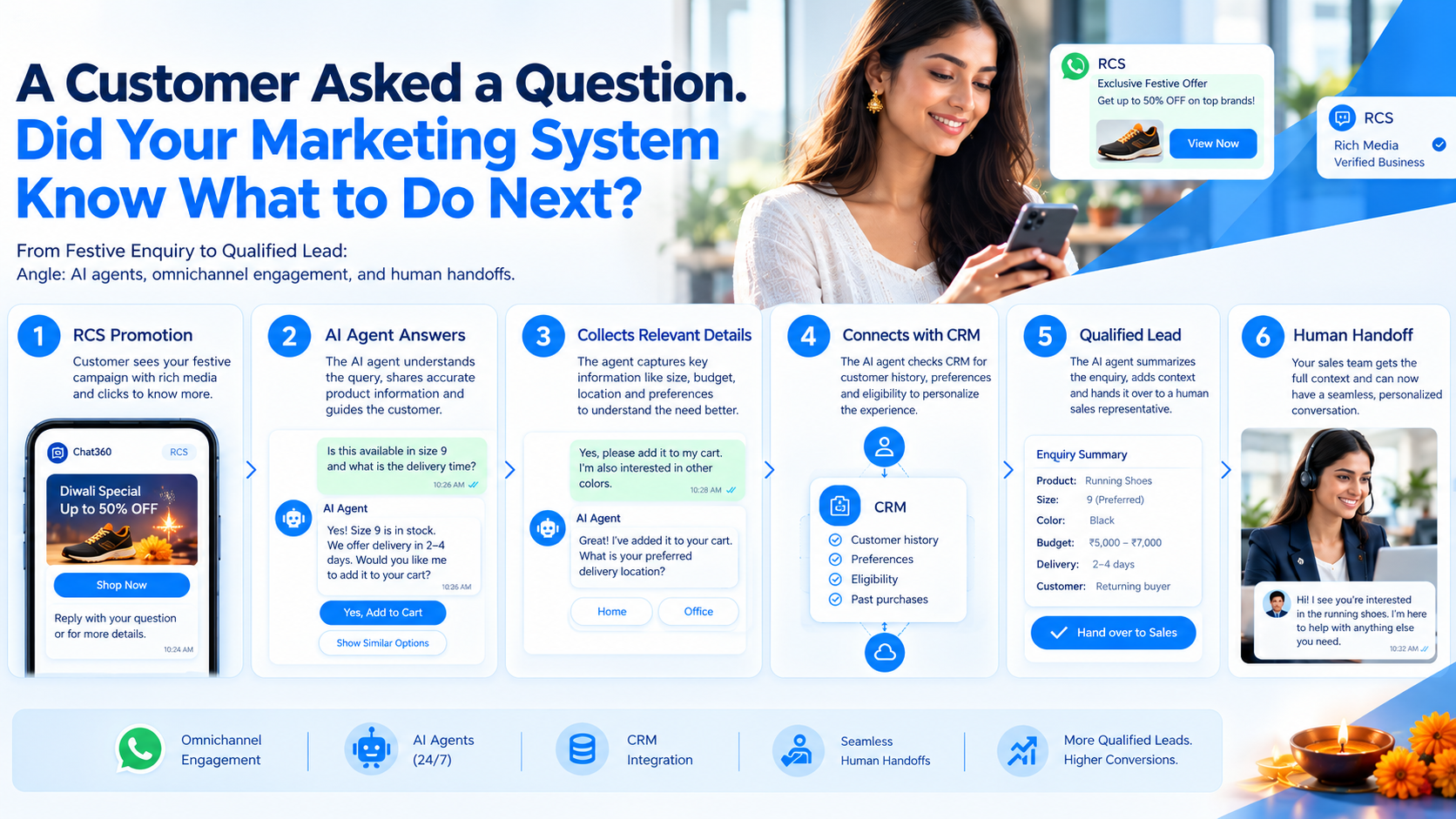
Use an AI Agent to answer approved product and policy questions from current business information.
Passing complex questions or high-intent leads to the right human team.
Send the conversation context to the CRM so customers do not need to repeat themselves.
Track whether the conversation becomes a qualified lead, appointment or purchase.
RCS can provide a more interactive starting point where supported. An omnichannel platform can connect interaction to other customer channels and business systems.
Measure: Response time, qualified-lead rate, handoff completion, appointment rate and lead-to-sale conversion.
5. Win back previous festive buyers without spamming them
The problem: Last year’s festive buyers received the same promotion as every other customer, even when their needs and purchase history differ.
A better workflow:
Segment customers by product purchased recency, frequency and relevant replenishment or upgrade cycles.
Exclude recent purchasers from reminders for the same product.
Recommend a complementary item or a relevant upgrade.
Set frequency limits across channels, not just within one campaign.
Stop promotional messages when a customer opts out, or the journey no longer applies.
For example, a customer who bought a small appliance last festive season may respond better to a compatible accessory than a generic sitewide sale.
Measure: Repeat-purchase rate, incremental revenue from returning customers, unsubscribe rate and contribution margin.
6. Find out whether messaging actually creates incremental sales
The problem: Sales rise after a campaign, so the entire increase is attributed to the message.
But some customers would have purchased it anyway. Others may have converted after seeing a search ad, visiting a store or receiving another communication.
A better workflow:
Create a holdout group that does not receive the campaign, where operationally and ethically appropriate.
Randomize eligible customers before sending messages.
Compare conversion and contribution margin over the same period.
Track orders across channels where attribution data is available.
Report on both attributed conversions and incremental lift.
Include message, platform, discount and fulfilment costs.
A campaign with a high click-through rate can still be unprofitable. A campaign with fewer clicks can generate more incremental margin if it reaches customers with stronger purchase intent.
Measure: Incremental conversion lift, cost per incremental order, incremental contribution margin, and repeat-purchase impact.
Where RCS Fits into Your Festive Messaging Strategy
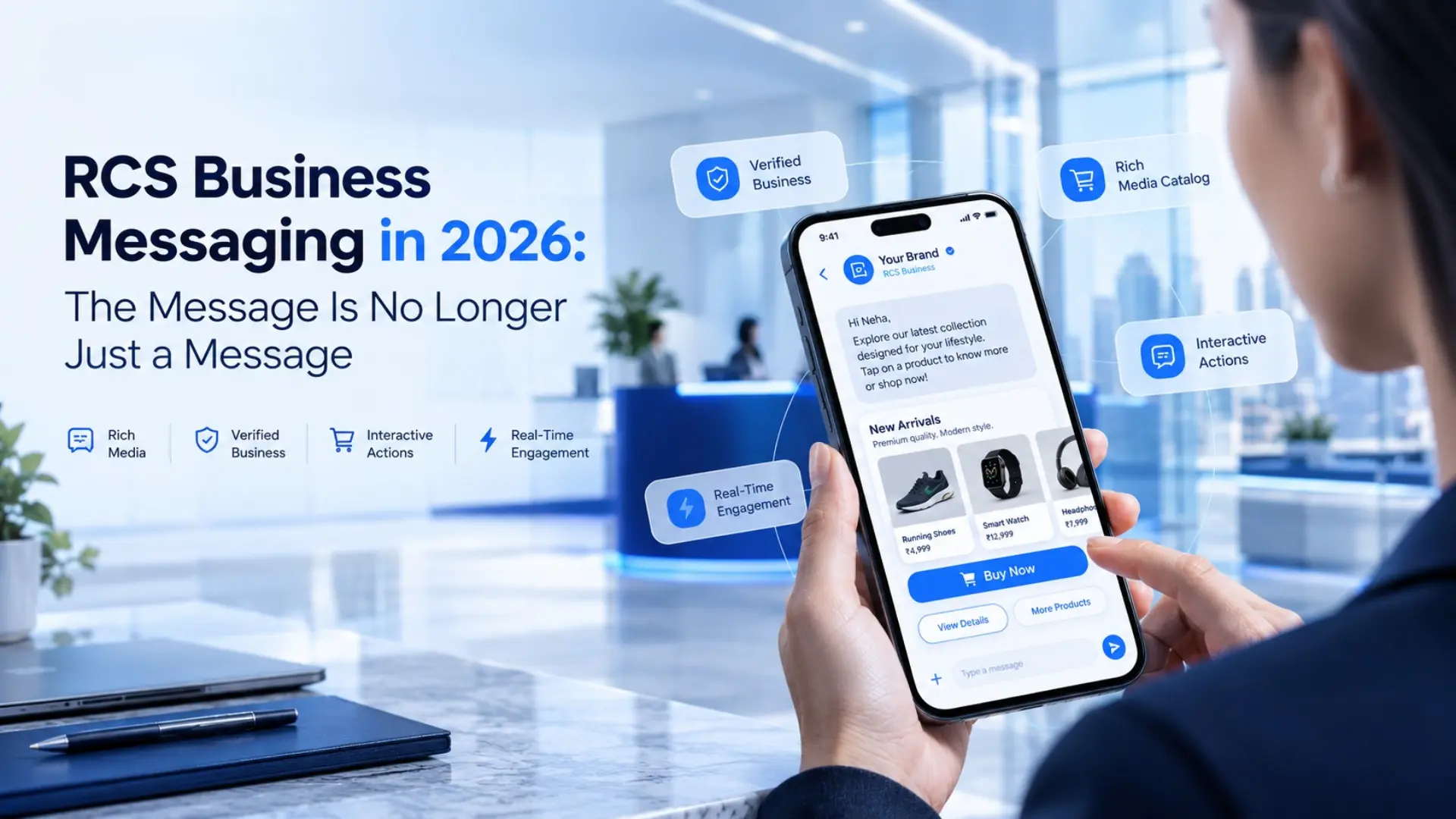
RCS is not a replacement for every SMS. It is another option for journeys where richer content or interactive choices can reduce friction.
For example:
Customer need | Suitable messaging approach |
Short, time-sensitive alert | SMS may be sufficient |
Order or delivery update | SMS or another appropriate service channel |
Product discovery and comparison | RCS rich cards where supported |
Guided choice between options | RCS suggested actions where supported |
Complex product question | Conversational support or AI Agent with human escalation |
Payment or order completion | Secure, approved checkout flow |
Infobip reported a 108% increase in RCS interactions in India between the first half of 2025 and the first half of 2026. This is provider-reported platform data, not a measure of adoption across every Indian business or consumer.
Before investing, verify device and carrier support, message delivery and fallback behavior, registration requirements, consent, campaign pricing and analytics. Keep a suitable fallback for customers who cannot receive the richer experience.
The goal is not to make every message interactive. It is to make the next customer action easier when interactivity has a clear benefit.
Where Chat360 Fits into This Strategy
The business opportunity is larger than sending a rich message. Enterprises need to connect customer engagement with the systems that manage conversations, leads, purchases, and support.
Chat360's omnichannel customer engagement platform can be positioned as part of that broader workflow, connecting supported customer channels with AI-powered conversations and business systems.
For example, a festive campaign can lead to a product enquiry, an AI-assisted conversation, a qualified sales handoff, or a support workflow, depending on the customer's need and the integrations available.
The objective is to maintain context and make the next action easier, rather than forcing customers to restart their journey at every touchpoint. Explore Chat360's RCS solution to understand how rich business messaging can fit into a wider customer engagement strategy.
Conclusion: Turn Festive Conversations Into Measurable Outcomes
The strongest festive campaigns do more than announce an offer. They help customers choose, remove purchase friction, set accurate expectations, and continue the journey when a shopper needs support.
For brands, the opportunity is to combine the reach of established messaging channels with richer interactions, customer context, and connected workflows. Use SMS marketing when a concise message is enough. Use RCS when an interactive experience solves a real problem. Connect both to the systems that help your business fulfil the promise.
Explore Chat360’s RCS solutions to see how richer messaging can fit into an omnichannel customer engagement strategy. The festive advantage is not sending more messages. It is converting more of the demand you already have, without sacrificing customer trust or profit.
Frequently asked questions
Not automatically. Define the purpose of each message, check eligibility and channel support, and use orchestration rules to avoid duplicate or conflicting communications. If a customer cannot receive RCS, use an appropriate fallback where permitted. Measure the combined journey rather than counting every message as a separate conversion.