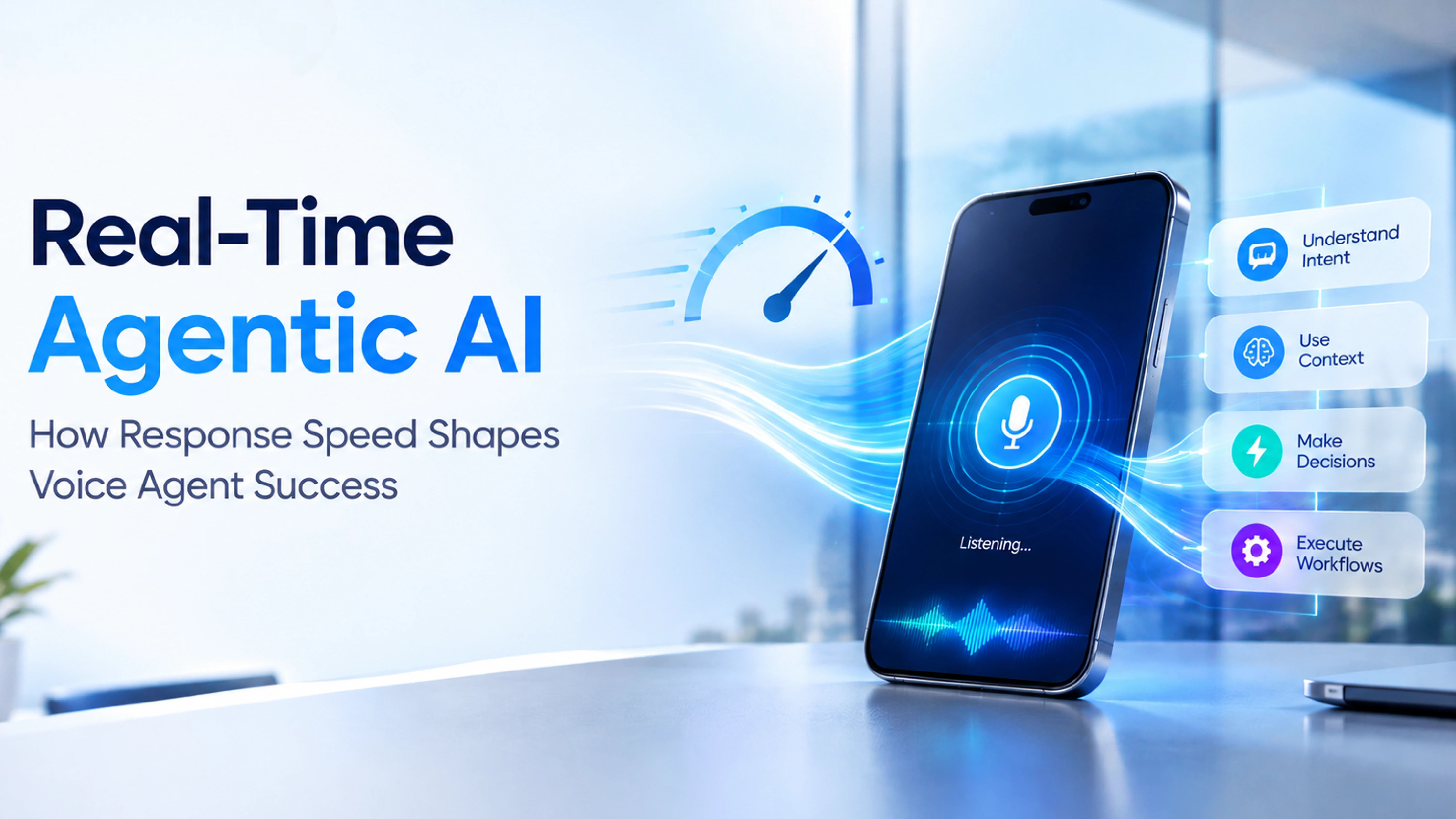
Real-Time Agentic AI: How Response Speed Shapes Voice Agent Success
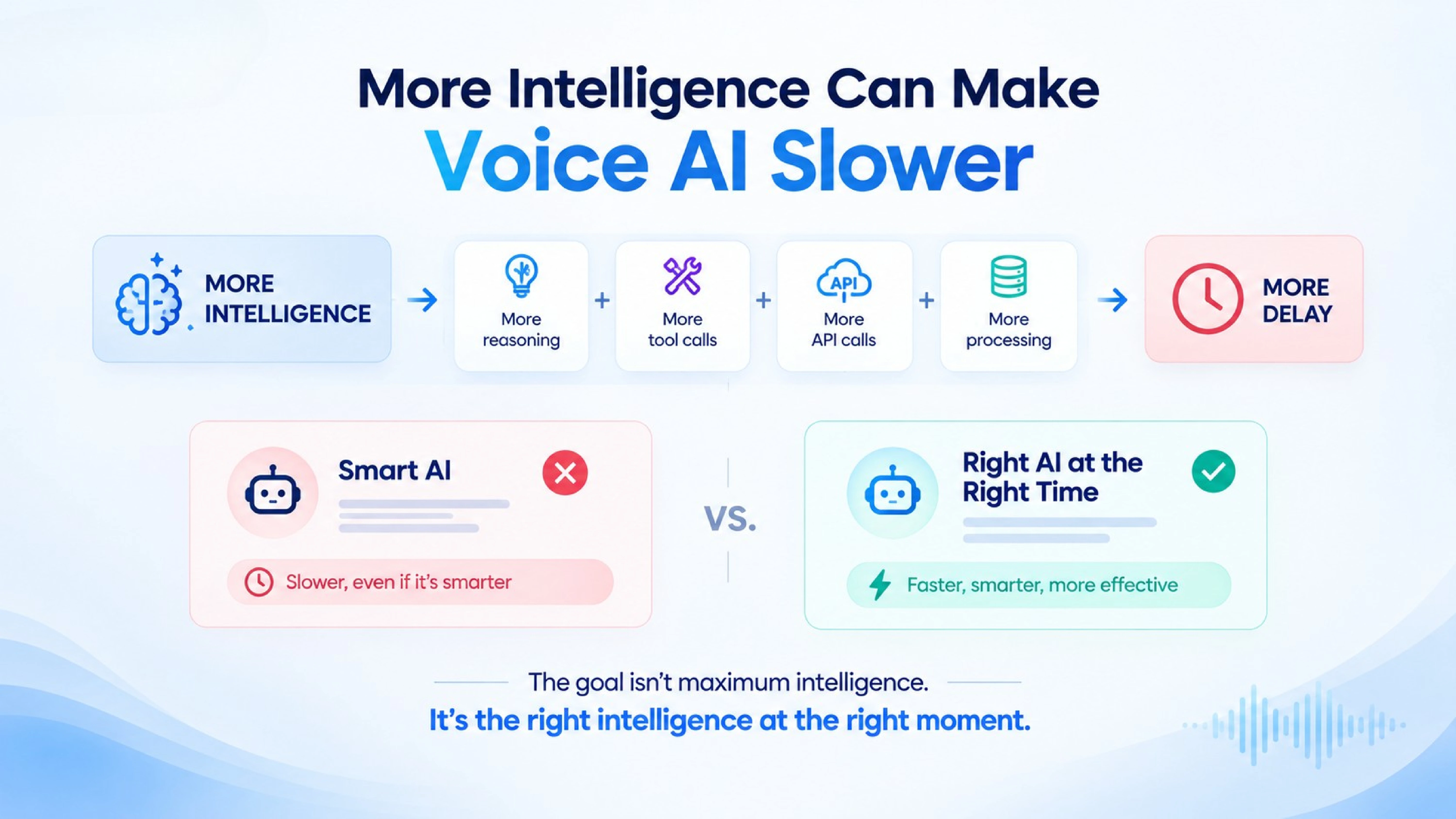
More intelligence doesn’t always mean better Voice AI. Excessive reasoning, tool calls, API requests, and processing can introduce latency and disrupt real-time conversations. The key is not maximum intelligence, but delivering the right intelligence at the right moment for faster, more natural, and effective voice interactions.
A voice agent can be smarter than your best chatbot and still lose the customer with one thing: silence. That is the uncomfortable reality of enterprise voice AI in 2026. Customers do not see your model, orchestration layer or API architecture. They hear a pause. They interrupt. They repeat themselves. Or they ask, "Are you still there?"
Technology is moving quickly. Gartner found that customer service leaders increased AI spending by 38% in 2026, while overall service and support budgets grew only 2%. Gartner also identified GenAI chatbots, GenAI voice bots and no-code agent builders among the technologies expected to deliver the greatest value over the next two years.
But there is a catch. A voice agent does not create better customer experience simply because it is intelligent. It must be intelligent at the speed of conversation. That makes response speed a product problem, a customer experience problem and, increasingly, a business problem.
Why Voice AI Success Depends on More Than Intelligent Responses
Imagine calling your bank and saying, "My EMI was deducted, but the payment still shows as pending."
A traditional IVR might ask you to press several numbers. A basic chatbot-style voice Bot might recognize "payment" and read out a generic policy. A modern AI voice agent could understand the intent, identify you, retrieve the transaction, check the payment system and explain what happened. That sounds like progress. But consider what must happen between your sentence and the answer.
Speech must be captured. Intent must be understood. Context must be retrieved. A decision must be made. An enterprise system may need to be queried. An action may need to be carried out. Then the response must reach your ears. Every step can add delay. This is why real-time AI cannot be evaluated by model speed alone.
Voice AI Latency Explained: Where Does the Customer Actually Wait?
A useful way to understand voice AI latency is to stop looking at the model as one box. A production voice interaction can involve several layers:
Layer | What happens | Potential delay |
Audio capture | Customer speech enters the system | Network and media delay |
Speech understanding | Spoken language is interpreted | Processing time |
Context retrieval | Customer or conversation data is retrieved | Database/API latency |
AI reasoning | Agent determines what to do | Model inference |
Tool calling | CRM, ERP, payment or other systems are queried | API latency |
Action execution | Approved workflow is performed | Workflow latency |
Voice generation | Response is converted to speech | Generation and streaming |
Network delivery | Audio reaches the customer | Round-trip and packet effects |
This is why an enterprise should never ask only, "How fast is your AI model?" The better question is, "How quickly can the complete system produce the next useful response?"
OpenAI's engineering work on low-latency voice AI makes this distinction explicit. Its real-time system is built around continuous audio streaming and reliable media delivery. That is because, as OpenAI puts it, any delay in transport, processing or inference can become an audible pause. In practice, that means customers hear network problems directly, as pauses, delayed interruptions and broken turn-taking.
Why 2026 Changed the Definition of Real-Time Voice AI
The biggest development in real-time AI is not simply that models have become faster. The architecture itself is changing.
Architecture | How a turn works |
Older, sequential voice systems | Listen → wait → transcribe → reason → generate → speak |
Newer real-time systems | Listen while processing → reason while context arrives → stream speech → continue listening |
That difference matters. In August 2026, OpenAI described its GPT-Live architecture as full-duplex, meaning the system can listen and speak at the same time. It also separates deeper reasoning and tool use from the core conversational path. This lets the voice model consult a more capable model without interrupting the flow of the conversation.
This is a major architectural shift. The goal is no longer simply to make the model answer faster. It is to stop the customer from waiting for every internal step to finish before the conversation can continue.
Can Agentic AI Make Voice Agents Slower? The Intelligence-Latency Trade-Off
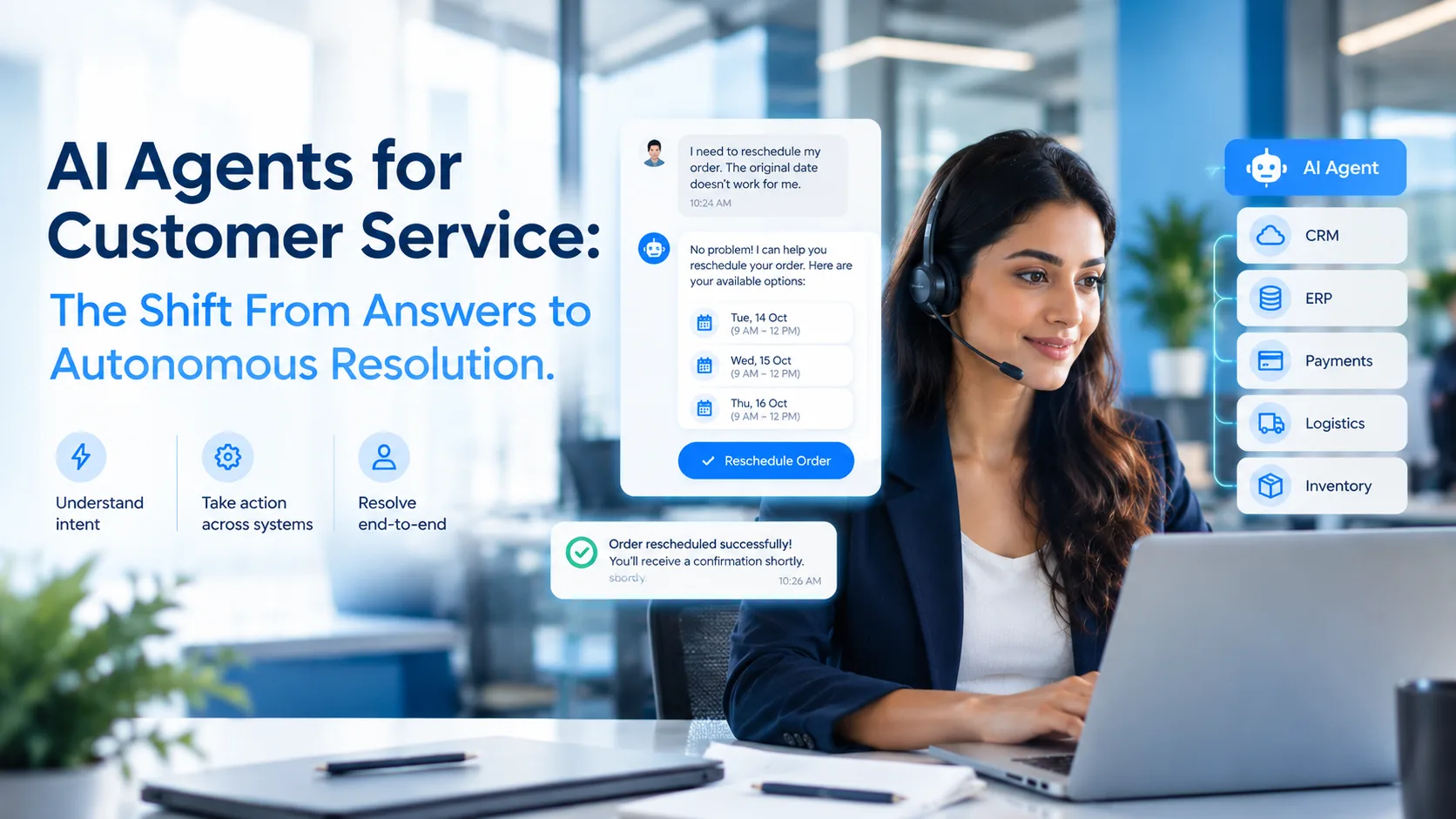
This is where the conversation around Agentic AI becomes more interesting. A simple voice bot can answer "What time do you close?" An agentic system might handle "Move my appointment to the earliest available slot next week and send me the confirmation."
The second request requires more work. The agent may need to understand the goal, identify the customer and check availability. Then it must choose a suitable slot, make the booking, update the CRM and send confirmation. That is a useful automation. It is also a much more complex latency path.
Gartner predicted in August 2026 that AI inference costs per agentic workflow will increase more than fivefold through 2028. Gartner contrasts a simple chatbot, which interprets a query and quickly responds, with an AI agent that must constantly reason, negotiate and question itself. So enterprises face a new optimization problem: more intelligence can create more work.
The winning architecture is therefore not the one that uses the biggest model for every interaction. It is the one that uses the right amount of intelligence at the right moment.
Why AI Voice Agents Need Different Reasoning for Different Tasks
Consider three requests, and the work behind each:
Customer request | What it requires |
"What are your working hours?" | Almost no reasoning |
"Where is my order?" | A customer looked up and an order API call |
"My payment was deducted twice. Please investigate and raise a dispute if necessary." | Multiple data sources, policy checks, transaction validation and potentially human approval |
They should not use the same reasoning path. Modern real-time AI platforms are beginning to expose this trade-off directly. OpenAI's GPT-Live-1 guidance, for example, suggests pairing the voice model with a faster model for high-volume tasks such as scheduling. For complex issues, it points to deeper reasoning models.
This creates a practical enterprise principle: do not optimize AI for maximum intelligence. Optimize it for minimum time to successful resolution. That is a much better definition of real-time Agentic AI.
Time to Useful Action: The hidden KPI
Most organizations still talk about response time. That is not enough. Imagine an AI voice agent responds immediately with "Sure, I can help with that," then takes eight seconds to check the customer's account. The customer did not experience a fast resolution. This is why enterprises should introduce a more useful metric.
Time to Useful Action
Time to Useful Action is the time between the customer's completed request and the first response or action that meaningfully moves the task toward resolution. For example, when a customer says "Cancel my appointment":
Measurement | What counts as a response |
Weak measurement | AI says, "Sure, one moment." |
Better measurement | The appointment is actually cancelled and the customer receives confirmation. |
This distinction changes how voice AI should be optimized. You are not trying to minimize every millisecond. You are trying to minimize customer-perceived waiting before progress happens.
Can Voice AI Keep Up When Humans Interrupt?
Real conversations are messy. People pause. They change their minds. They say "Actually..." They interrupt. They correct themselves. They speak while the other person is still talking.
A voice agent that waits for perfectly completed sentences can feel robotic even when its underlying AI is powerful. Recent research and product development are increasingly focused on this problem. OpenAI's August 2026 engineering work describes full-duplex voice systems designed to listen and speak at the same time. Its September 2026 GPT-Live-1 release highlighted better interruption handling. In early evaluations cited by OpenAI, Speak saw interruptions fall by almost 80% compared with previous turn-based systems.
The lesson: voice AI quality is not just about what the agent says. It is about when the agent decides to speak.
Voice AI Accuracy vs. Latency: Why Faster Is Not Always Better
Here is another problem that is overlooked. A faster voice agent is not automatically a better voice agent. If an agent responds immediately but misunderstands the customer, the customer must correct it, and the conversation becomes longer, not shorter.
For example, the customer says, "I want to change my delivery address," and the agent replies, "Sure, I'll cancel your order." Fast response. Wrong action. Terrible experience.
The correct optimization target is therefore not the lowest latency, but the lowest latency that preserves task accuracy and safety. That is especially important in BFSI, healthcare, insurance and other workflows where a wrong action can cost more than a slow response.
From AI Automation to Task Completion: What Customers Actually Want
Customer expectations are changing at the same time. Gartner's July 2026 research found that 58% of customers who use GenAI have used it to complete a task on their behalf, rising to 74% among B2B customers. Gartner also found customers were about three times more likely to use third-party GenAI than company-provided chatbots for customer service.
That tells enterprises something important. Customers are not necessarily looking for another conversational interface. They want the problem solved. The evolution looks like this:
Technology | What the customer gets |
IVR | Route me. |
Chatbot | Answer me. |
Generative AI | Explain it to me. |
Agentic AI | Handle it for me. |
Real-time Agentic AI | Handle it for me without making me wait. |
That last step is where voice becomes especially powerful.
Why Voice AI Still Matters in the Omnichannel Customer Experience
It would be easy to assume that messaging and chat will eventually make voice irrelevant. The data does not support such a simple conclusion. Zendesk reported in June 2026 that voice still represents 40% of contact center volume. It also found that 75% of contact center leaders said legacy technology prevents them from delivering a true omnichannel experience.
The opportunity, therefore, is not to replace voice. It is to modernize it. A customer should be able to start on WhatsApp and move to voice for a complex issue. The voice agent should already have the relevant context. If escalation becomes necessary, the human agent should inherit the conversation context instead of asking the customer to repeat everything. That is where omnichannel AI and voice AI agents begin to converge.
The Architecture Enterprises Should Build
A production-grade AI voice agent should be designed around six principles.
1. Stream instead of waiting
Process audio continuously wherever the architecture allows. Waiting for an entire turn to finish before starting downstream work creates avoidable delays.
2. Separate conversation from deep reasoning
Not every task requires expensive reasoning. Simple requests should move quickly, while complex workflows can invoke deeper reasoning when the value justifies it.
3. Optimize the tool layer
A fast model cannot hide a slow CRM, ERP or payment API. Instrument every external dependency and find which tools add the most end-to-end latency.
4. Preserve context
The customer should not have to repeat information because an agent handed the conversation to another system or a human.
5. Design for interruption
Barge-in, backchannels, corrections and incomplete utterances are normal human behavior, not edge cases.
6. Measure outcomes, not demos
A successful voice agent should be measured on resolution rate, task completion, escalation quality, customer satisfaction, latency distribution and cost per resolved interaction.
What does this mean for Voice360
For an enterprise platform such as Chat360's Voice360, the opportunity is bigger than creating a voice Bot that sounds natural. The valuable architecture is one where voice becomes an intelligent interface to the enterprise. A customer speaks naturally. The agent understands intent, retrieves context, reasons about the next step, interacts with approved systems, executes the workflow and then communicates the result clearly.
Approach | Flow | Result |
Basic voicebot | Listen → Generate → Speak | A conversation |
Real-time AI voice agent | Listen → Understand → Context → Reason → Act → Confirm | An outcome |
The first creates a conversation. The second can create an outcome, and that is ultimately what enterprises are buying.
Conclusion: The Fastest Voice Agent is Not Necessarily The Best One
The future of voice AI will not be won by whoever claims the lowest latency in a benchmark. It will be won by systems that combine speed, intelligence, context, action and trust into one experience.
The market is already moving beyond standalone chatbots. Gartner reports that customer service AI spending is rising fast and that customers increasingly use Gen AI to complete tasks. At the same time, customers still expect access to a human when AI cannot resolve their issue. That creates a new definition of real-time.
Real-time does not mean "the model responded quickly." It means the customer made a request, the system understood it, the required context was available, the necessary action happened, and the customer never felt they were waiting for the machine to catch up.
That is the standard enterprise Agentic AI should aim for. At Chat360, the opportunity is to bring that intelligence across voice and other customer channels. That means connecting AI conversations with enterprise context, workflows and human teams. The future of voice AI is not about talking faster. It is about getting customers to the right outcome faster.
Ready to move from voice automation to real-time Agentic AI? Explore Chat360's Voice AI capabilities and build customer journeys designed for conversation, action and scale.
Frequently asked questions
Real-time Agentic AI combines voice conversation with reasoning, context retrieval, tool use and action. A traditional voice Bot mainly follows a script. An agent can decide what needs to happen and carry out approved steps while keeping the conversation going.