Beyond ChatGPT: Why AI Agents Are the Next Big Shift in Customer Experience
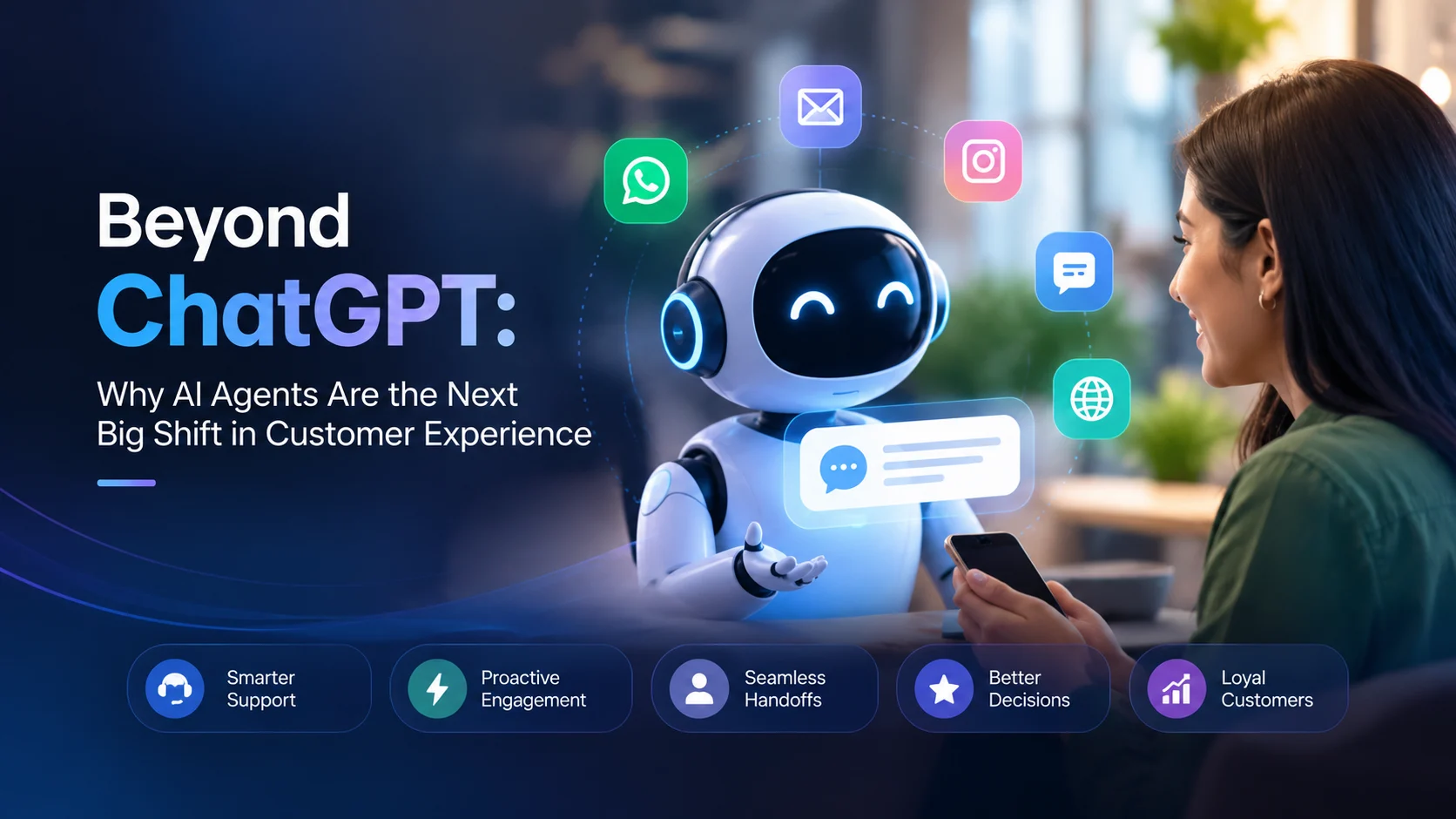
What happens when AI stops answering questions and starts solving customer problems? Explore how AI agents are changing customer experience through context, connected systems, intelligent actions, and seamless customer journeys.
Your Customers Don’t Need Another Chatbot. They Need Their Problems Solved. A customer contacts your business to check an order. Another wants to change an appointment. Someone else has a billing issue, needs product guidance, or wants an update on a complaint that has already been raised.
Your chatbot responds instantly. The language is clear. The answer sounds helpful.
But the order still needs to be checked in another system. The appointment cannot be changed without action. The billing issue requires verification. The complaint remains unresolved because the conversation has no connection to the team responsible for fixing it.
The customer is back where they started. This is the gap between an AI that can answer questions and an AI that can move a customer’s problem toward resolution.
Tools such as ChatGPT have changed what people expect from digital conversations. Customers increasingly expect natural language, relevant answers, and interactions that understand context. But enterprise customer experience involves more than generating a good response. It requires access to business knowledge, coordination between systems, appropriate decision-making, and the ability to complete authorized actions.
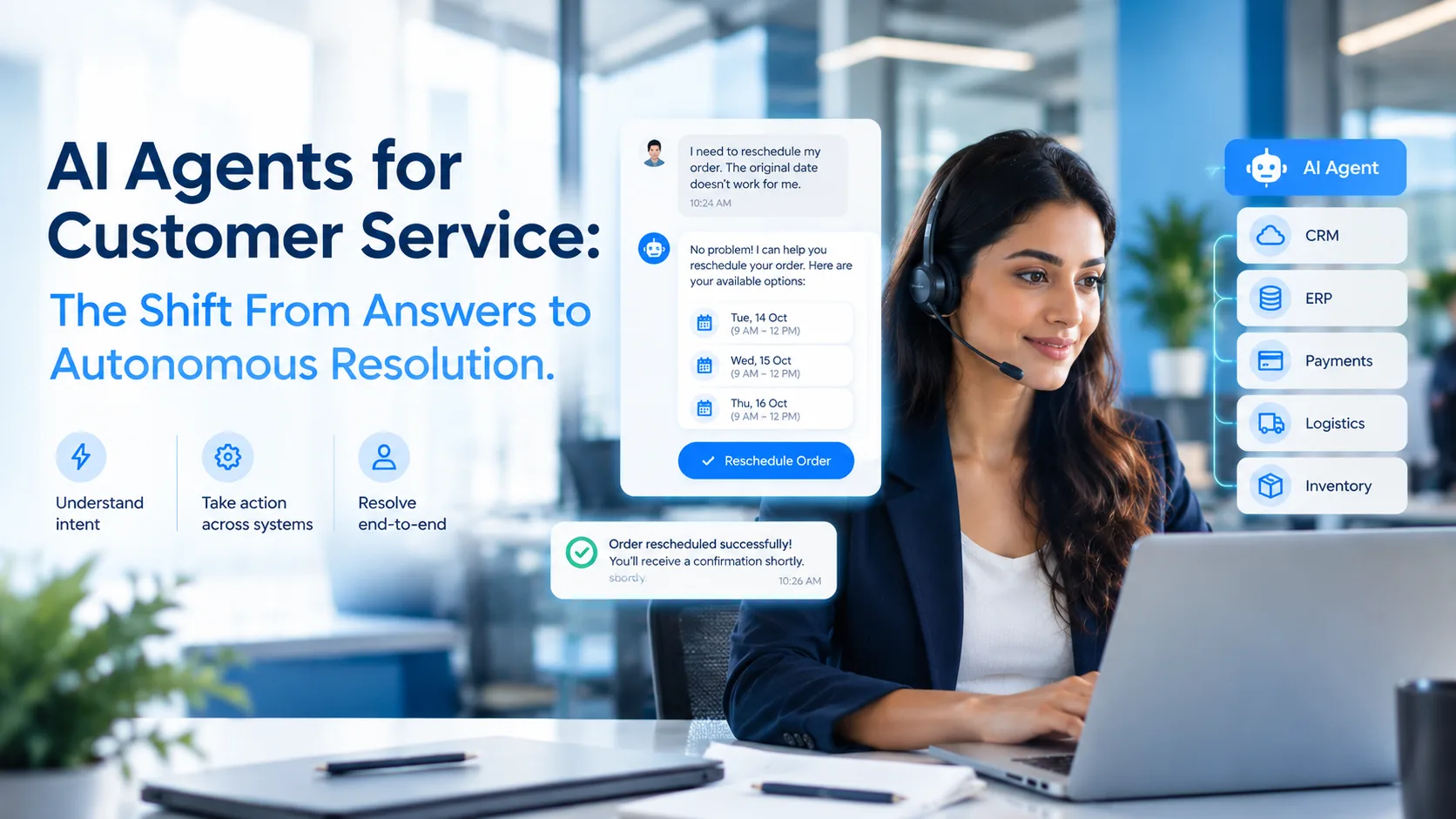
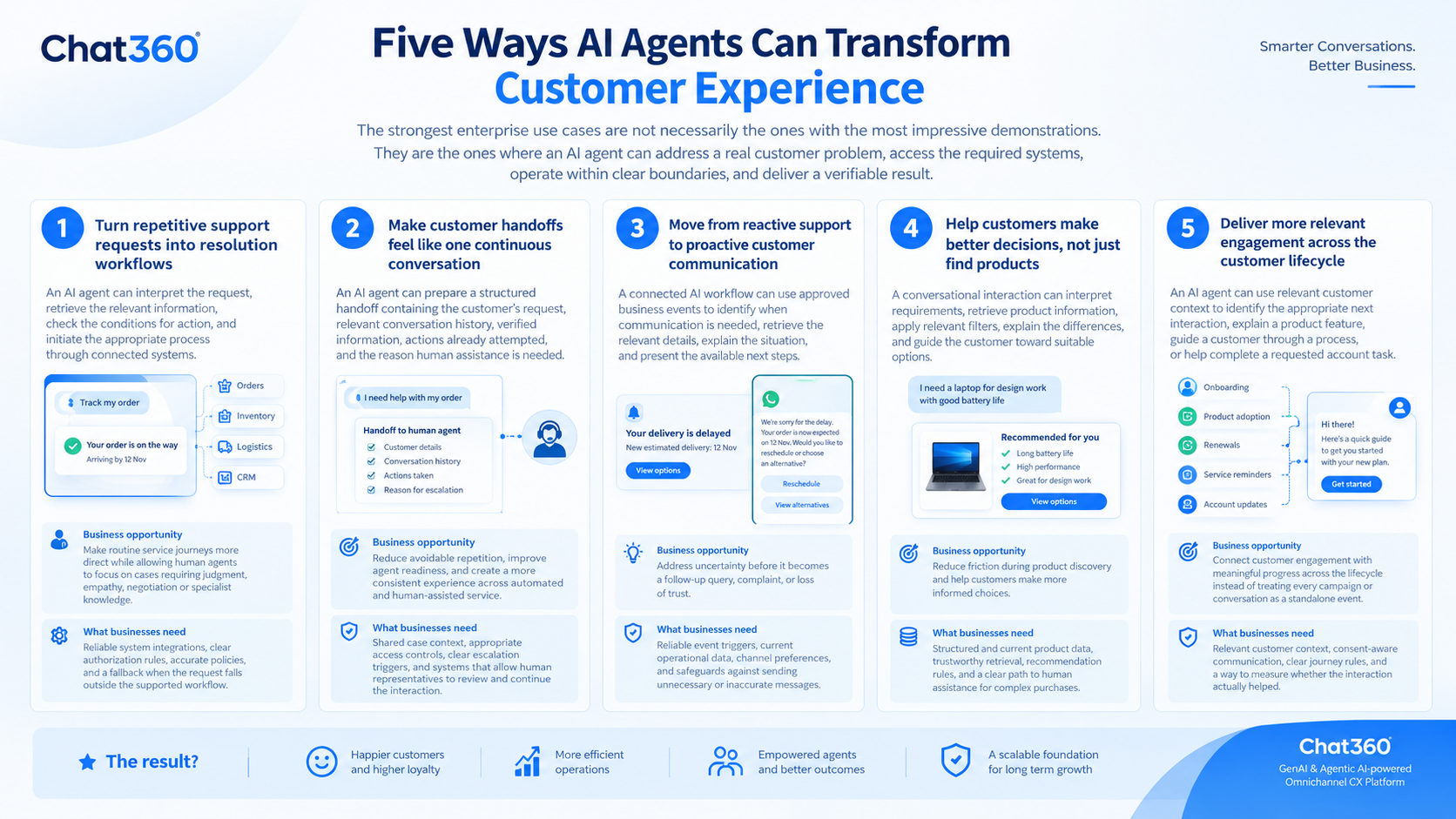
That is where an AI agent can make a meaningful difference. Rather than treating every interaction as an isolated question, an AI agent can be designed to understand the customer’s goal, determine what needs to happen next, use connected tools, and move a task through a defined workflow.
For businesses, the opportunity is not simply to introduce another conversational interface. It is to rethink how customer requests move from the first message to the final resolution.
The Real Problem with Traditional Customer Support Isn’t Just Slow Responses
Many businesses have already invested in chatbots, CRM platforms, help desks, messaging channels, and automation tools. Yet customers can still experience disconnected service.
Why? Because being available across channels is not the same as delivering a connected customer experience.
Consider a customer who starts a conversation on WhatsApp, follows up through email, and eventually calls customer support. The business may have all three channels, but the experience can still break down if each interaction has a different view of the customer’s history.
The same problem appears inside individual channels. A chatbot may provide a policy explanation but lack access to the order system. A support representative may have the customer’s details but need another department to approve the requested action. An automated notification may announce a delay without offering a useful next step. These failures often come from four underlying gaps.
1. The context gap
The business knows something about the customer, but the system handling the current interaction may not know enough.
Previous conversations, preferences, orders, complaints, and ongoing requests can sit in different systems. Without relevant context, the AI may ask customers to repeat themselves or provide advice that ignores their situation.
2. The action gap
The AI can explain what a customer should do, but it cannot perform the next step. For example, it may explain a return policy without initiating a return, describe appointment availability without booking a slot, or identify a payment issue without starting the appropriate resolution workflow.
3. The ownership gap
A request can move between a chatbot, a human agent, a specialist team, and a backend system without anyone maintaining a clear view of the overall task. Customers experience this as repetition, transfers, and follow-ups. The business experiences it as fragmented responsibility.
4. The continuity gap
The conversation ends, but the customer's problem does not. If the next interaction begins without the relevant history or status, the customer must reconstruct the situation. The business may technically have automated the conversation while leaving the underlying work unfinished.
An effective AI strategy must address these gaps together. Improving the language model alone cannot fix disconnected data, missing permissions, unclear workflows, or weak handoffs.
ChatGPT vs. AI Agents: The Difference Is What Happens After the Answer
ChatGPT has helped make conversational AI familiar to millions of people. A user can ask a question in everyday language, explore a complex topic, and refine a request through follow-up conversations. Enterprise customer experience introduces another requirement: the interaction often needs to produce a real business outcome.
The distinction is not that ChatGPT is inherently incapable of using tools, or that every AI agent is autonomous. Modern AI systems can have overlapping capabilities. The important difference is how the solution is designed, connected, governed, and measured.
Capability | Conversational AI focused on answering | AI agent designed for business workflows |
Primary objective | Explain, answer, and assist | Work toward a defined customer or business goal |
Context | Uses the information available in the interaction | Can retrieve relevant customer, policy, and transaction context from connected sources |
Tool usage | May provide information or recommend a next step | Can use authorized tools to execute specific steps |
Workflow | Often ends after providing a response | Can coordinate multiple steps within a defined workflow |
Exceptions | May ask the customer to contact support | Can identify exceptions and route them with relevant context |
Human involvement | May transfer the conversation | Can escalate with a summary, completed steps, and outstanding decisions |
Evaluation | Answer quality and conversational usefulness | Answer quality, task completion, correctness, policy compliance, and customer outcomes |
An AI agent can combine language understanding with retrieval, tools, workflow logic, and controlled execution. It may check an order, retrieve an applicable policy, determine whether a request meets the conditions for an action, and initiate the next step through an authorized integration.
However, it should not be assumed that an agent can do all of this automatically. Its capabilities depend on the systems it can access, the permissions it receives, the reliability of its integrations, and the safeguards around its decisions.
This is the more useful way to think beyond ChatGPT: not as a competition between products, but as a shift from conversational assistance toward goal-oriented, connected, and accountable customer service.
What an AI Agent Actually Does During a Customer Interaction
Imagine a customer messages a retail business: “My order was supposed to arrive yesterday. Can you tell me what happened?”
A basic conversational system might explain how to track an order. An AI agent connected to the right systems could follow a more complete process:
Understand the request → Verify the customer → Retrieve the order → Check the latest status → Identify the available next steps → Execute an authorized action or escalate → Confirm what happens next.
Each step matters.
Understand the request: Recognize that the customer is asking for an explanation and a resolution, not merely a tracking link.
Verify the customer: Follow the business's authentication requirements before revealing account-specific information or changing an order.
Retrieve the order: Access the appropriate order record through an approved integration.
Check the latest status: Consult the relevant operational source rather than relying on outdated conversational knowledge.
Identify the next step: Apply the applicable delivery policy and determine which options are actually available.
Execute or escalate: Perform an authorized action where possible, or transfer the case if an exception requires human judgment.
Confirm the outcome: Explain what has been completed, what remains pending, and what the customer should expect next.
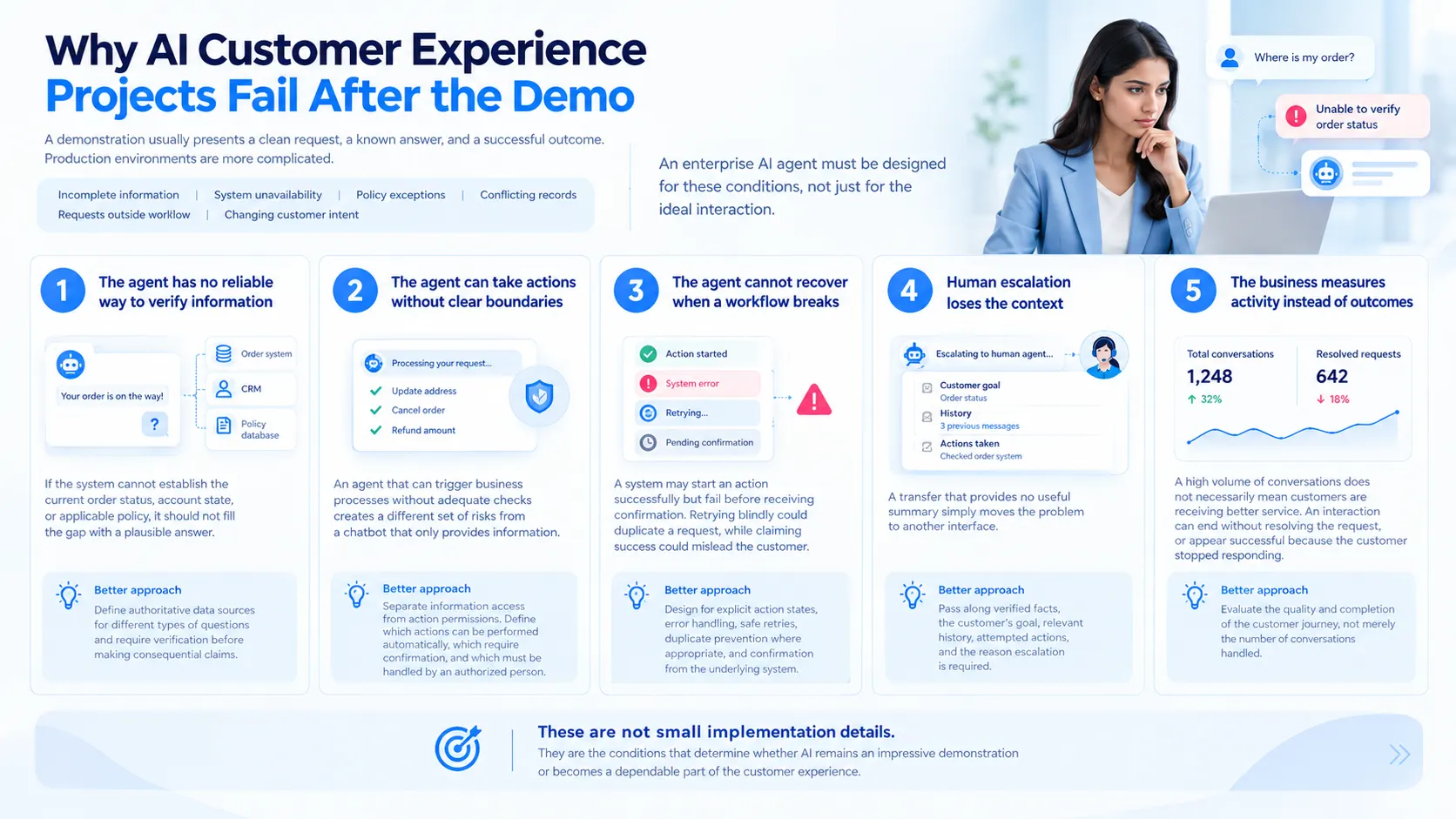
The agent should not invent a delivery date, promise a refund without authorization, or claim an action has succeeded when the backend system has rejected it. That last point is critical. A confident-sounding response is not proof that a business action occurred. The goal is not to make AI appear more capable. It is to make the customer journey more dependable.
The Metrics That Reveal Whether an AI Agent Is Actually Working
Businesses need to evaluate an AI agent against the purpose of the workflow it supports. For example, a product discovery agent and a complaint-resolution agent should not be judged using exactly the same success criteria. Their goals, risks, and definitions of completion are different.
A useful measurement framework connects customer outcomes, operational performance, and control.
Measurement area | What to evaluate | Why it matters |
Resolution quality | Whether the customer's original request was correctly resolved | Prevents fluent but incomplete answers from being treated as success |
Task completion | Whether the required backend action was completed and verified | Distinguishes intended actions from successful execution |
Customer effort | Repeated questions, unnecessary transfers, and avoidable steps | Reveals friction in the overall journey |
Context continuity | Whether relevant information survives across channels and handoffs | Helps identify disconnected experiences |
Answer reliability | Correctness, source relevance, and appropriate handling of uncertainty | Reduces misleading or unsupported responses |
Escalation quality | Whether the case reaches the right person with sufficient context | Makes human involvement more effective |
Safety and compliance | Unauthorized actions, privacy failures, policy violations, and inappropriate responses | Keeps automation within acceptable boundaries |
Business impact | The outcome relevant to the workflow, such as successful onboarding or completed service requests | Connects AI deployment to an actual business objective |
The measurement process should also include unsuccessful interactions. Businesses need to know where customers abandon a workflow, where agents repeatedly escalate, where tool calls fail, and where human representatives must correct an AI-generated response.
These cases often reveal more about the quality of the implementation than successful demonstrations do.
The central question is not “How many conversations did the AI handle?” It is “What changed for the customer because the AI was involved?”
How to Introduce AI Agents Without Losing Customer Trust
Not every customer interaction should be automated, and not every AI agent should receive the same level of autonomy.
A practical rollout starts with the task, the consequences of an error, the available data, and the reliability of the supporting systems.
Step 1: Start with a customer problem, not a model
Identify a recurring journey where customers face unnecessary effort, unclear information, repeated follow-ups, or disconnected handoffs.
Map the process from the customer's initial request to the actual resolution. Include the internal teams, systems, approvals, and exceptions involved.
Step 2: Separate what the AI must know from what it must do
List the information needed to answer the request and the actions needed to complete it. For example, explaining a cancellation policy is different from cancelling a subscription. The second requires an authorized action, a verified account, and confirmation that the request was processed.
Step 3: Establish the boundaries before enabling execution
Define the actions the agent may perform, the conditions it must check, and the situations that require human approval. High-impact, sensitive, ambiguous, or exceptional cases may need a stricter level of control than routine informational requests.
Step 4: Test real-world exceptions
Evaluate incomplete customer information, contradictory records, unavailable integrations, unexpected requests, failed actions, and attempts to obtain information without appropriate authorization. Test the recovery path as carefully as the successful path.
Step 5: Make human support part of the design
Human assistance should not be an afterthought reserved for when the AI becomes confused. Establish clear escalation triggers, provide useful case summaries, and give human representatives enough context to continue the work.
Step 6: Improve the workflow using evidence
Review unsuccessful cases, customer feedback, policy exceptions, and operational failures. Identify whether the underlying problem comes from the model, retrieval, data quality, integration logic, workflow design, or unclear ownership.
Then fix the appropriate layer rather than simply rewriting the prompt. This approach makes AI adoption a continuous service-improvement process, rather than a one-time chatbot launch.
What This Means for Businesses Building Omnichannel Customer Experiences
Customers may interact through a website, WhatsApp, email, voice, or another service channel. Each channel has different interaction patterns, but the customer's underlying goal remains the same.
A customer who asks about an order should not receive conflicting information simply because they changed channels. A complaint should not lose its history when it moves to a human representative. A service request should not become disconnected from the system responsible for completing it.
An AI agent can help coordinate these journeys, but only when the business provides the right foundations.
That includes consistent customer identity where appropriate, access to relevant conversation history, trusted business knowledge, connected operational systems, channel-specific consent and communication rules, and a shared understanding of when a task is complete.
This is where omnichannel strategy and agentic AI intersect. Omnichannel creates connected ways for customers to interact. AI agents can help connect those interactions to the business processes required to fulfil the customer's request.
Without that connection, a business may offer many channels but still deliver a fragmented experience. With it, the business can work toward a more continuous journey in which the customer does not have to understand the company's internal structure to get help.
Conclusion: The Future of Customer Experience Is Not More Automation. It Is Better Resolution.
The next phase of customer experience will not be defined simply by whether a company uses ChatGPT, a chatbot, or an AI agent. It will be defined by how effectively its systems understand customer intent, retrieve reliable information, take appropriate action, recognize their limits, and maintain continuity when a request becomes complicated.
AI agents offer a way to connect conversational intelligence with business workflows. But technology alone does not guarantee better service. The result depends on the quality of enterprise data, integration design, governance, workflow ownership, and the ability to verify outcomes.
For business leaders, the opportunity is to stop viewing AI as another interface placed on top of existing processes and start examining the processes themselves.
Where do customers repeat information? Where do requests become stuck between teams? Which actions still require unnecessary manual steps? Where does the business know a problem exists but fail to communicate the next step? And where should a human remain firmly in control?
Those questions provide a more valuable starting point than choosing a model based on a demonstration. Beyond ChatGPT, the real opportunity is to build customer experiences in which AI does more than respond it helps move the right request through the right process, with the right safeguards, toward a result the customer can trust.
For businesses, that is the difference between making customer service sound intelligent and making the customer experience genuinely better.
Frequently asked questions
ChatGPT is a conversational AI product that can answer questions, generate content, and assist with a wide range of tasks. An AI agent is a system designed to work toward a defined goal, potentially using tools, connected data, and workflows to perform authorized actions. Their capabilities can overlap, but an enterprise agent is typically designed around a particular task, its integrations, and its execution rules.