WhatsApp Automation for Businesses - The Complete Guide to Better Customer Experience
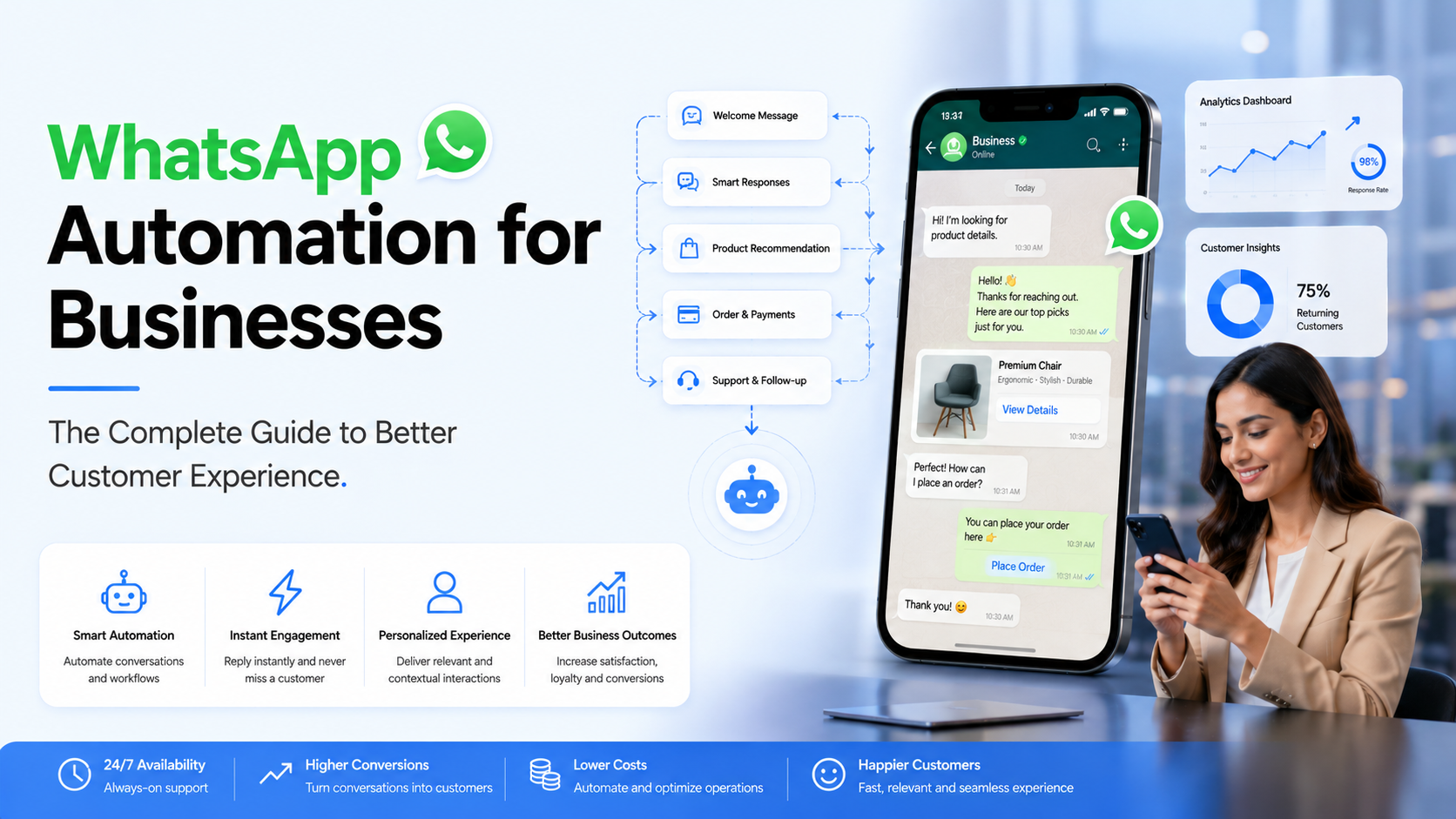
Customer expectations have grown a lot. Nowadays, WhatsApp is where many of those expectations play out. With more than 3 billion monthly active users and over 200 million businesses using the platform globally (source: Meta Reports First Quarter 2025 Results, Global WhatsApp Statistics: Every Busin
Customer expectations have grown a lot. Nowadays, WhatsApp is where many of those expectations play out. With more than 3 billion monthly active users and over 200 million businesses using the platform globally (source: Meta Reports First Quarter 2025 Results, Global WhatsApp Statistics: Every Business Should Know in 2026), it has become one of the most important customer engagement channels that businesses can no longer overlook. Importantly, it's a platform customer already trust, with engagement rates that consistently outperform traditional channels like email. Your customers are already there. They trust the channel and expect queries to be addressed quickly, no matter what time it is.
That's not really a support issue anymore. It's about how your brand's perceived. When replies take longer than anticipated, customers definitely take note. Even if they don't complain, the experience leaves an imprint. As conversation volumes increase, relying on human agents becomes increasingly complicated, and slower response times can gradually deteriorate customer trust. This is where WhatsApp automation earns its place: AI paired with your existing systems turns conversations into something you can actually measure across sales, support, and engagement.
This guide breaks down what WhatsApp automation looks like, how it enhances customer experience, where enterprises are seeing the returns, and what to consider before choosing a platform.
What WhatsApp Automation Means for Businesses
Let's clarify confusion first. The free WhatsApp Business App, the one with replies and a basic message, is not an automation. It works well for businesses, but once conversation volumes increase, its limitations become obvious.
WhatsApp automation for companies is made on the WhatsApp Business Platform. This is different from the chatbots that many companies tried a while back. Today's AI agents possess a genuine capacity to interpret customer intent, drawing necessary insights from internal platforms like your customer management or enterprise administration systems. They are capable of managing inquiries independently, seamlessly escalating to a human representative only when necessary. The main idea is not just to send replies; it is to help customers do things faster and with less work with automation.
Why WhatsApp Automation Is a Business Priority
The businesses seeing the results aren't trying to automate every customer interaction. Instead, they focus on volume, repetitive conversations, and ensuring customers can easily reach a human when the situation calls for it.
WhatsApp automation has evolved beyond a mere customer support tool for CXOs. As an emerging enterprise capability, it enhances customer support, drives sales acceleration, and optimizes daily operations.
● Response time is reduced; no more queues, and routine questions get answered instantly any time of day.
● Conversion follows engagement; quicker replies indicate completed purchases, booked demos, and scheduled appointments.
● Cost per interaction reduces, automates the repetitive 70% (source: 50 Cart Abandonment Rate Statistics 2026)
● Handle routine inquiries like FAQs, tracking updates, and bookings automatically, so your support teams can dedicate more time to interactions that require human expertise.
● Data compounds; each automated conversation yields insights into user intent and patterns, continuously optimizing future touchpoints.
How WhatsApp Automation Improves Customer Experience
Customer experience is often shaped by the moments that happen on an everyday basis. A quick answer to a product query, an order update delivered at the time, or a support case resolved without switching channels can leave a lasting impression. According to Salesforce, 80% of customers say the experience a company provides is just as important as its products or services (Source: What Are Customer Expectations, and How Have They Changed?). To meet rising expectations, businesses must deliver consistent experiences at scale.
This is where WhatsApp automation can really help. Customers receive answers instantly 24/7. The AI takes information from your CRM and other business tools to make the chats more personalized. When an issue needs human judgement or understanding, the chat switches smoothly to a human agent without repeating the chat history.
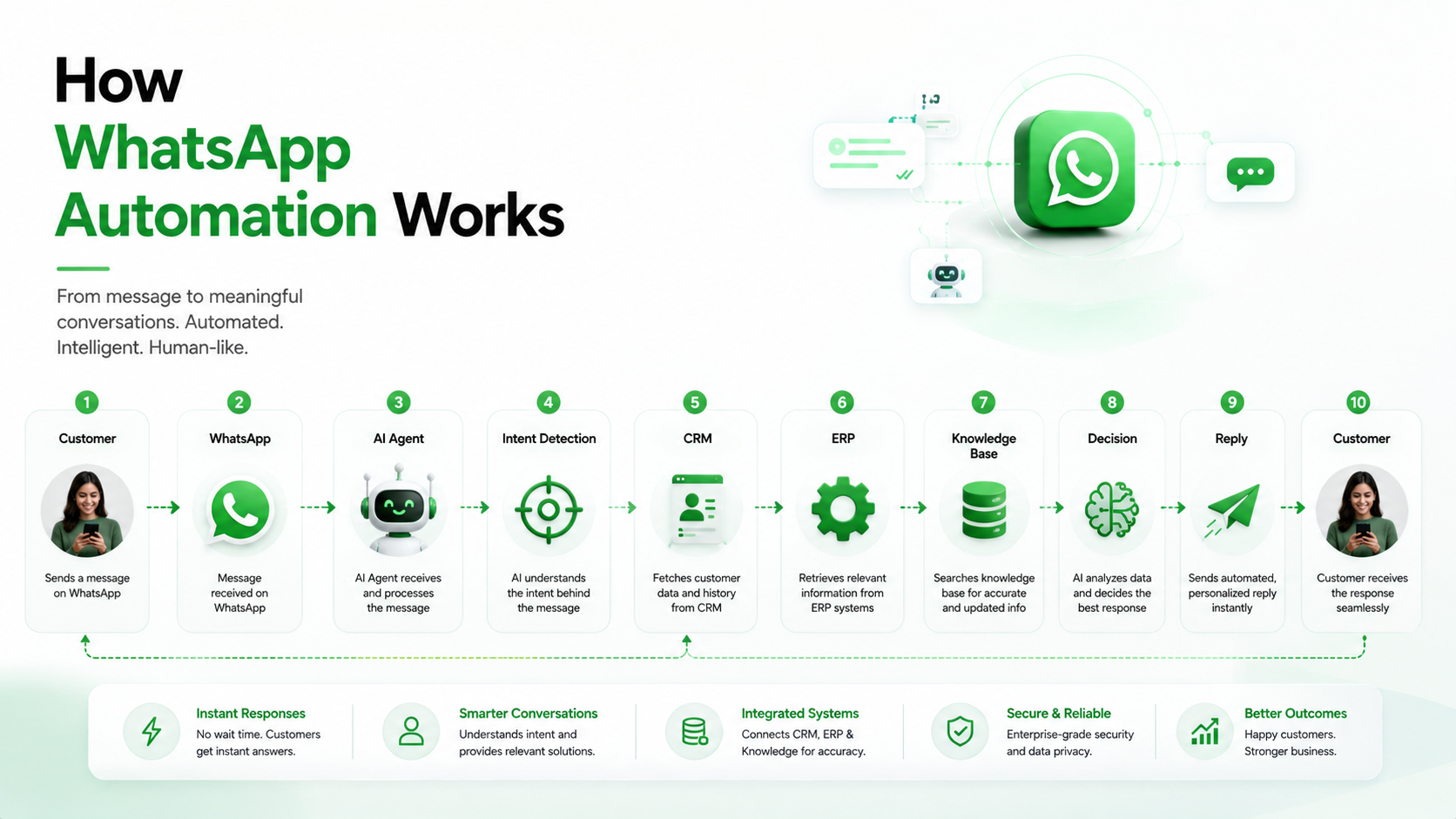
For customers, the experience simply feels easier. They spend less time receiving more relevant support and move from their first question to resolution without unnecessary conflict. Businesses can provide satisfaction, stronger loyalty, and a customer experience that's consistent across every interaction.
Where the ROI Actually Shows Up
WhatsApp automation can add value across the customer journey. The business impact varies significantly depending on the specific use case. In organizations, a handful of workflows generate the quickest and most measurable returns because they reduce manual effort to improve the customer experience.
● Support at scale - Provide instant answers to common questions like FAQs, return policies, and order tracking via AI agents trained on your company's knowledge base. For more complicated issues, conversations can be smoothly escalated to a human agent without any interruption.
● Lead capture and qualification - Turn Click-to-WhatsApp. Website visitors into meaningful conversations. Rather than filling out forms and waiting for a callback, prospects can engage with your business immediately.
● Cart recovery and reactivation - Re-engage customers who leave without completing a purchase through timely WhatsApp reminders, personalized product suggestions, or exclusive offers.
● Order updates - Automate booking confirmations, appointment reminders, delivery updates, and payment notifications to reduce no-shows while keeping customers informed at every stage.
The business impact becomes more apparent in day-to-day operations. A retailer can automatically reconnect with shoppers who abandon their carts outside business hours, helping retrieve revenue that might otherwise be lost. In healthcare, follow-up instructions, appointment confirmations, and reminders can be sent automatically, reducing work while creating a smoother patient experience.
Although the use cases differ, the outcome is quite consistent: customer interactions, lower operational effort, and better business results.
Selecting the Right WhatsApp Automation Platform
Selecting a WhatsApp automation platform isn't about comparing feature lists. The main question is whether the platform can help your business as customer expectations increase, conversation volumes increase, and your operations become more complex.
● Can the platform use your company's data to deliver context-aware responses? AI should reflect your products, policies, and procedures. Not generate answers that are incompatible with your business.
● Are the template regulations and conversation windows managed with precision? Getting this means paying for messages you didn't need to or worse getting your number flagged.
● Is the handoff seamless? Automation should escalate a customer, not trap them in a loop.
● Does it work across channels? Customers move between WhatsApp, web chat, and voice mid-conversation; your automation should follow them with context
● Can it integrate seamlessly with your existing CRM, ERP, and customer support systems? The more connected your automation platform is, the more personalized and efficient every customer interaction becomes.
The Real Shift: From Messaging Tool to Experience Engine
WhatsApp is no longer another customer communication channel. For companies, it's where prospects ask their first questions, customers seek support, and buying judgments are often influenced. The quality of those interactions increasingly shapes how customers perceive a brand.
That's why WhatsApp automation earns a place in customer experience strategy rather than being viewed as another support initiative. When common conversations are automated and complex ones reach the right people quickly, businesses can improve responsiveness without sacrificing the quality of the experience.
Chat360’s Omnichannel Agentic AI enables businesses to achieve this with AI-powered WhatsApp automation that integrates with enterprise systems, maintains compliance, and scales customer conversations without losing the personal touch customers expect.
Over a few years, businesses will need to do more than just speeding up their response times to truly differentiate themselves among others. They will be the ones delivering consistent connected customer experiences every time someone starts a conversation.
Frequently asked questions
It allows businesses to automate customer conversations with WhatsApp Business Platform, AI, and workflow automation. It can answer queries, qualify leads, send notifications, and handle routine interactions, helping teams respond faster while delivering a more consistent customer experience.