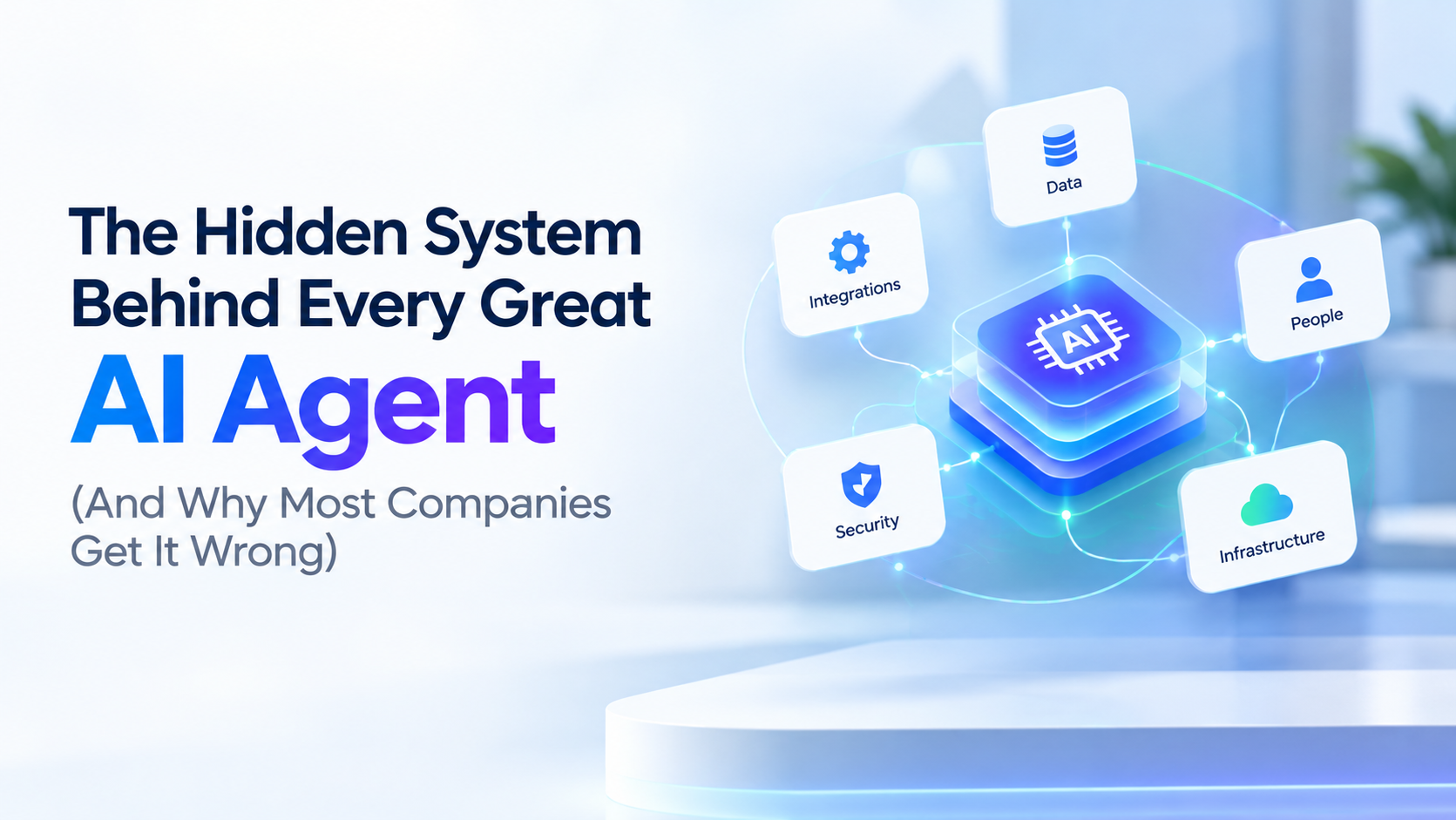
AI Agents for Customer Service: The Shift From Answers to Autonomous Resolution
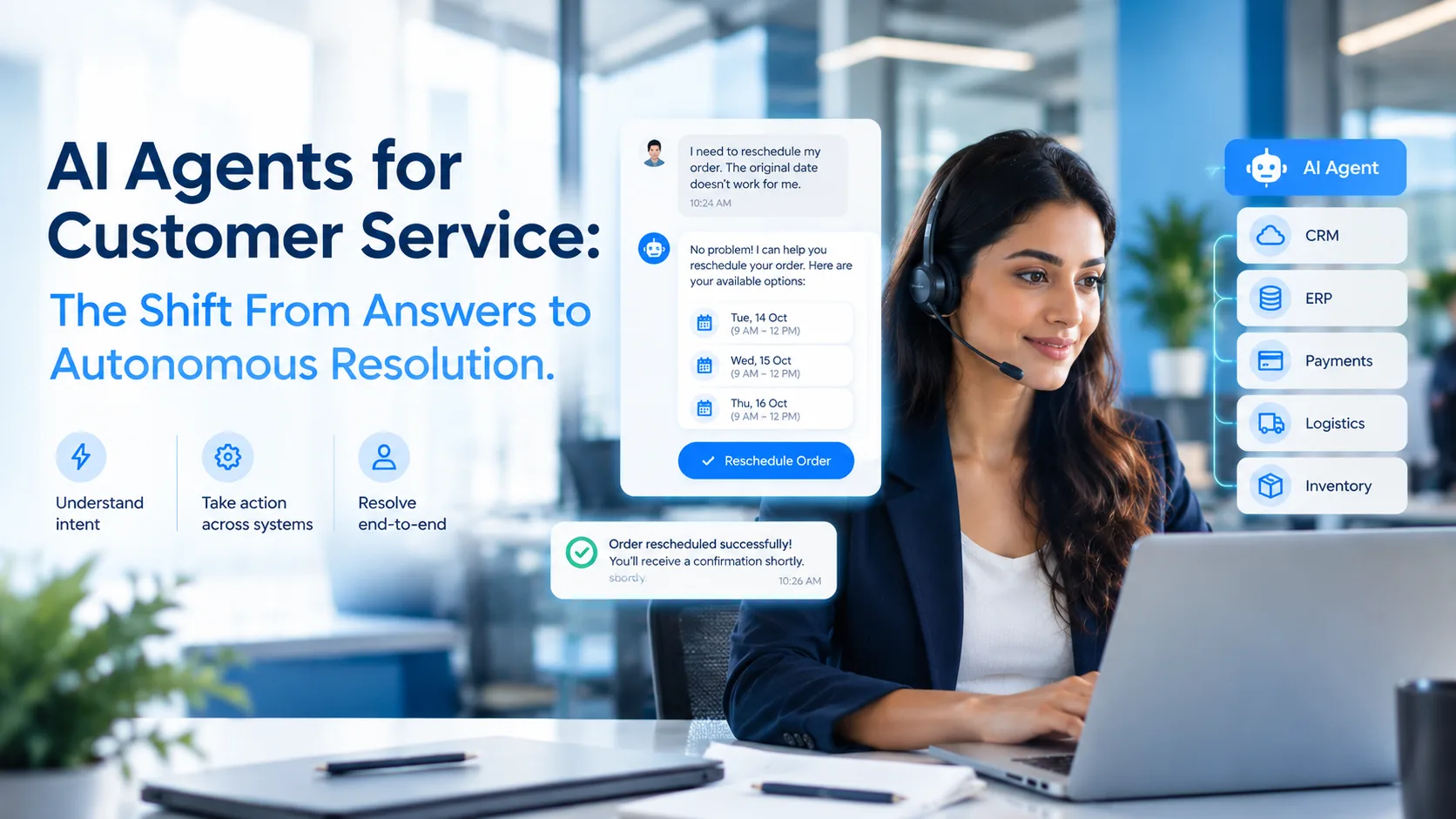
AI agents are transforming customer service from answering questions to resolving problems. Discover how Agentic AI understands intent, uses enterprise data, executes workflows, escalates complex cases, and delivers faster, more personalized customer outcomes across channels.
Your customer doesn't care whether your chatbot uses the latest LLM. They care whether their problem is solved. That distinction is reshaping customer service in 2026.
For years, businesses measured conversational AI by how many questions it could answer. But customers are moving beyond information retrieval. They increasingly expect AI to help them complete tasks, take action and reach an outcome.
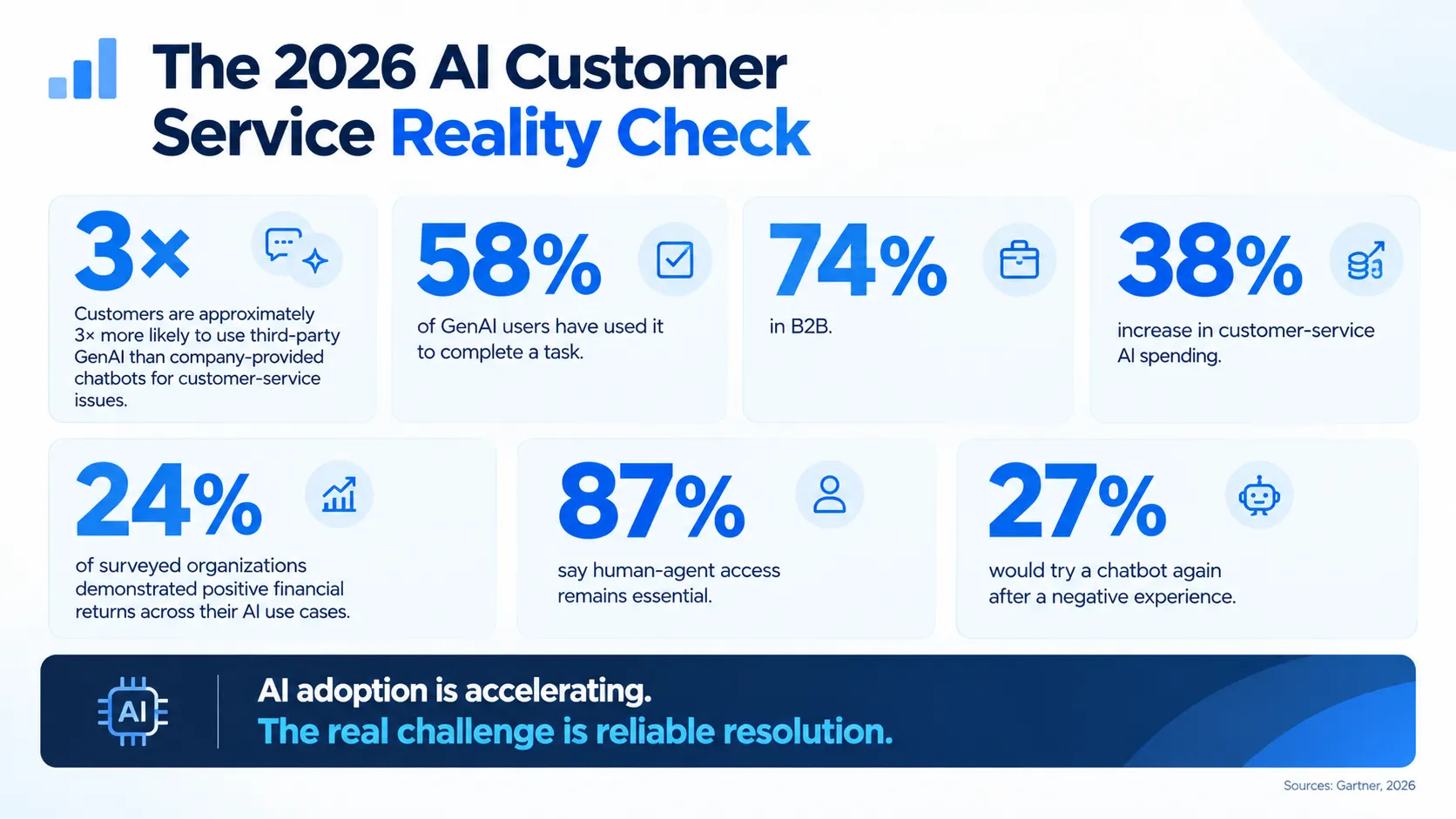
Gartner's 2026 research found that customers are approximately 3x more likely to use third-party GenAI than company-provided chatbots when resolving customer service issues. The same research found that 58% of customers who use GenAI have used it to complete a task on their behalf, rising to 74% in B2B. Customers are using GenAI to act, not just to obtain information.
That creates a new benchmark for AI customer service: don't ask how many conversations AI handled. Ask how many customer problems it resolved. That is where AI agents are changing the enterprise support model.
The chatbot answered. The AI agent acts.
Customer service automation has evolved in three stages:
Approach | How it works |
Traditional automation | Customer question → Intent detection → Predefined response |
Generative AI | Customer question → Context → Generated answer |
Agentic AI | Intent → Context → Reasoning → Tools → Action → Verification → Resolution |
That difference matters more than it sounds. Imagine a customer asking:
"My payment was deducted, but my order still shows pending. What happened?"
A conventional chatbot might explain payment policies. A generative AI assistant might explain possible reasons. An AI agent can authenticate the customer, retrieve the transaction, check the order status, identify the mismatch, initiate an approved workflow and escalate the exception when required.
The objective changes from answering the customer to completing the customer's job. McKinsey's 2026 research describes this as the vision of humans and AI agents working together to reduce friction across customer journeys. It calls on leaders to rewire how work gets done, rather than simply adding AI to an existing process.
The uncomfortable truth: AI adoption is rising faster than AI ROI
This is where the AI customer service conversation becomes more interesting. Gartner reported in August 2026 that customer service leaders increased AI spending by 38%, while overall customer service and support budgets grew only 2%. Gartner identified GenAI chatbots, GenAI voicebots and no-code agent builders among the technologies expected to deliver the greatest value over the next two years. But spending does not equal success.
A separate Gartner survey found that service and support leaders invested a median 12% of their 2025 budgets in AI, yet only 24% demonstrated positive financial returns across their AI use cases. That exposes one of the biggest mistakes enterprises make: they optimize AI for activity instead of outcomes.
More conversations handled does not necessarily mean lower cost. More automated responses do not necessarily mean higher CSAT. A higher containment rate does not necessarily mean a better customer experience. The real KPI is successful resolution at an acceptable cost and risk.
Why some AI customer service deployments fail
The problem isn't always the AI model. Sometimes the experience itself is broken. Gartner reported in September 2026 that only 27% of customers would try a chatbot again after a negative experience. Gartner recommends prioritizing reliability overreach, starting with targeted use cases where successful resolution can be demonstrated.
The lesson for enterprises is clear. A chatbot that fails occasionally is not just inefficient; it can reduce future adoption. That means businesses should not begin with "What can we automate?" They should begin with "Which customer problems can AI reliably resolve?"
That small change in thinking can completely alter an AI customer service strategy.
The 5-layer architecture behind high-performing AI agents
A production-grade AI agent needs more than a large language model.
1. Understand
The agent identifies the customer's intent, language, sentiment, context and desired outcome.
For example: "Can you tell me why my EMI changed this month?"
The intent isn't simply "EMI question." Answering it may require understanding the customer's account, payment history and applicable policy.
2. Retrieve
The agent accesses approved knowledge and relevant customer information. This could include CRM records, previous conversations, product information, order data, account information, policies and knowledge bases.
3. Reason
The agent determines what needs to happen next. This is where Agentic AI differs from a simple response generator. The system isn't merely asking "What should I say?" It is asking, "What should I do?"
4. Act
The agent uses approved tools and integrations to execute the next step. For example:
CRM → retrieve customer
ERP → check transaction
Payment system → verify status
Ticketing system → create case
Calendar → schedule appointment
5. Escalate
Not every situation should be automated. A mature AI customer service system should recognize uncertainty, risk and exceptions, and transfer the conversation to a human with the relevant context intact.
The best AI customer service doesn't eliminate humans
This is one of the most important findings of 2026. Gartner found that 87% of customers say it is essential for companies using GenAI for customer service to provide access to a human agent. At the same time, 50% said their interactions were easier when companies used GenAI.
Those numbers are not contradictory. They describe what customers want: speed when AI is good at the task, and human judgment when the situation demands it.
Gartner also found that 85% of service and support leaders are expanding human agent responsibilities, while only 31% have implemented or are planning AI-driven frontline workforce reductions through Q1 2027. The future therefore isn't AI vs. humans. It is AI + humans + enterprise systems. AI handles scale. Humans handle judgment. Enterprise systems provide context.
Where AI agents can deliver the most value
The highest-value use cases generally share four characteristics:
High volume + repeatable process + accessible data + measurable outcome
That makes several enterprise journeys strong candidates.
BFSI
AI agents can support loan status, EMI queries, KYC assistance, payment information, document collection, service requests and customer follow-ups. Sensitive financial decisions should retain appropriate authentication, permissions, controls and human escalation.
Healthcare
AI can assist with appointment scheduling, patient navigation, department routing, follow-up communication, service information and administrative queries. Clinical decisions require appropriate safeguards and qualified human oversight.
Retail and ecommerce
AI agents can help customers with product discovery, order tracking, returns, refund status, delivery updates and post-purchase support.
Enterprise sales
AI can qualify prospects, collect information, schedule meetings, personalize follow-ups and synchronize interactions with CRM systems. The common thread is simple: the agent has a defined objective and access to the systems required to pursue it.
The next competitive advantage is orchestration
Customers don't think, "I am now switching from WhatsApp to CRM." They think, "I need my issue resolved."
That's why omnichannel customer service is becoming less about having multiple channels and more about maintaining continuity across them. A customer might begin on WhatsApp, move to a website and eventually speak with a human over voice. The experience should not reset each time.
Channel automation | Journey orchestration |
WhatsApp bot + website bot + voice bot + human support | Customer → WhatsApp → AI Agent → CRM → Voice → Human → Resolution |
This is the shift from channel automation to journey orchestration. McKinsey's July 2026 research describes it as a move from static optimization to dynamic orchestration, where human judgment sets objectives, guardrails and escalation points while AI agents manage moment-to-moment execution at scale.
Measure AI customer service by resolution, not containment
A high containment rate can look impressive on a dashboard. But what if customers return three times because the first interaction didn't solve the problem?
That is why enterprises should track a broader customer support automation scorecard:
Metric | What it measures |
Resolution rate | Did AI actually solve the issue? |
First-contact resolution | Was another interaction required? |
Escalation rate | Where is human expertise required? |
Customer effort | How difficult was resolution? |
CSAT | How did the customer perceive the experience? |
Cost per resolution | What did successful service actually cost? |
AI accuracy | Did the system provide the correct outcome? |
Exception rate | How often did workflows fall outside normal conditions? |
Revenue influenced | Did AI contribute to commercial outcomes? |
This approach reflects Gartner's point that the challenge is not funding AI, but ensuring those investments produce measurable business value. Automation does not automatically produce savings.
What Chat360 brings to the equation
Chat360 is built around the idea that enterprise conversations should become automated journeys, not isolated chatbot interactions. Its Agentic AI approach connects customer conversations across channels such as WhatsApp, web and voice, with enterprise context and defined workflows. The strategic difference:
Model | Flow |
Traditional chatbot | Customer → Question → Answer |
Generative AI assistant | Customer → Question → Context → Answer |
Agentic AI | Customer → Intent → Context → Reasoning → Action → Outcome |
That last model is where customer service becomes an operational capability rather than just another communication channel.
Ready to move beyond chatbot automation? Give your customer service AI the ability to understand, act and escalate, not just respond. Explore Chat360's Enterprise Agentic AI Platform.
Conclusion
The next phase of AI customer service is not about replacing every human interaction with a machine. It is about giving AI the ability to understand customer intent, access the right context, take approved actions and know when human expertise is required.
The evidence from 2026 makes that distinction increasingly important. AI investment is accelerating, but customer expectations are rising at the same time. Businesses cannot measure success by chatbot adoption or conversation volume alone. They need to measure resolution, customer effort, quality, cost and business outcomes.
That is where Agentic AI can create a meaningful advantage. Instead of stopping at an answer, AI agents can coordinate information, systems, workflows and channels to move customers toward an outcome.
At Chat360, this approach brings AI agents, omnichannel conversations, enterprise integrations and workflow automation together, so businesses can move from fragmented chatbot interactions to intelligent customer journeys.
The future of customer service isn't AI replacing people. It's AI handling the work it does best, while people focus on the moments that require judgment, empathy and expertise. The question for enterprises is no longer whether to experiment with AI. It is whether their customer service architecture is ready for what comes next.
Frequently asked questions
AI agents are software systems that can understand customer intent, use business context, reason through a task, interact with connected systems and take actions toward a defined outcome. Unlike traditional chatbots that primarily provide predefined responses, AI agents can support multi-step customer service workflows.