Voice AI That Actually Grows the Business and Not Just Answers Calls

Most Voice AI platforms can hold a conversation, but few can complete a task. Learn how Agentic AI enables enterprise Voice AI to automate workflows, connect with business systems, preserve customer context, and deliver measurable improvements in customer experience and operational efficiency.
There’s a specific moment every CXO knows well. A customer calls in, gets stuck in an IVR maze pressing “1 for sales, 2 for support,” and hangs up before reaching anyone. Multiply that by a few thousand calls a month, and you’re not looking at a minor CX annoyance; you’re looking at lost revenue, a support team drowning in repeat queries, and a churn number your board keeps asking about.
Most of the Voice AI pitches you’re hearing right now solve half of that problem. They give you a system that talks like a human instead of routing like a machine, which is real progress, but it’s not, by itself, the thing that moves your numbers. The half that actually matters is what happens after the AI understands the customer. That’s where this piece is going to spend most of its time.
Where Agentic AI Comes In
Here’s a distinction worth making before you sit through another vendor pitch: understanding what a customer says is table stakes now. Every serious Voice AI product on the market can hold a natural-sounding conversation, handle interruptions, and switch languages mid-call. That’s no longer the differentiator it was two years ago.
What separates a genuinely useful deployment from a glorified transcription layer is what happens after the AI understands the request. That’s the job of Agentic AI; the decision-making layer that sits underneath the conversation. Instead of just answering a question, an Agentic AI system can validate an account number against your CRM, update a record, trigger a refund workflow, or check inventory before confirming an order, then hand off to a human agent with full context if the situation calls for judgment a model shouldn’t make alone.
The difference matters at the P&L level. A Voice AI that can only talk is a nicer front door; most of what’s being sold as “Voice AI” right now is still, functionally, IVR with better transcription and a friendlier voice. A Voice AI powered by Agentic AI is closer to an actual extension of your operations team, one that can complete a task, not just describe how to do it. If your evaluation criteria stop at “does it sound human,” you’re evaluating the wrong layer.
Where Voice AI Actually Moves Business Metrics
Market sizing numbers move around depending on who’s counting and what they include. Grand View Research, a market research firm, pegs the global AI voice agents market at roughly $2.5 billion in 2025, growing toward $35 billion by 2033 (Source: Grand View Research ‘AI Voice Agents Market (2026 - 2033)) Take any single figure like that as directional, not gospel; different research firms scope “voice AI” differently, and the more useful question for you isn’t the market’s size; it’s what changes inside your own contact center.
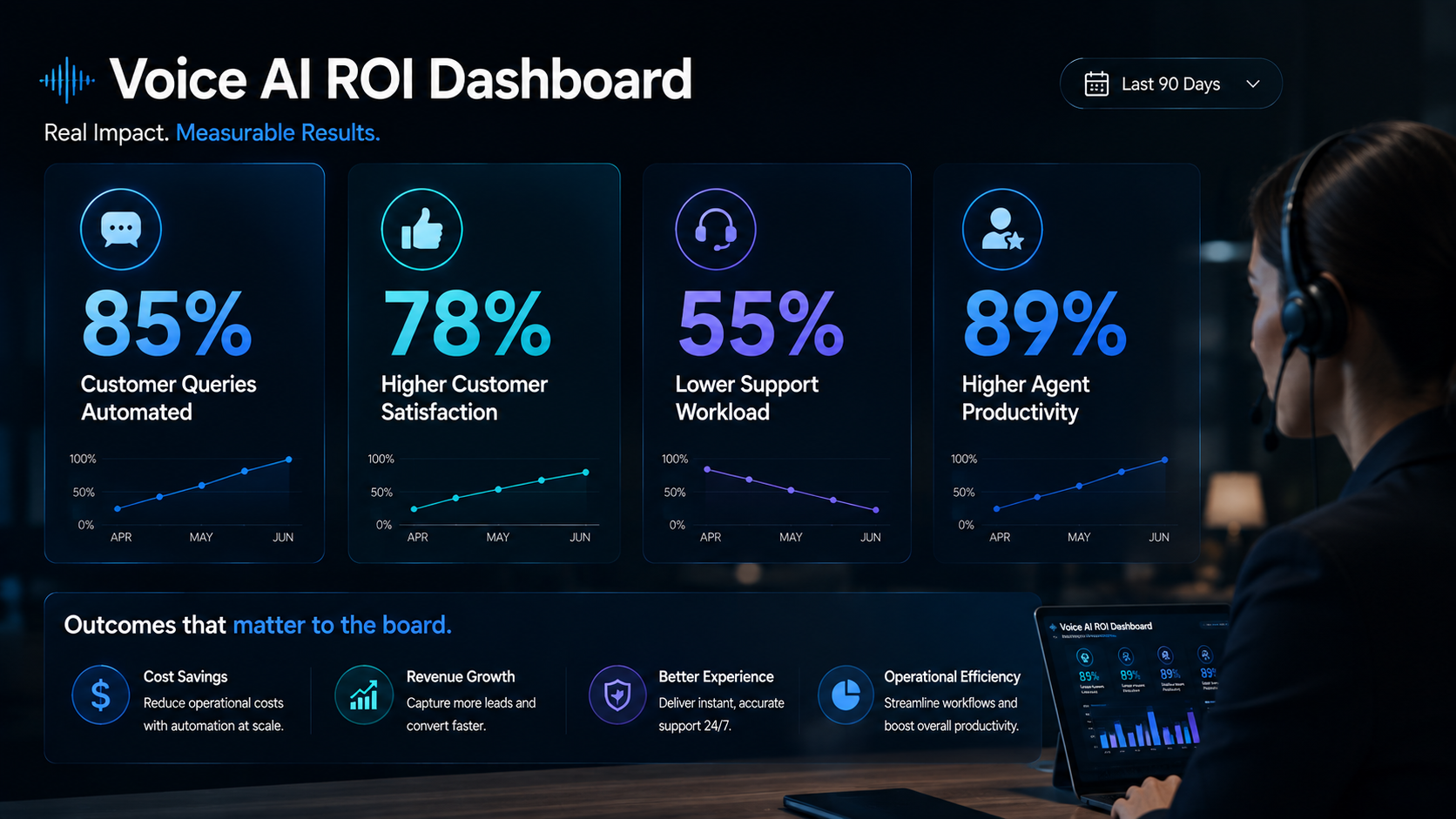
That's where the real evidence sits. According to Chat360's own published performance data for its Voice360 platform, businesses running it have seen:
● 85% of inquiries handled without a human agent stepping in
● A 78% lift in customer satisfaction scores
● A 55% drop in operational workload for support teams
● An 89% boost in agent productivity, because agents stop fielding repetitive questions and start handling the conversations that actually need a human
None of these numbers matter in isolation. What they add up to is a support function that scales without a proportional headcount increase, which is usually the exact conversation a CXO is having with the board every quarter about doing more with the same budget.
Voice Alone Isn’t the Whole Story
Here’s where most Voice AI deployments stop too early: they treat voice as its own island. A customer calls, gets helped, and the call ends. Done.
But that’s not how customers behave. Someone might start a conversation on a phone call, get partway through an order issue, then switch to WhatsApp because they’re now in a meeting and can’t talk. Or they browse a product on your website chat, then call to confirm before buying. If your systems don’t carry context across that switch, you’ve just made the customer repeat themselves, which is the exact frustration Voice AI was supposed to eliminate in the first place.
This is why the more useful way to think about Voice AI isn’t as a standalone channel. It’s one channel in a connected customer engagement layer that includes WhatsApp, web chat, and voice, all sharing the same context. A customer service rep, human or AI, picking up mid-conversation should already know what happened five minutes ago on a different channel. That continuity is genuinely hard to build, which is exactly why most platforms that are strong on voice alone haven’t solved it, and most chat platforms that are strong on WhatsApp haven’t solved voice.
What to Check Before You Deploy
Before any vendor conversation gets serious, a few questions are worth asking directly rather than assuming the answer:
Compliance and data handling. If you’re in BFSI or healthcare, ask specifically how call recordings are stored, whether consent disclosures are built into the flow, and where data resides. “We’re enterprise-grade” is not an answer. A data residency map and a compliance certification list are.
Voice conversations fall apart if the AI takes more than a beat to respond; customers notice a half-second delay in a way they’d never notice in a chat window. Ask for a live demo call, not a canned video.
When the AI can’t resolve something, does the human agent get the full conversation history, or does the customer start over? This single detail is often the difference between a deployment your team loves and one they quietly route around.
Multilingual can mean two languages, or it can mean genuine regional dialect and tone adaptation across 100+ languages. Ask which one you’re buying.
The businesses getting real value from Voice AI aren’t the ones chasing the flashiest demo. They’re the ones treating it as infrastructure, something that has to hold up under regulatory scrutiny, handle volume spikes without falling over, and connect cleanly to the channels customers already use.
What This Looks Like in Practice
A mid-sized insurer runs a call center handling policy renewal, claims status checks, and premium payment reminders. Call volume spikes hard around renewal season and month-end, and the support team either scrambles to cover it with overtime or let’s hold times climb.
A customer calls to check a claim status. Voice AI picks up and understands the request in natural language, no menu navigation, then pulls the claim record through the Agentic AI layer underneath it. Whether the claim is straightforward and resolved, still in review, or denied with a reason, the system answers directly and offers to text a summary. If the customer wants to dispute the outcome or the case involves a judgment call the AI isn’t authorized to make, it hands it off to a human agent, complete with the claim number, the customer’s stated concern, and a transcript of the call so far. No repeating themselves, no cold transfer.
The same customer, if they’d started that conversation on WhatsApp instead, would hit the same system with the same context. And during the month-end spike, the AI absorbs the routine status checks and payment confirmations, freeing the human team to handle disputes, complex claims, and the conversations that require empathy and judgment, rather than every call getting the same overworked, rushed treatment.
That’s the difference in practice, not “fewer humans,” but humans spending their time on the calls that need a person, while the rest resolve without anyone waiting on hold.
The Bottom Line
Voice AI that only talks is table stakes now, not a differentiator. The businesses seeing growth from this category are the ones asking a sharper question than “does it sound human?” Can it act, and does it carry context across every channel a customer might use?
That’s the evaluation to run before your next vendor call, not whether the demo sounds impressive, but whether what’s underneath the conversation can do something with it.
Frequently asked questions
This depends more on your compliance review cycle than the technology itself. Vendors who’ve deployed in regulated industries before should be able to walk you through a specific timeline for data residency review, consent flow sign-off, and a pilot period, not just implementation.