Omnichannel Agentic AI: How Autonomous Agents Deliver Unify Seamless Customer Experience
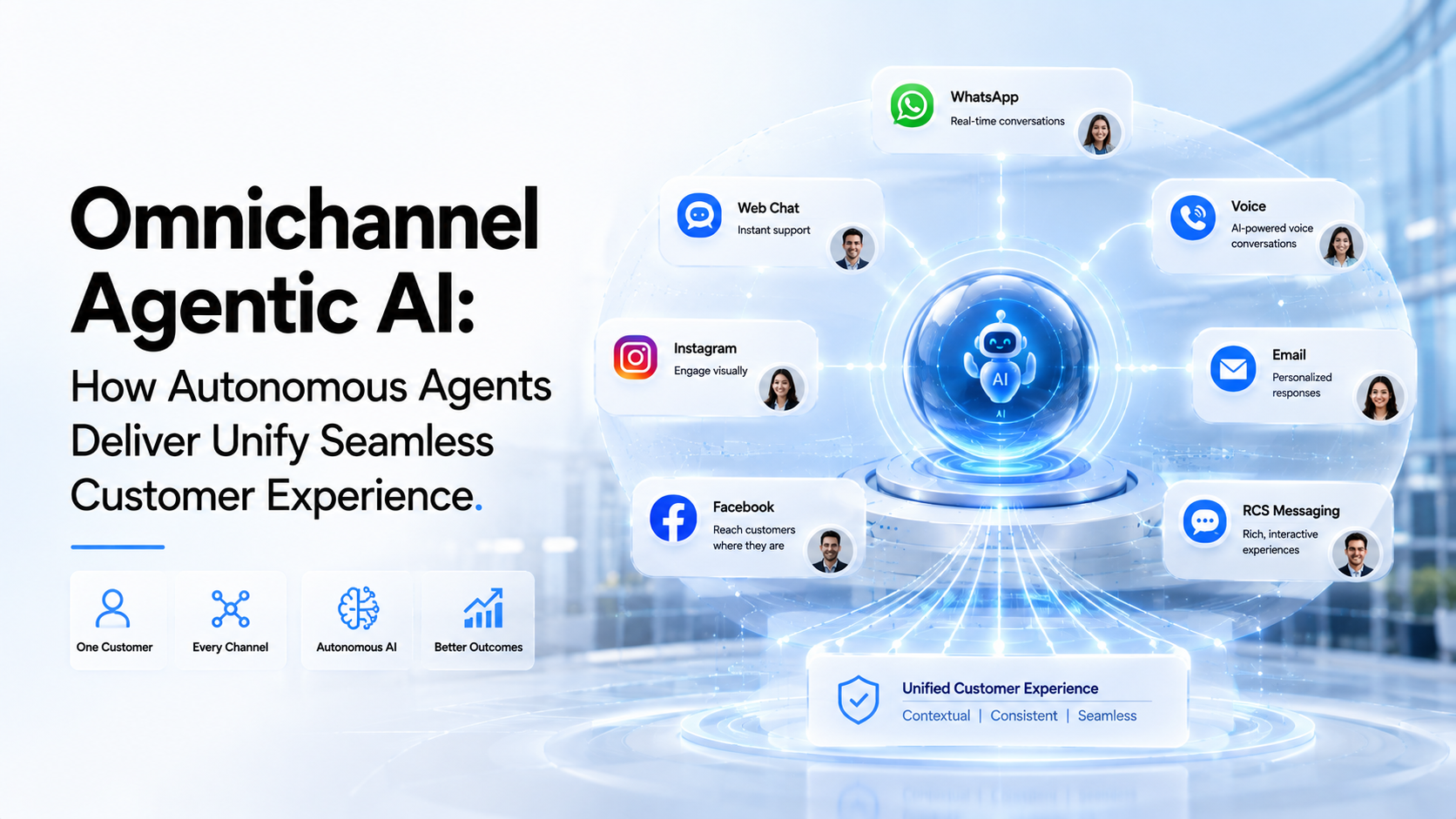
Omnichannel agentic AI enables autonomous AI agents to share customer context across every communication channel, allowing seamless conversations without repetition. This guide explains how AI orchestration, shared memory, enterprise integrations, and intelligent human handoffs work together to deliver faster resolutions, better customer experiences, and scalable enterprise automation.
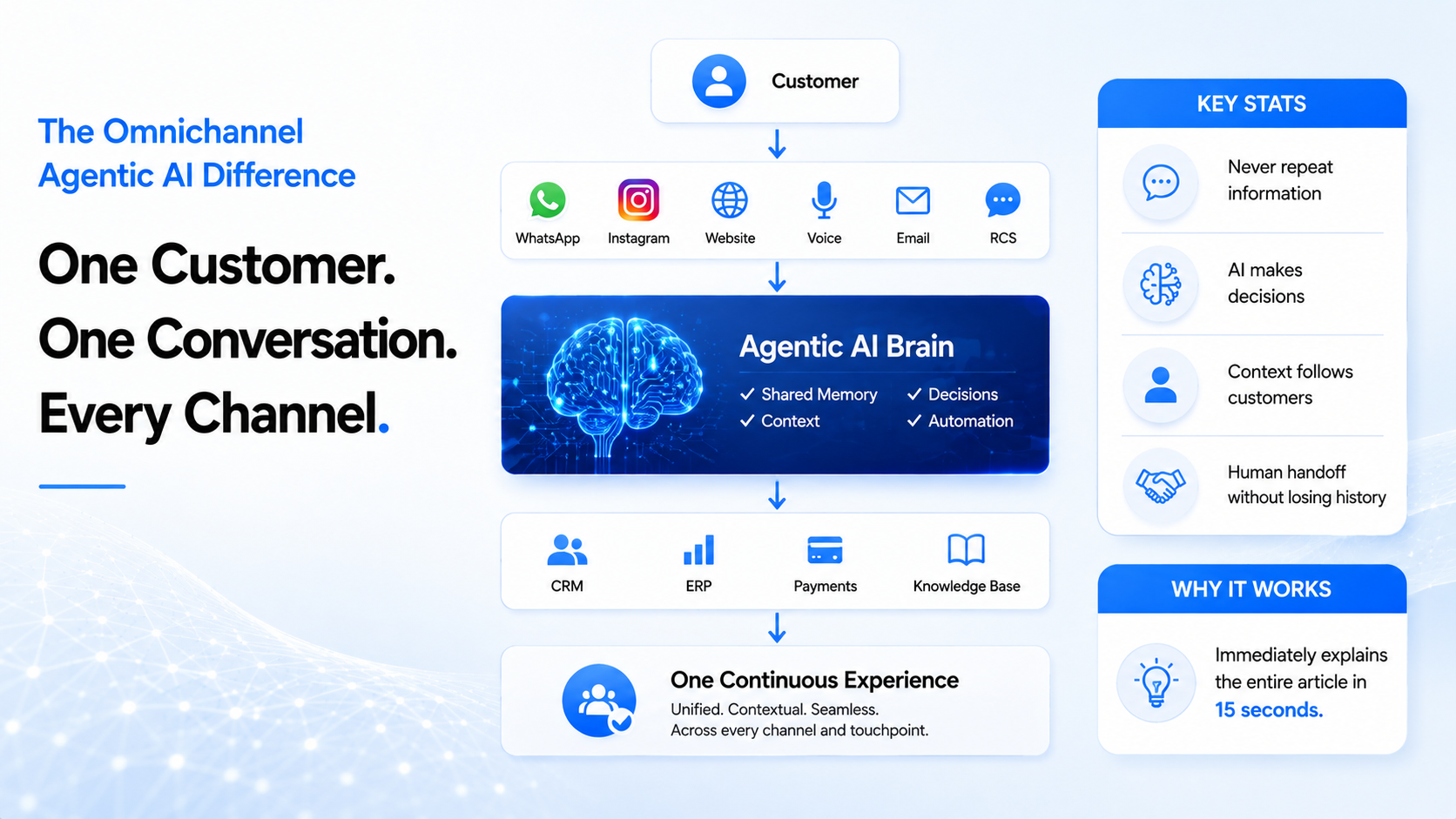
Omnichannel Agentic AI is a network of AI agents that share context and hand off work across every channel WhatsApp, voice, web, email so customers never repeat themselves.
Most of that promise never shows up in the product. Most vendors selling “omnichannel Agentic AI” today are really selling a shared inbox with a bolted-on chatbot, and calling the result an omnichannel experience. If you’re evaluating platforms for your contact center, the gap between those two things is worth more scrutiny than the pitch deck gives it.
What Is Omnichannel Agentic AI?
The two words get conflated constantly. Separated, they mean specific things.
Omnichannel means the customer’s history, preferences, and open issues travel with them across every channel; they don’t start over when they switch from Instagram DM to a phone call.
Agentic means the AI isn’t just retrieving answers. It’s making decisions: pulling data from your CRM, checking order status in your ERP, deciding whether to resolve an issue itself or route it to a human, without a person manually seaming the workflow together.
Together, that’s a system where an autonomous agent, not a static bot running a decision tree, carries a customer’s entire context across every touchpoint and acts on it.
Omnichannel vs. Multichannel
Most "omnichannel" platforms are multichannel with a shared login screen. Here's a simple way to check, ask what happens to context when a customer switches channels mid-conversation. If the customer has to repeat themselves, it's not omnichannel; it's several disconnected channels having the same logo. How Cross-Channel Orchestration WorksMost vendor content skips this part. It shouldn’t, because it’s where the real evaluation happens. The “agentic mesh” model McKinsey’s framework for this is the “agentic mesh”: a coordinated ecosystem of specialized AI agents, with a central orchestrator that activates the right agent at the right moment instead of forcing one generalist bot to handle everything. Rather than a single assistant trying to be an expert in billing, technical support, and sales all at once, specialized agents hand off to each other in real time, coordinated by an orchestration layer. (Source: McKinsey, “Seizing the Agentic AI Advantage,” June 2025) That’s a different architecture from a chatbot with more integrations bolted on and the right benchmark for any platform you’re evaluating. Context retention and memory across channelsContext retention isn’t a feature you claim in a single bullet point. It’s a mechanism you point to. Concretely: ● A unified customer record that updates in real time regardless of which channel wrote to it ● A conversation memory layer that persists intent, sentiment, and unresolved issues, not just message logs ● Shared session state, so an agent picking up a conversation on channel two already has everything from channel one If a platform can’t show you where that memory lives and how it’s synced, “context retention” is marketing copy, not architecture. Ask to see it. |
Understanding of Agent-to-agent Handoff
Here’s what breaks in most platforms, and what shouldn’t: a customer messages your brand’s Instagram about a delayed order. The agent checks order status, sees a refund is warranted, and flags it rather than resolving it somewhere the customer might miss the follow-up. The customer agrees to continue by voice. The voice agent already has the order ID, the refund reason, and the full Instagram thread. No re-explaining. No “can you repeat the order number.” The handoff is invisible to the customer, which is exactly the point.
Human Handoff and Escalation
The question most vendors avoid: what happens when the AI cannot handle it?
A well-built omnichannel agentic system knows its own limits. Escalation should trigger on defined signals: repeated failed resolution attempts, detected frustration, high-value accounts, regulatory or financial complexity. When it does trigger, the human agent needs the same context the AI had. Not a transcript dump. A summary: what the customer wants, what’s already been tried, why it’s being escalated.
If “show me the escalation path” isn’t already on your evaluation checklist, put it there. It’s the single biggest predictor of whether customers trust an AI-first support model.
What Channels Should Be Covered
“Omnichannel” gets used loosely enough that scope needs to be explicit.
WhatsApp & RCS
For most global brands, this is where volume lives: order updates, support threads, proactive outreach. RCS is the newer layer, bringing richer media and verified branding to what used to be plain SMS. It’s also the channel Chat360’s WhatsApp Agentic AI is built around.
Voice
Still the default for anything urgent or emotionally charged. Voice agents need the same context layer as chat, plus low-latency handling; nobody tolerates a five-second pause on a phone call the way they’ll tolerate it in chat. Chat360’s Voice360 Agentic AI handles this, and it’s typically the hardest channel to get right, because latency and context both have to hold up at once.
Web chat & Instagram/Facebook
High-intent, often pre-purchase. This is where orchestration between sales and support agents matters most; the same conversation can shift from “is this in stock” to “where’s my order” without warning.
Email and knowledge-base grounding
Lower urgency, but this is where an agent’s answers need to be grounded in real documentation, not generated from general knowledge. A confidently wrong response here erodes trust faster than almost anything else in the stack.
Governance, Security, and Compliance
For BFSI, healthcare, and other regulated industries, this isn’t a nice-to-have section. It’s the first thing procurement will ask about. Any agentic AI platform touching customer data across channels should be able to speak to:
● Data residency and encryption standards
● Role-based access controls on what each agent can see and act on
● Audit trails for every autonomous decision, not just every conversation
● Compliance certifications relevant to your industry (GDPR, ISO 27001, and sector-specific standards)
A platform that can’t produce an audit trail for why an agent made a decision, not just what it said, isn’t ready for a regulated environment, regardless of how polished the demo looks.
The Business Impact: What Omnichannel Agentic AI Changes
The gap between connected and disconnected customer experience shows up directly in the numbers.
Disconnected multichannel | True omnichannel | |
CSAT | ~28% | ~67% |
Firms reporting stronger engagement, retention, and CLV after adopting omnichannel | — | 45% / 35% / 46% respectively |
That’s a 39-point CSAT gap, the difference between a support function that’s a retention asset and one that’s quietly costing you renewals. (CSAT source: SQM Group, “Multi-Channel & Omni-Channel Customer Experience Difference.” Engagement/retention/CLV figures: Forrester’s Omnichannel Difference Report, 2024)
The AI-maturity data makes the same point from a different angle: McKinsey’s customer-care research found that organizations further along in AI-driven customer care report revenue growth 50% of the time, compared to just 8% among those lagging. (Source: McKinsey, “From Exploration to Impact: AI in Aftermarket, Field Services, and Customer Care”) That’s a wide enough gap to matter to any CXO’s roadmap, with the caveat that it reflects AI-in-customer-care maturity broadly, not omnichannel orchestration specifically.
The honest caveat for this audience: most organizations are still in the pilot phase with agentic AI in the contact center. That’s not a reason to wait. It’s the opening that companies moving from pilot to production now are the ones setting the CSAT and retention benchmarks the rest of the market gets judged against in two years.
A Real Case study: Chat360 in Practice
A mid-size D2C brand was running support across WhatsApp, Instagram, and voice through three disconnected tools. Customers repeated order numbers on every channel switch; the support team manually copied context between systems to keep up. Moving to a single orchestrated agent layer changed the shape of that: a customer could start a return request on WhatsApp, get redirected to voice for a refund confirmation, and reach an agent already holding the order details. No repeat. No hold music while someone searches a separate system.
What to Look for in an Omnichannel Agentic AI Platform
Six questions for the procurement conversation:
Can you see the orchestration layer, or is “seamless” just a claim in the sales deck?
Where does context live day to day: one unified record, or several systems synced on a schedule?
What triggers human escalation, and what context does the human agent receive?
What’s the audit trail for autonomous decisions, not just conversation logs?
Which channels are natively supported versus bolted on through a third-party integration?
What compliance certifications does the platform hold, and do they match your industry?
A vendor who can’t answer all six clearly is selling multichannel with better branding.
Frequently asked questions
A system of AI agents that share a customer’s context across every channel chat, voice, email, social and can independently decide how to act on it, rather than requiring a human to connect the dots between channels manually.