35% of Americans Have Used AI for Customer Service. What Comes Next?
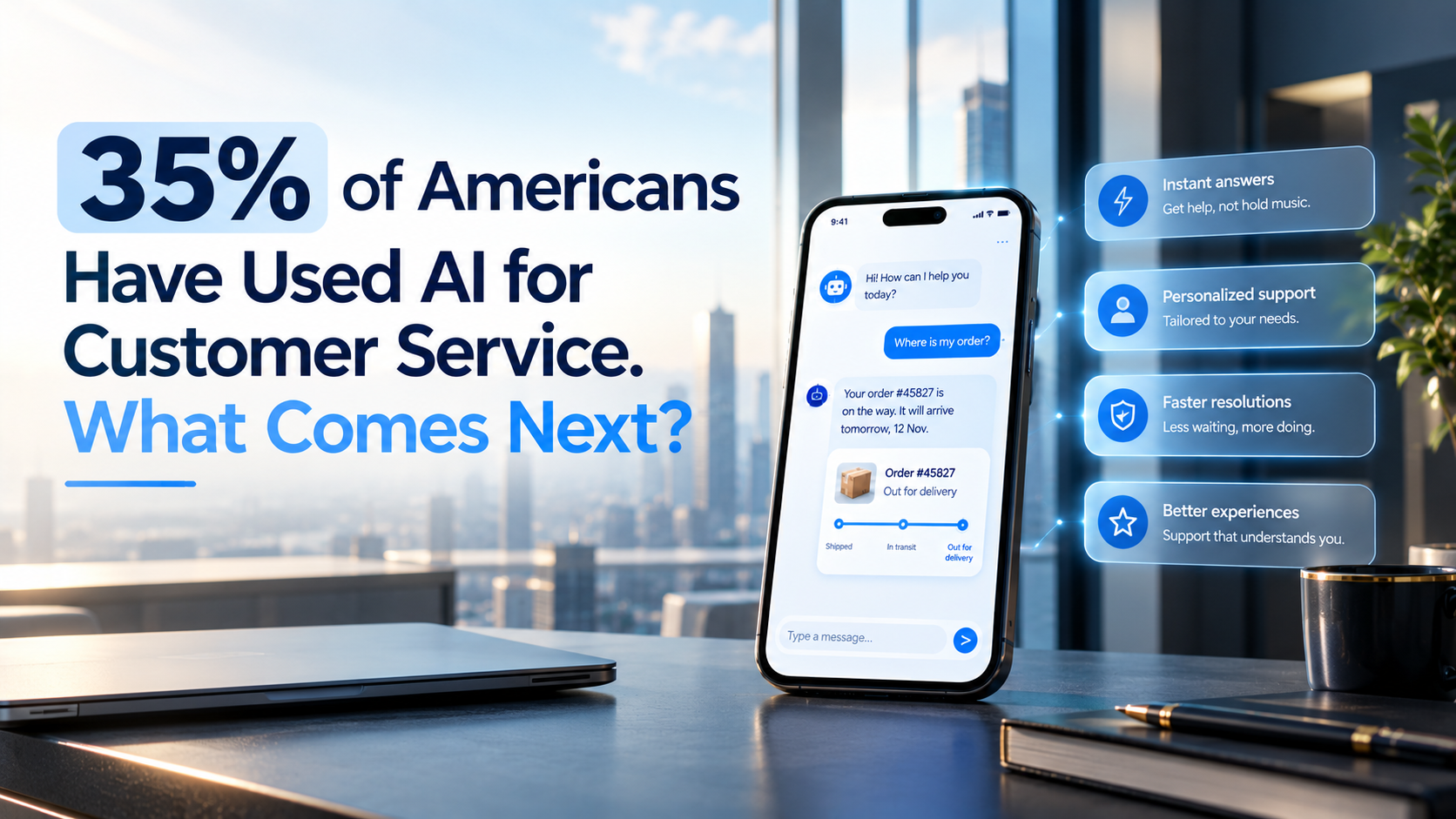
35% of surveyed Americans have used AI agents for customer service. Discover how AI chatbots are evolving into action-oriented agents that resolve customer issues, build trust, and deliver measurable business outcomes.
One in three Americans has used an AI agent for a customer service request. The bigger shift is what happens next: customers expect problems to be solved, not just explained.
A customer wants a refund. Your chatbot shares the refund policy. The customer checks it against information from ChatGPT. Your support representative gives a different answer. Now the customer is asking for proof, quoting your own policy back to you, and expecting an immediate resolution.
Nobody has resolved the refund. But AI has changed the conversation. This is the customer service challenge businesses are walking into in 2026. Customers are not just asking AI for answers anymore. They are using it to research policies, question decisions, and increasingly handle service requests.
Meanwhile, many businesses are still measuring their AI chatbot success by how quickly it replies. That gap matters. Because the next stage of customer service will not be won by the business with the most conversations automated. It will be won by the business that resolves customer problems accurately, with less effort.
How Is AI Changing What Customers Expect From Customer Service?
A survey of 1,000 US consumers published on October 27, 2026, found that 35% had used an AI agent to handle a customer service request. Among Gen Z and Millennial respondents, the figure rose to 49%.
[Source: Capacity, Agentic Consumer Report 2026, October 27, 2026]
The wider picture is even more telling. 55% of surveyed consumers used an AI tool to help with customer service requests. That might mean researching a return policy, preparing questions about a bill, or checking whether a company's response is correct.
[Source: Capacity, Agentic Consumer Report 2026, October 27, 2026]
Think about what this means for a business. A customer can arrive at a support conversation having already researched the policy, compared possible answers, and prepared a list of questions. A vague response or an outdated policy is more likely to be challenged. AI is changing the customer to the other side of the conversation, too. And businesses need to adapt.
Why Are Customers Losing Trust When AI Gives the Wrong Answer?
The most interesting finding in the Capacity report is not just how many people are using AI. It is how that use changes their expectations.
44% of surveyed consumers said AI had contradicted a company representative or company policy.
[Source: Capacity, Agentic Consumer Report 2026, October 27, 2026]
That does not mean the AI was right. AI can misunderstand policies, use outdated information, or produce an incorrect answer. But it does mean businesses can no longer assume customers will accept the first response they receive.
Consider a simple example. A customer asks whether a purchase qualifies for a refund. The company chatbot says no. The customer's AI assistant suggests that the published policy allows it. The customer returns to support and asks the company to explain the discrepancy.
The business now has two problems: the original refund request and a trust issue. This is why deploying an AI chatbot without fixing the knowledge behind it can backfire. If your website, support team, internal documents, and AI systems provide inconsistent answers, faster automation can spread the confusion faster.
The solution is not to prevent customers from using AI. It is to make your own customer experience more accurate, transparent, and useful.
What Is the Difference Between an AI Chatbot and an AI Agent?
For years, businesses have used chatbots to answer frequently asked questions, guide visitors, and reduce repetitive support for work. These remain valuable uses of AI. But answering a question is only one part of solving a problem.
When a customer asks, "Where is my order?", a useful answer provides the status. A more complete experience retrieves the order, checks the latest shipment information, explains any delay, and offers an appropriate next step.
When a customer asks to reschedule an appointment, the goal is not to explain the booking process. It is to help them find a suitable time and complete the change.
This is where AI agents for customer service become important. An AI agent can understand the customer's goal, retrieve information from connected systems, determine the next permitted step, and execute actions within defined rules.
Customer need | Basic AI chatbot | Action-oriented AI agent
Check an order | Explains how to track it | Retrieves the current order status
Reschedule an appointment | Shares booking instructions | Checks availability and completes an approved change
Request a refund | Explains the refund policy | Checks eligibility and initiates an allowed workflow
Update account information | Provides instructions | Verifies the request and updates permitted fields
Resolve a complex issue | Repeats standard answers | Collects context and transfers the case to the right person
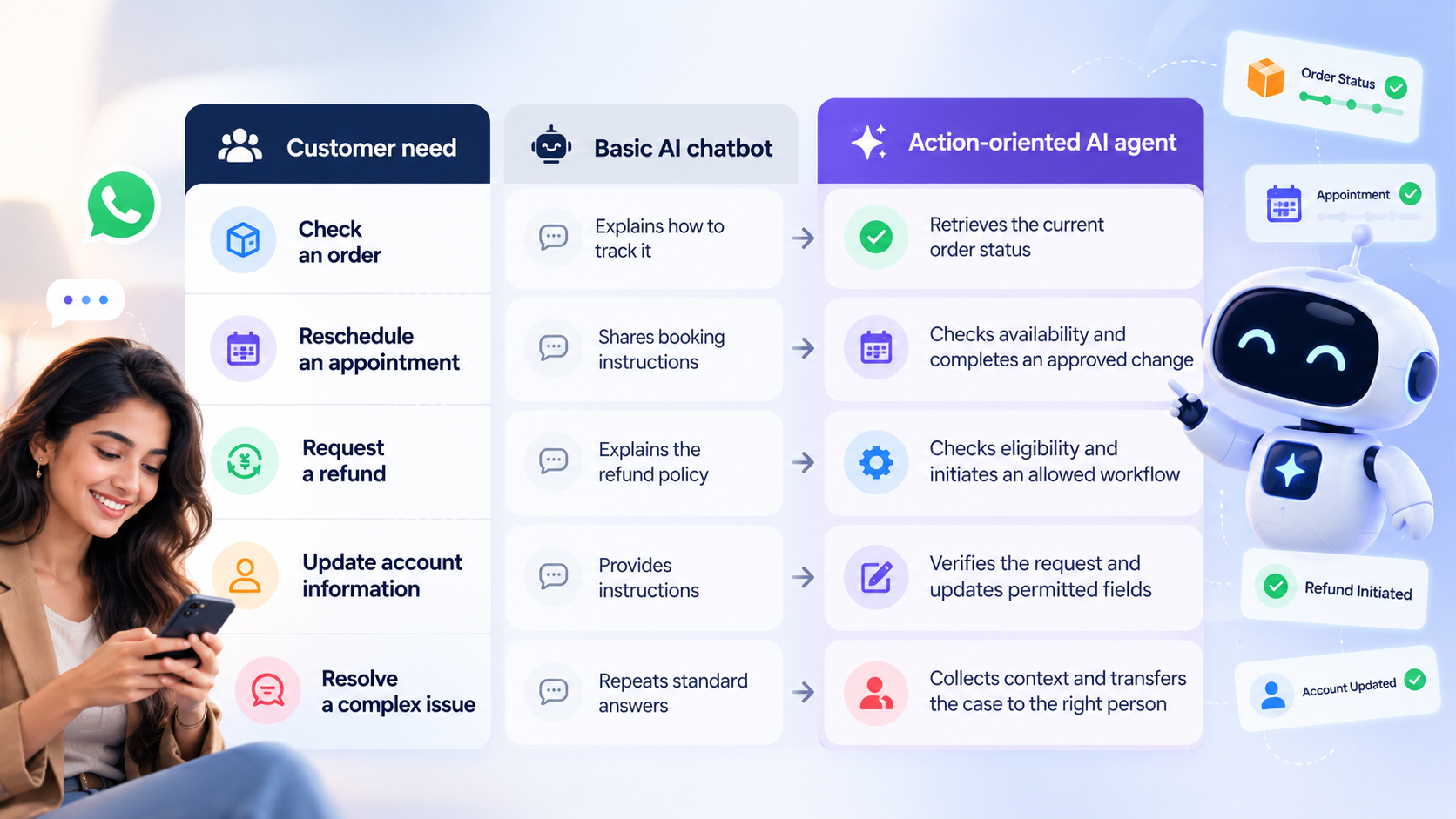
These capabilities depend on system integrations, reliable data, and the permissions the business grants the agent. An AI agent should never claim to have completed an action if the underlying system has not confirmed it. That distinction separates useful automation from a convincing demonstration.
What Is Agentic AI, and How Does It Help Resolve Customer Issues?
Agentic AI refers to AI systems that can work toward a goal by understanding context, selecting appropriate steps, and using available tools to carry out tasks within defined limits.
A traditional AI chatbot is often designed around the question: "What should I say?"
An agentic AI system also considers: "What needs to happen next, and am I allowed to do it?"
That shift changes how businesses should design automation. Instead of building a separate bot for every question, teams can start with the customer outcome they want to deliver. They can then connect the required knowledge, business rules, and systems to support that outcome.
For example, an e-commerce business might want to resolve eligible delivery issues without requiring customers to contact support twice. A financial services company might want to answer routine account questions while escalating sensitive transactions. A real estate business might want to qualify for enquiries, schedule site visits, and pass relevant customer details to sales.
The workflow differs by industry, but the principle stays the same: use AI to remove unnecessary steps while preserving control over important decisions. This is the practical value of agentic AI. It connects understanding with execution.
Do Customers Want AI to Act Without Human Approval?
There is a mistake businesses could make at this point: assuming that because customers are using AI, they want AI to make every decision for them. The evidence does not support that assumption.
Gartner's 2026 survey of 3,566 B2B and B2C customers found that 50% said interactions were easier when companies used generative AI. Yet 87% said it was essential to have an option to reach a human agent when companies use generative AI for customer service.
[Source: Gartner, Customer Service and Support Survey, August 4, 2026]
That is the balance businesses need to get right. Customers may be happy for AI to check a delivery, answer a product question, or arrange a routine appointment. They may feel differently when it comes to a disputed charge, a sensitive account change, or a decision that could have serious consequences.
A good AI agent needs clear boundaries.
Automate routine actions: Handle repetitive tasks that follow clear, approved rules.
Ask for confirmation when needed: Make the action and its consequences clear before proceeding.
Escalate when the risk is high: Transfer sensitive, unusual, or uncertain cases to a human.
Keep the customer informed: Explain what was completed, what remains pending, and what happens next.
The objective is not maximum autonomy. It is the right amount of autonomy for the task.
What Should Businesses Fix Before Giving AI More Control?
Before investing in more advanced AI automation, business leaders should address three fundamentals.
1. Give AI access to reliable, current information
An AI system is only as useful as the information it can access. Outdated return policies, incomplete product records, and inconsistent support documents can lead to wrong answers and poor decisions. Create a trusted source of information, assign ownership for updates, and make sure the AI uses the correct policy for the customer's situation.
2. Connect AI to the systems where work actually happens
If an AI chatbot cannot access order records, appointment availability, CRM data, or the relevant workflow, it may be able to explain the next step but not complete it. Choose integrations based on the customer outcome you want to deliver. Start with one workflow and verify that every action works as expected before expanding.
3. Measure resolutions, not replies
A high number of chatbot conversations does not automatically mean better service. Track the percentage of requests resolved successfully, time to resolution, repeat contacts, escalation rates, customer satisfaction, and cost per resolved issue. If customers still have to call support after using the chatbot, the automation may be reducing the workload of one team while creating extra work for another. The metric that matters are whether the customer resolves the problem.
How Many Consumers Are Ready to Let AI Act on Their Behalf?
This shift is not limited to customer service. Menlo Ventures' 2026 consumer AI research found that 32% of US AI users had allowed AI to take action on their behalf at least once without final approval.
[Source: Menlo Ventures, 2026 Consumer AI Research, September 16, 2026]
This is an important signal, but it needs context. It does not mean that a third of all Americans have handed over control of their finances or accounts. The finding applies to AI users and covers actions across different activities. Still, it points to a broader change in how people are experimenting with AI: some are beginning to delegate tasks rather than using AI only for advice.
For businesses, that raises a practical question. If customers are becoming comfortable delegating suitable tasks to AI, why should every routine service request still require several manual steps?
The answer is not to automate every interaction. It is to identify where delegation makes sense, establish clear permissions, and make the result easy to verify.
How to Start Building AI That Actually Gets Things Done
Businesses do not need to replace their entire customer service operation to benefit AI agents. Start with one repetitive workflow that has clear rules and reliable data. Order tracking, appointment scheduling, lead qualification, and routine status enquiries are potential starting points.
Then follow a simple process:
Choose one customer problem. Identify a task that creates repeated effort for customers and employees.
Map the current process. Document the information required, decisions involved, systems used, and common exceptions.
Set action boundaries. Decide what the AI can do independently, what needs confirmation, and what must go to a human.
Test real scenarios. Include incomplete information, conflicting data, failed integrations, and requests outside the approved rules.
Measure the outcome. Compare resolution rates, time, errors, repeat contacts, and customer feedback before and after launch.
Expand only when the results justify it. Use evidence from the first workflow to decide what should be automated next.
This approach makes AI adoption a business improvement exercise, not just a technology project.
Conclusion: What Will Give Businesses a Competitive Advantage in AI Customer Service?
The customer who asks a question and receives a useful answer is still important. But the customer who gets a problem resolved without repeating information, waiting for multiple teams, or chasing an update is experiencing something better.
That is the opportunity behind the shift from AI chatbots to agentic AI. The technology needs to understand the request, access the right information, act within clear boundaries, and recognize when a human should take over. Businesses need to measure whether those capabilities improve the experience, not just whether they increase automation.
For business leaders, the question is no longer simple: "Where can we add an AI chatbot?"
It is: "Which customer problems can we resolve safely, accurately, and with less effort?"
Start there. Give AI the tools and authority to complete the right tasks. Keep humans involved where judgment matters. And measure success by what the customer no longer must do. Because the future of customer service is not AI, that talks more. It is AI that helps get the job done.
Frequently asked questions
A Capacity survey of 1,000 US consumers published on October 27, 2026, found that 35% had used an AI agent for a customer service request. Among Gen Z and Millennial respondents, the figure was 49%.