The Human Side of Agentic AI: How Smarter Technology Creates Better Conversations
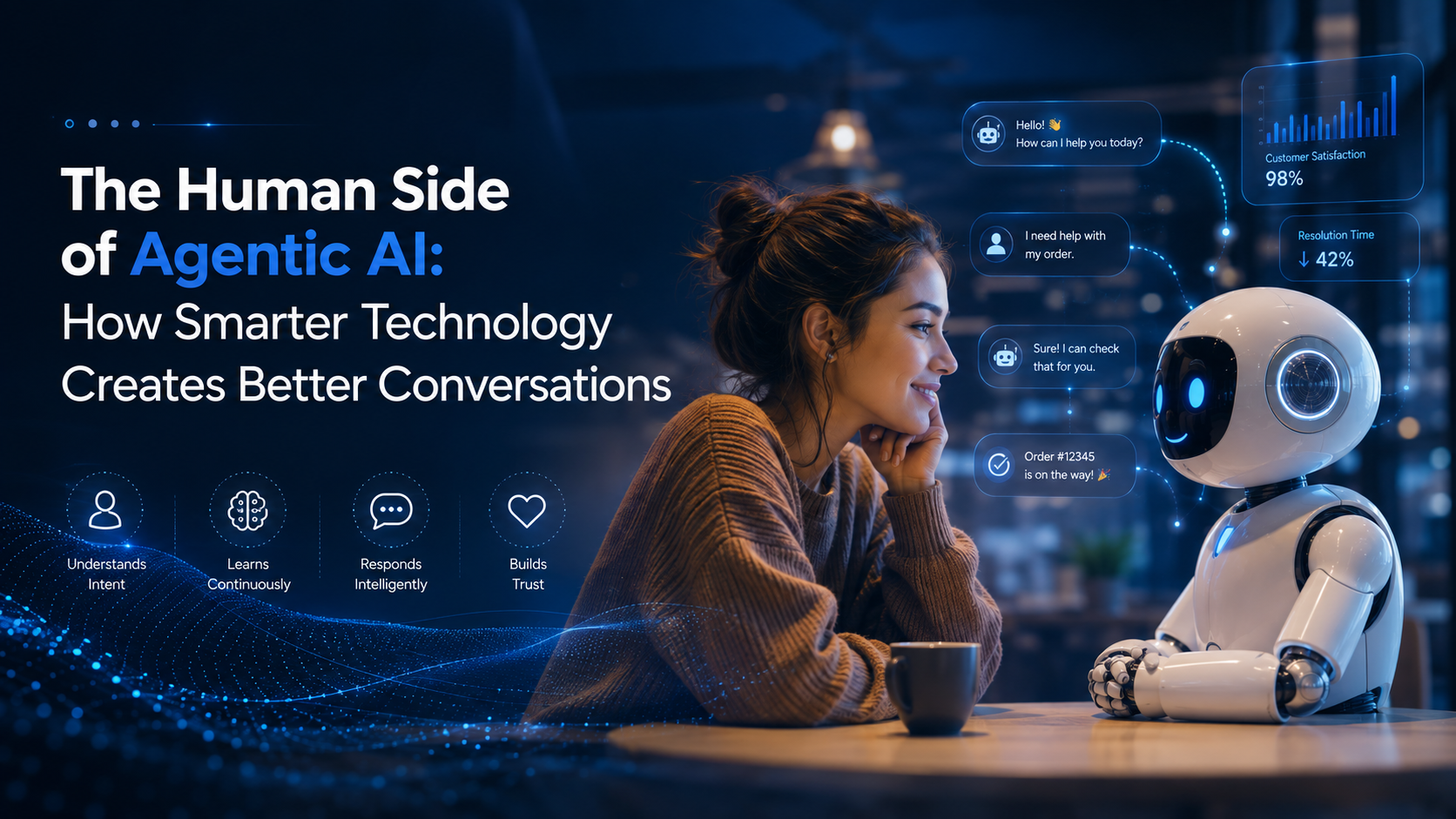
What happens when AI goes beyond understanding words and starts understanding intent, context, and human behavior? Discover how Agentic AI is transforming customer conversations by combining intelligence, reasoning, and action to create more personalized and meaningful experiences.
A customer types:
“I’ve already submitted my documents twice. Why is my application still pending?”
A basic chatbot searches for an answer.
A smarter system understands the context, recognizes frustration, checks the customer’s history, determines what action is possible, and knows when a human needs to step in.
That is the shift happening in enterprise AI. Agentic AI is moving customer conversations from answering questions to understanding intent, reasoning through problems, and taking action. And the most important technology behind that shift may not be AI alone. It is the ability to understand human behavior.
What Is Agentic AI?
Agentic AI refers to AI systems that can pursue a goal by reasoning through multiple steps, using tools or enterprise systems, taking permitted actions, and adapting based on the outcome.
Unlike traditional chatbots that primarily respond to predefined questions, Agentic AI can connect conversation with execution.
That distinction matters as enterprises move AI from experimentation into production.
A May 2026 industry study of 12 companies found that many organizations were still struggling to move from AI assistants toward more advanced agentic workflows. The research identified verification, confidentiality, non-deterministic outputs, and integration challenges as major barriers. In other words, the hard part is no longer simply making AI intelligent. It is making AI useful, controllable, and trustworthy.
Human Behavior Is the Context AI Needs
Customers do not communicate like databases. They hesitate. They change their minds. They become frustrated. They leave information incomplete. Their intent can change halfway through a conversation. This is where Conversational AI becomes more than a digital FAQ.
Modern Conversational AI can combine language, intent, sentiment, conversation history, customer information, and business context to determine what a customer is actually trying to accomplish.
For example, “Can you check my order?” is straightforward. But “Where is my order? I needed it yesterday” contains additional signals: urgency, dissatisfaction, and a potentially higher-risk Customer Experience moment. The best systems respond to the complete context, not just the sentence.
From Conversation to Action
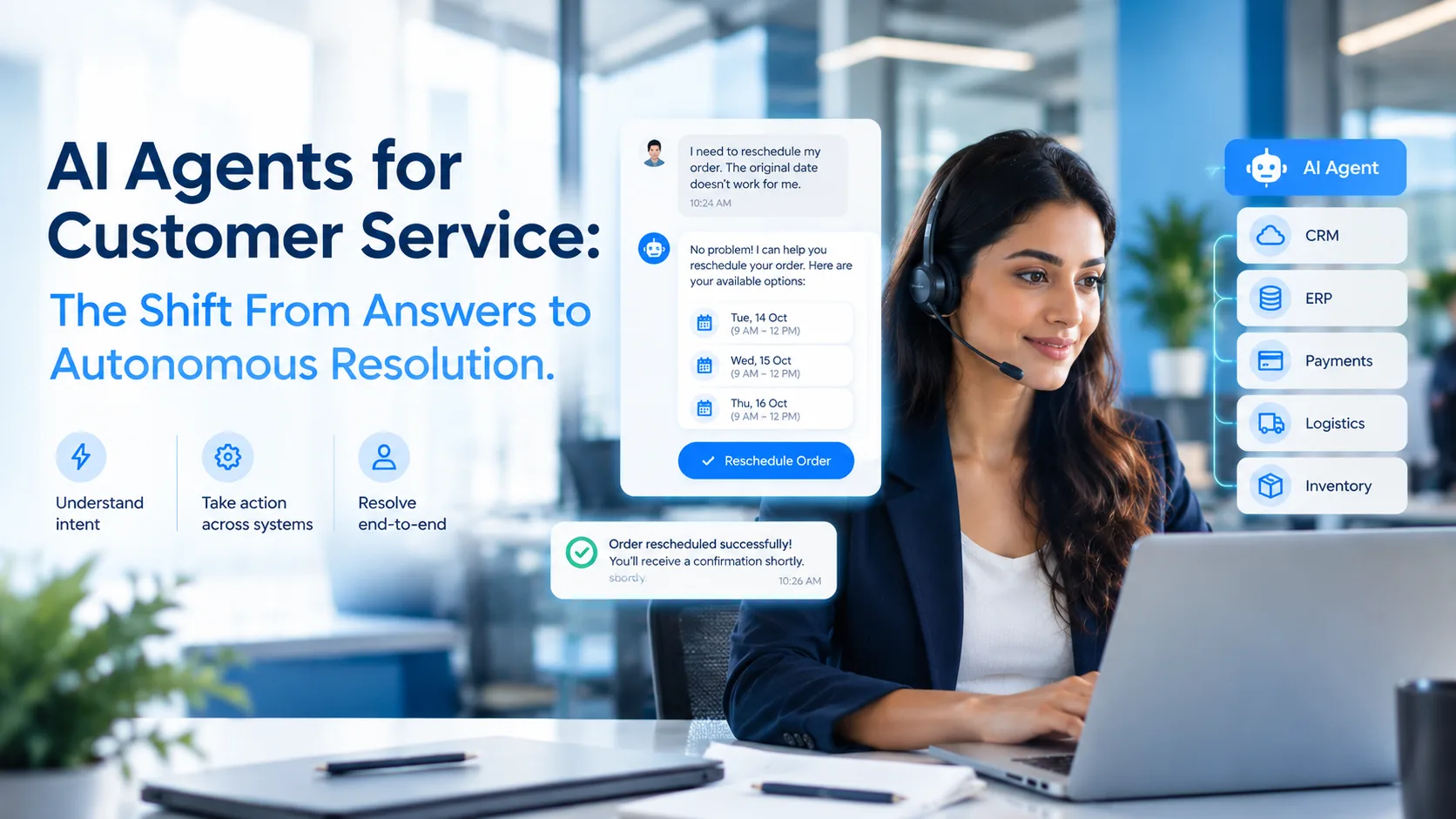
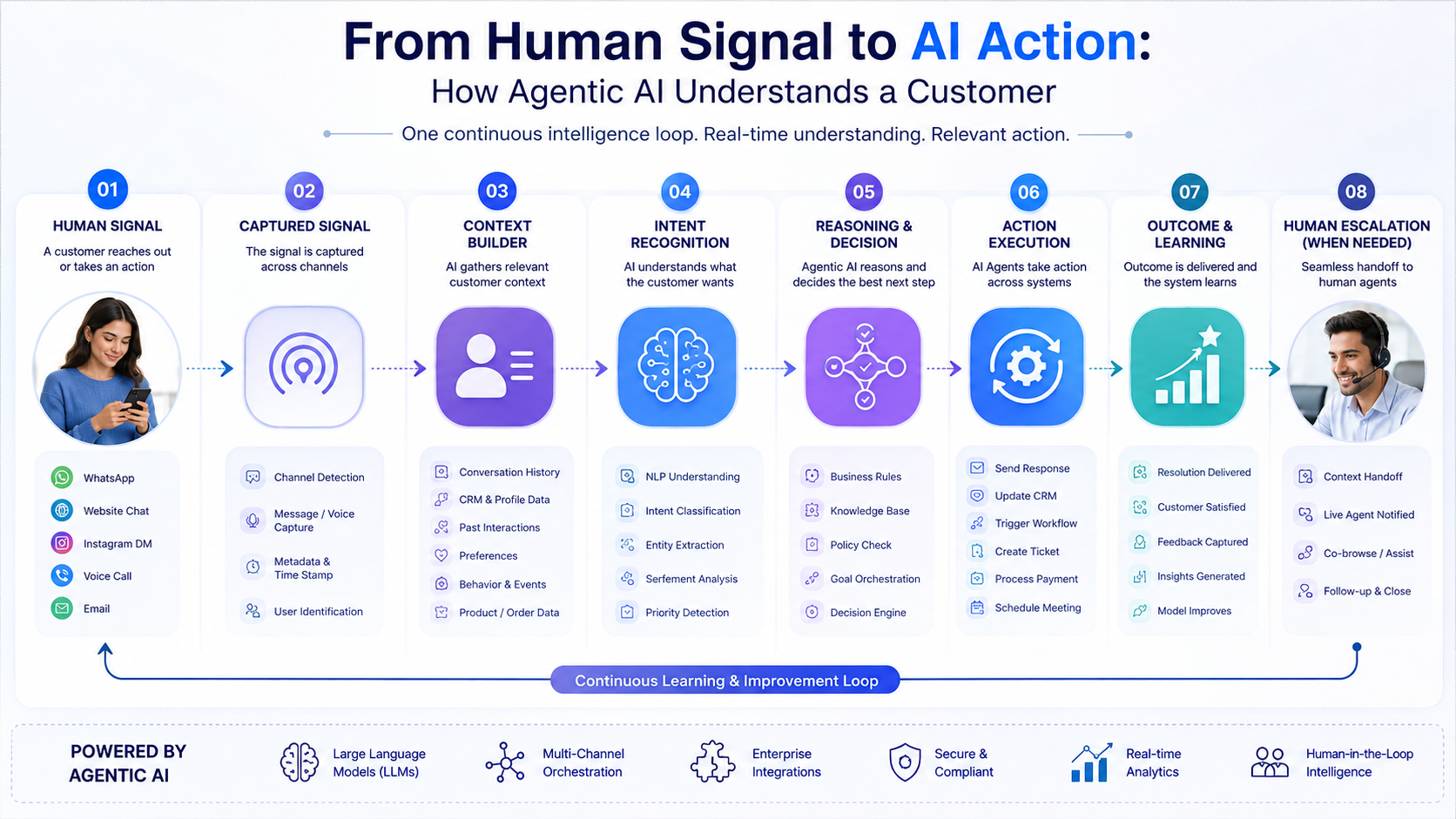
This is where Agentic AI creates its biggest advantage. An AI agent can understand a request, identify the objective, break the task into steps, retrieve information, use approved tools, execute an action, and confirm the result.
Recent research from LinkedIn demonstrates what this can look like in production. Its self-evolving customer-support system improved QA self-service by 9 percentage points and routing accuracy by 30.6 percentage points in a two-week randomized production test.
Research from Nubank similarly reported a 37 percentage-point improvement in transactional NPS and a 29 percentage-point improvement in self-service rate in one production customer-support deployment. The lesson is important: AI value comes from connecting intelligence to measurable outcomes.
The Human Side of AI Still Matters
More automation does not mean less human involvement. It means humans should spend less time handling predictable requests and more time handling judgment, empathy, exceptions, and complex decisions. This is already becoming an enterprise priority. HubSpot's 2026 customer communication research reported that 85% of customer-service leaders were actively exploring customer-facing AI solutions.
Meanwhile, Deloitte research reported that only 21% of surveyed organizations had strong guardrails for AI agents, highlighting the growing gap between adoption and governance. That gap matters. A trustworthy Customer Experience strategy needs permissions, escalation rules, monitoring, evaluation, data controls, and clear boundaries around what an AI agent can do.
The Real Future of Customer Experience
The next generation of Customer Experience will not be defined by AI that simply talks better.
It will be defined by AI that understands better. Conversational AI becomes the interface. Agentic AI becomes the decision and action layer. Human experts provide judgment where automation should stop.
That model is already emerging beyond customer service. Reuters reported in August 2026 that AI shopping assistants were increasingly capable of recommending products, selecting merchants, and initiating payments, raising a new strategic question for businesses: how do brands preserve direct customer relationships when AI becomes part of the buying journey?
The answer is not more automation for its own sake. It is better context, responsible action, and experiences that actually solve customer problems. The future of customer engagement is not human-like AI. It is human-centered AI that knows what to do next.
The Technology Behind AI That Understands Human Behavior
The smartest AI conversations do not begin with a better answer. They begin with better understanding. Human behavior is messy. Customers change their minds, use incomplete sentences, express frustration indirectly, switch languages, refer to previous conversations, and expect brands to remember context. For enterprises, understanding those signals requires more than a large language model. It requires multiple layers of AI working together.
Three technologies form the foundation: Machine Learning, Natural Language Processing, and Large Language Models. Together, they help AI move from recognizing words to understanding intent, context, and patterns.
Machine Learning: Turning Customer Signals Into Intelligence
Machine Learning (ML) helps AI identify patterns across large volumes of customer interactions. Instead of relying only on predefined rules, ML models can learn statistical relationships from historical data and use those patterns to support predictions, classification, personalization, and recommendations. In customer engagement, these signals can include:
What customers frequently ask
Which interactions lead to conversion
Where customers abandon a journey
Which issues require human escalation
How preferences change across interactions
However, there is an important distinction between learning from data and continuously retraining a production AI model. Enterprise systems can use conversation history, customer profiles, retrieval systems, feedback signals, and analytics to personalize an interaction without changing the underlying model after every conversation.
This distinction matters because AI personalization is only as useful as the data behind it.
Salesforce's 2026 State of Marketing research found that 81% of Indian marketers have adopted AI, while 86% say they would trust AI to respond to customers. Yet fragmented or irrelevant customer data remains a major barrier to scaling AI-driven engagement. The message for enterprises is clear: smarter AI needs connected customer data.
Natural Language Processing: Understanding What Customers Mean
Natural Language Processing (NLP) gives AI the ability to process human language beyond simple keyword matching. NLP helps systems identify intent, entities, sentiment, language patterns, and conversational context. It allows an AI system to distinguish between:
“I want to cancel my order.”
and
“I think I need to cancel my order because it still hasn't arrived.”
The words are similar. The underlying intent and urgency are different.
This capability is becoming increasingly important in India, where customer expectations are moving toward faster, more contextual service. ServiceNow's 2026 Customer Experience research found that 48% of Indian customers say service interactions lack empathy, while 45% report being transferred between multiple people or departments.
That is not simply a language problem. It is a context problem. Effective Conversational AI needs to understand what the customer said, what happened previously, what the customer is trying to accomplish, and what should happen next.
Large Language Models: Moving From Words to Context
Large Language Models (LLMs) changed conversational AI by making it possible to process and generate language with far greater flexibility and contextual awareness. LLMs can summarize conversations, interpret complex requests, generate responses, translate languages, extract information, and adapt communication to different contexts. But an LLM alone is not an enterprise AI agent.
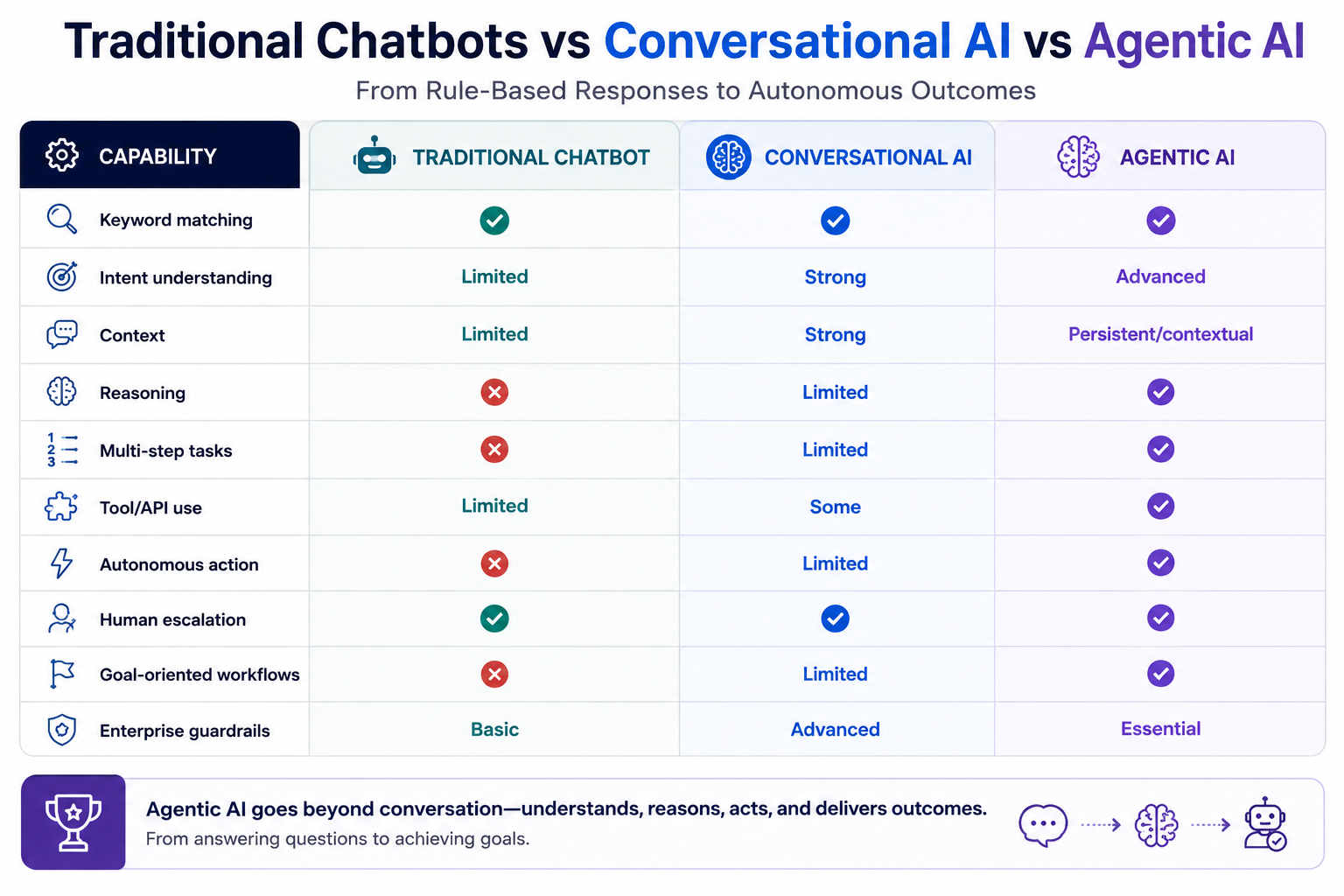
The distinction is critical. An LLM primarily provides language intelligence. Agentic AI adds reasoning, tools, memory, workflows, permissions, and actions around that intelligence. This is why the enterprise AI stack is evolving from:
Data → ML → NLP → LLM
toward:
Data → Context → LLM → Reasoning → Tools → Agent → Action → Human Oversight
McKinsey's latest global AI research shows that 62% of organizations are already experimenting with AI Agents, but only 23% report scaling an agentic AI system somewhere in the enterprise. The gap reveals an important truth: building an intelligent model is only one part of the challenge. Connecting that intelligence to reliable enterprise data, workflows, permissions, and measurable outcomes is what turns AI into business value.
Why These Technologies Matter for Human-Centered AI
The goal is not to make machines behave like humans. The goal is to make technology understand people better. Machine Learning identifies behavioral patterns. NLP interprets language and intent. LLMs provide contextual language intelligence. Agentic AI connects that intelligence to reasoning and action.
Together, these technologies can create a Customer Experience that feels less scripted and more relevant. And the opportunity is significant. IBM's research found that executives expect AI-powered personalized self-service to increase by 53% by 2027, alongside a projected 47% improvement in self-service call resolution.The next generation of customer engagement will therefore not be defined by how human an AI sounds. It will be defined by how well it understands the human behind the conversation.
Key Takeaways
Agentic AI connects customer intent with multi-step action.
Conversational AI helps AI understand language, context, and intent.
Customer Experience improves when AI resolves problems instead of simply deflecting questions.
Enterprise AI needs governance, evaluation, human escalation, and measurable outcomes.
The competitive advantage will come from connecting AI to real business workflows.
Frequently asked questions
A traditional chatbot primarily responds to predefined requests. Agentic AI can pursue a goal, reason through multiple steps, use approved tools, and take actions within defined boundaries.