RCS Business Messaging in 2026: The Message Is No Longer Just a Message
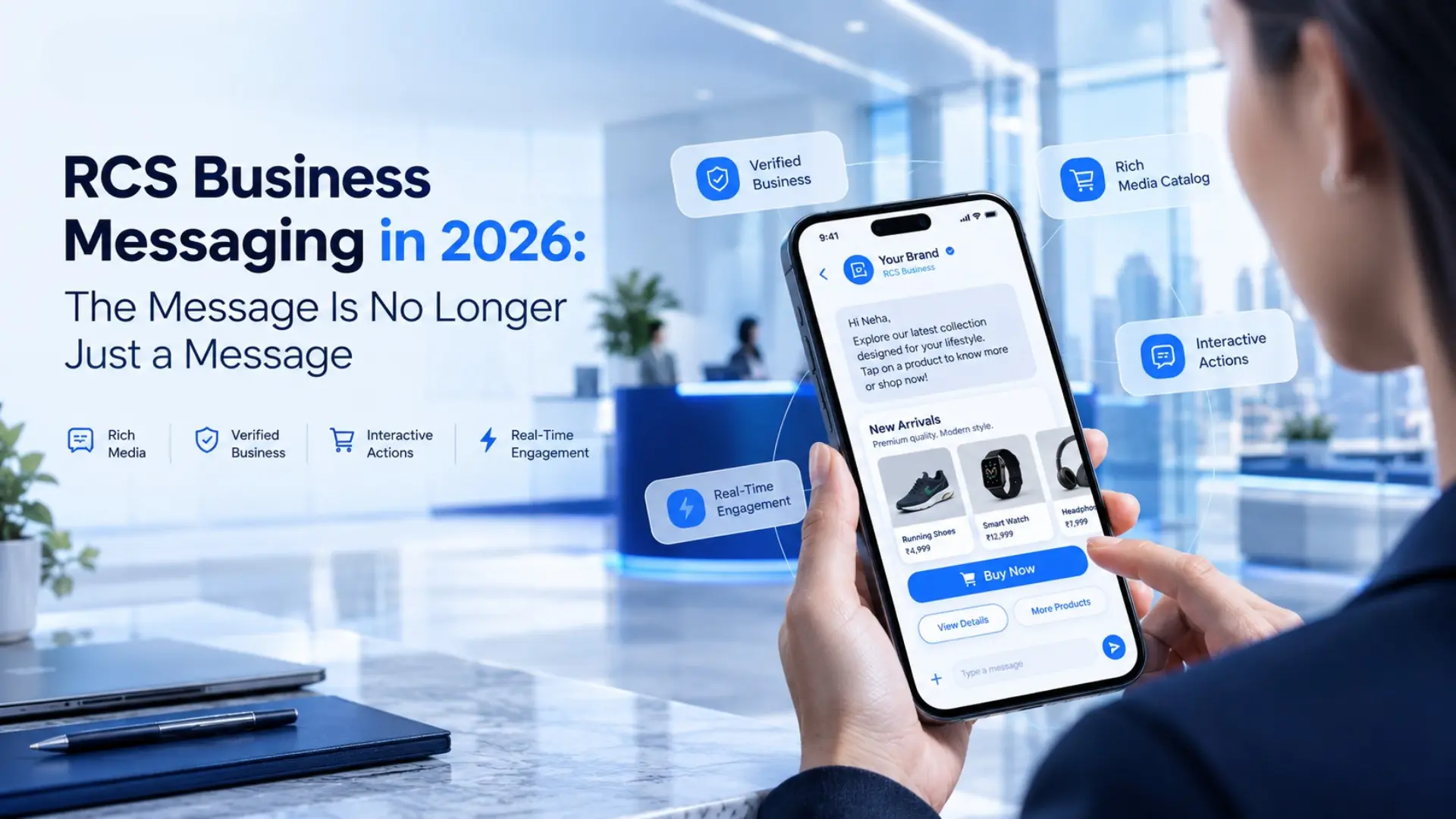
RCS Business Messaging is evolving beyond traditional SMS. Discover how rich media, interactive features, verified business identities and smarter customer journeys are reshaping business messaging in 2026.
What if your next customer message could answer a question, showcase a product, qualify a lead, and trigger the next action without sending the customer somewhere else?
For years, SMS has been one of the most dependable ways for enterprises to reach customers. But dependability is not the same as interactivity. A traditional text can notify a customer about a payment, an appointment, a delivery, or a promotion. To act on it, the customer has to click a link, open an app, visit a website, or call someone.
RCS Business Messaging changes that experience. Instead of treating the message as the end of a campaign, RCS makes the message part of the customer journey. And the market is moving. According to Infobip's 2026 Messaging Trends Report, based on its analysis of 628 billion messages in 2025, RCS interactions in India grew 70% and the RCS user base reached 550 million. Marketing and advertising recorded a 2,907% increase in RCS activity in Infobip's India data, with retail and ecommerce, finance and fintech, and real estate also identified as major adoption sectors. These figures reflect Infobip's platform data, not the entire Indian messaging market.
The bigger question is no longer whether RCS can deliver a richer message. It is what enterprises can make that message do.
What Is RCS Business Messaging?
RCS Business Messaging, also known as RBM, is the business-focused implementation of Rich Communication Services. Google now markets it as RCS for Business. It upgrades conventional text messaging with interactive, branded experiences.
Instead of receiving:
"Your order #4582 has shipped. Track here: [link]"
a customer can receive a branded conversation containing:
Order details → Product image → Tracking action → Support option → Suggested reply
Google's business messaging experience supports verified business identities, rich media, suggested replies, suggested actions, cards, carousels, product catalogues, and other interactive formats. Availability of specific capabilities can vary by market, device, and carrier. That distinction matters. SMS delivers information. RCS can turn information into interaction.
Why RCS Is Becoming Important for Enterprise Messaging
The strongest argument for RCS is not that it replaces every other channel. It is that it combines strengths enterprises already want in one place:
Mobile reach + branded identity + rich media + interactive actions + conversational capability
The GSMA says its RCS Universal Profile delivers a consistent messaging experience for 6.7 billion consumers worldwide. It supports chat, file transfer, location sharing, rich business messaging, privacy controls, and spam protection. The underlying technology is still evolving. In July 2026, the GSMA published RCS Universal Profile 4.1, with improvements to transport efficiency, profile sharing, privacy controls, and end-to-end encryption interoperability. For enterprises, this signals that RCS is no longer simply a richer version of SMS. It is becoming part of a broader business messaging ecosystem.
RCS vs SMS: The Difference Is the Experience
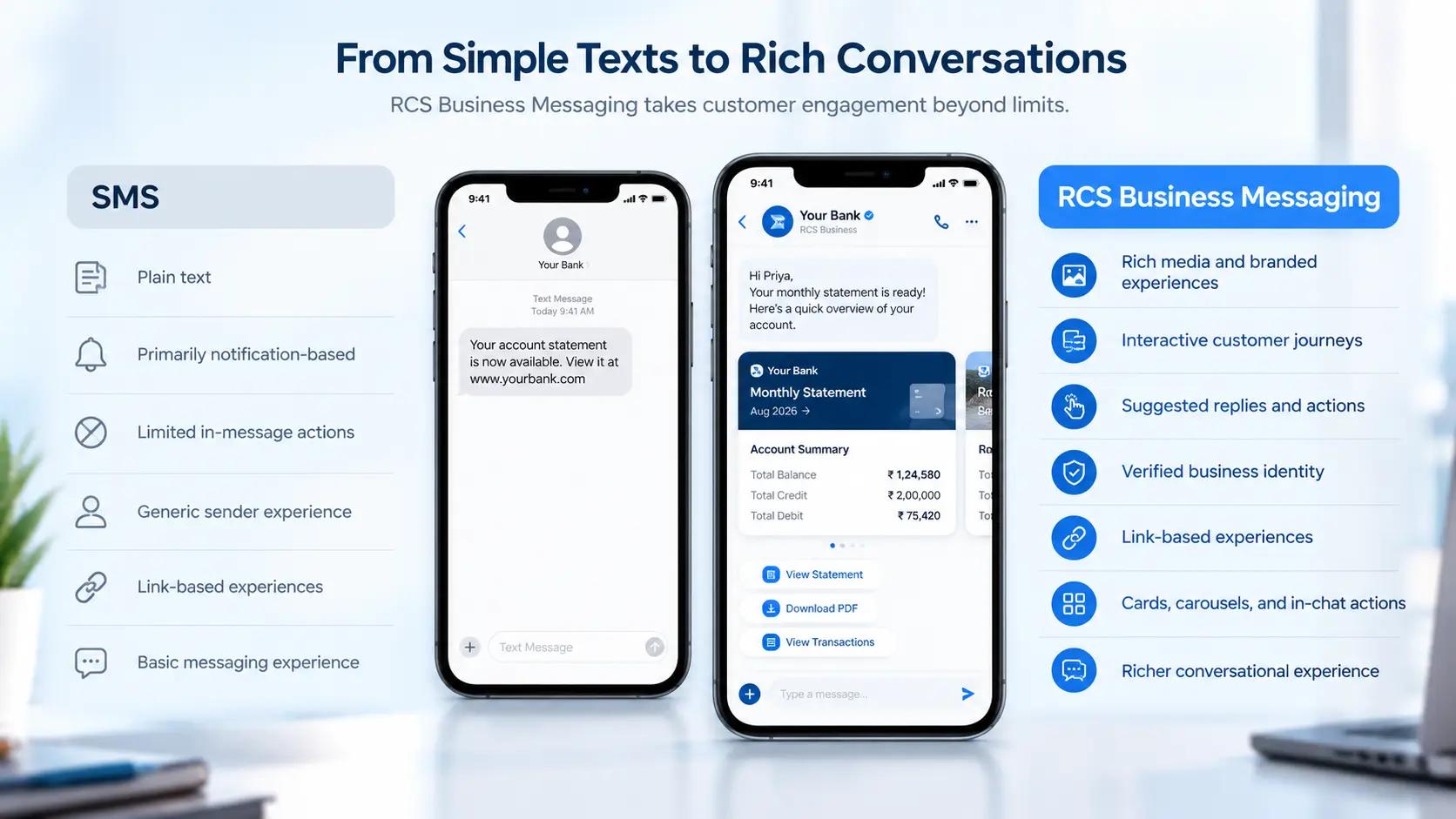
The easiest way to understand RCS is to compare what the customer can actually do.
SMS | RCS Business Messaging |
|---|---|
Plain text | Rich media and branded experiences |
Primarily notification-based | Interactive customer journeys |
Limited in-message actions | Suggested replies and actions |
Generic sender experience | Verified business identity |
Link-based experiences | Cards, carousels, and in-chat actions |
Basic messaging experience | Richer conversational experience |
Google's documentation highlights business verification, branded sender information, rich media, suggested actions, suggested replies, cards, and carousels as core parts of RCS business conversations. So the real comparison is not SMS vs RCS. It is message delivery vs customer interaction.
5 RCS Use Cases That Can Drive Real Business Value
1. RCS for Lead Generation
Imagine a prospect searching for a product and being able to start a conversation with the brand directly.
Instead of:
Ad → Landing Page → Form → CRM → Salesperson
the journey can become:
Ad → RCS conversation → Qualification → Sales action
In 2026, Google introduced Message Ads with RCS for Business, which move people from a Search ad into a verified text thread where leads can be qualified instantly. For enterprises, this is an opportunity to connect RCS messaging with conversational AI and sales automation, instead of treating messaging and advertising as separate systems.
2. RCS for Ecommerce
A promotional SMS might say:
"20% off selected products. Shop now."
An RCS experience can make the product itself part of the message:
Product image → Product information → CTA → Catalogue → Customer conversation
Google supports product catalogues, rich cards, and carousels within business messaging. This shortens the distance between customer interest and customer action.
3. RCS for BFSI
Financial services depend on trusted, timely communication. RCS can support use cases such as:
Payment reminders
Transaction updates
Service notifications
Customer support
Account-related communication
Fraud and security communication
Product discovery
Verified business identity is especially relevant here. Customers see a business name, logo, and verification badge instead of an unfamiliar phone number. However, enterprises should distinguish identity verification from end-to-end encryption. Google states that verified RCS business conversations are not end-to-end encrypted; messages are encrypted in transit, and the businesses, providers, and carriers operating the conversation may access message content for delivery. That distinction matters when evaluating RCS for regulated industries.
4. RCS for Real Estate
Real estate businesses often lose prospects between enquiry and sales follow-up. RCS can help compress that journey. A property campaign could present:
Property image → Configuration → Location → Price information → View details → Schedule visit → Talk to sales
The customer does not have to interpret a generic promotional message. The conversation guides the next action.
5. RCS for Customer Support
The biggest opportunity may not be promotional messaging at all. It may be the service journey.
Consider:
Delivery update → Track order → Report issue → Select problem → AI agent → Resolution
Google's business messaging experience supports suggested actions such as tracking an order or contacting a business, alongside interactive content. When RCS connects to an AI agent and enterprise systems, the message becomes the entry point to an automated resolution workflow.
RCS + AI: Where the Opportunity Gets Bigger
RCS provides the interaction layer. Agentic AI provides the intelligence layer. Enterprise systems provide the context and the ability to act. Put them together and the architecture becomes:
Customer → RCS → AI Agent → Context → Enterprise System → Action → Outcome
For example, a customer receives an RCS message about an upcoming payment and taps "Need Help." The AI agent understands the intent, retrieves the relevant customer context, answers the question, offers an approved option, and escalates to a human if needed.
The customer does not simply receive another message. The customer enters a journey. That is where RCS becomes particularly interesting for an Enterprise Agentic AI Platform.
India's RCS Market Is Moving Fast
India deserves particular attention. Infobip's 2026 India report found that RCS interactions grew 70%, with the RCS user base reaching 550 million in its dataset. Marketing and advertising saw a 2,907% increase in RCS activity on Infobip's platform.
The momentum has continued into 2026. In August 2026, Infobip reported 108% growth in RCS interactions in India between H1 2025 and H1 2026, with finance and fintech contributing more than three-quarters of its India RCS traffic.
These numbers do not mean every Indian business will see the same growth. They point to something more useful: enterprise messaging behaviour is changing.
The industries adopting RCS are those where rich, trusted, interactive communication can influence the customer journey:
Finance and fintech | Retail and ecommerce | Marketing | Real estate
For Indian enterprises, RCS is becoming an increasingly relevant part of an omnichannel customer engagement strategy.
Trust Is Becoming Part of the RCS Experience
Richer messaging creates another requirement: customers need to know who they are talking to. Google's business messaging experience uses verified business identities, so users see the business name, logo, and a verification check mark instead of a phone number.
At the ecosystem level, security is also evolving. On May 11, 2026, Apple and Google began rolling out end-to-end encrypted RCS messaging in beta for conversations between iPhone and Android users, with encryption enabled automatically over time for eligible chats. The GSMA's RCS Universal Profile 4.1 further refined the technical foundations for end-to-end encryption interoperability.
One caveat matters for enterprises: these encryption advances apply to person-to-person chats. Business RCS conversations remain encrypted in transit but not end to end. Security should therefore be evaluated based on the specific RCS implementation, provider, carrier, device, and use case.
What Should Enterprises Measure?
Sending millions of RCS messages is not a business outcome. The better question is: what happened after the customer received the message?
Enterprises should evaluate RCS against metrics such as:
Area | Metrics |
|---|---|
Engagement | Message interaction rate, CTA engagement, conversation initiation |
Sales | Lead qualification rate, appointment bookings, conversion rate, revenue influenced |
Customer Service | Resolution rate, first-contact resolution, escalation rate, customer satisfaction |
Operations | Workflow completion, response time, manual intervention, cost per interaction |
This is where RCS becomes more than a messaging investment. It becomes a measurable customer journey layer.
Where Chat360 Fits
RCS works best when it does not operate in isolation. Chat360 brings RCS, WhatsApp, Voice, and AI-powered customer engagement into a single enterprise conversation strategy. The goal is not simply to send richer messages. It is to connect:
Reach → Conversation → Context → AI Agent → Action → Business Outcome
For sales, support, and engagement teams, that means using RCS as the entry point to journeys that connect customer intent with enterprise workflows.
Ready to turn RCS messages into intelligent customer journeys? Explore Chat360's RCS and Enterprise Agentic AI capabilities and see how your customer conversations can move from messaging to measurable action.
Conclusion: The Future of Business Messaging Is Interactive
SMS solved one problem exceptionally well: how do you reliably reach a customer?
RCS addresses the next one: what can the customer do once they receive the message?
With branded identities, rich media, interactive actions, conversational capabilities, and an expanding global ecosystem, RCS is becoming a core part of modern business messaging.
India's 550 million RCS users reported by Infobip, combined with 70% growth in RCS interactions in its 2026 India data, signal meaningful momentum. But the biggest opportunity is not simply replacing SMS with richer content. It is connecting RCS with AI, customer data, and enterprise workflows.
The next generation of customer engagement will not be built on messages customers merely read. It will be built on messages that help customers act. That is where RCS becomes much more than another communication channel: it becomes the front door to an intelligent customer journey.
Frequently asked questions
RCS Business Messaging is an enterprise messaging channel that lets brands send interactive, branded, rich-media messages through supported native messaging apps. Unlike traditional SMS, RCS supports verified sender profiles, images, videos, rich cards, carousels, suggested replies, suggested actions, and two-way conversations.