The Hidden System Behind Every Great AI Agent (And Why Most Companies Get It Wrong)
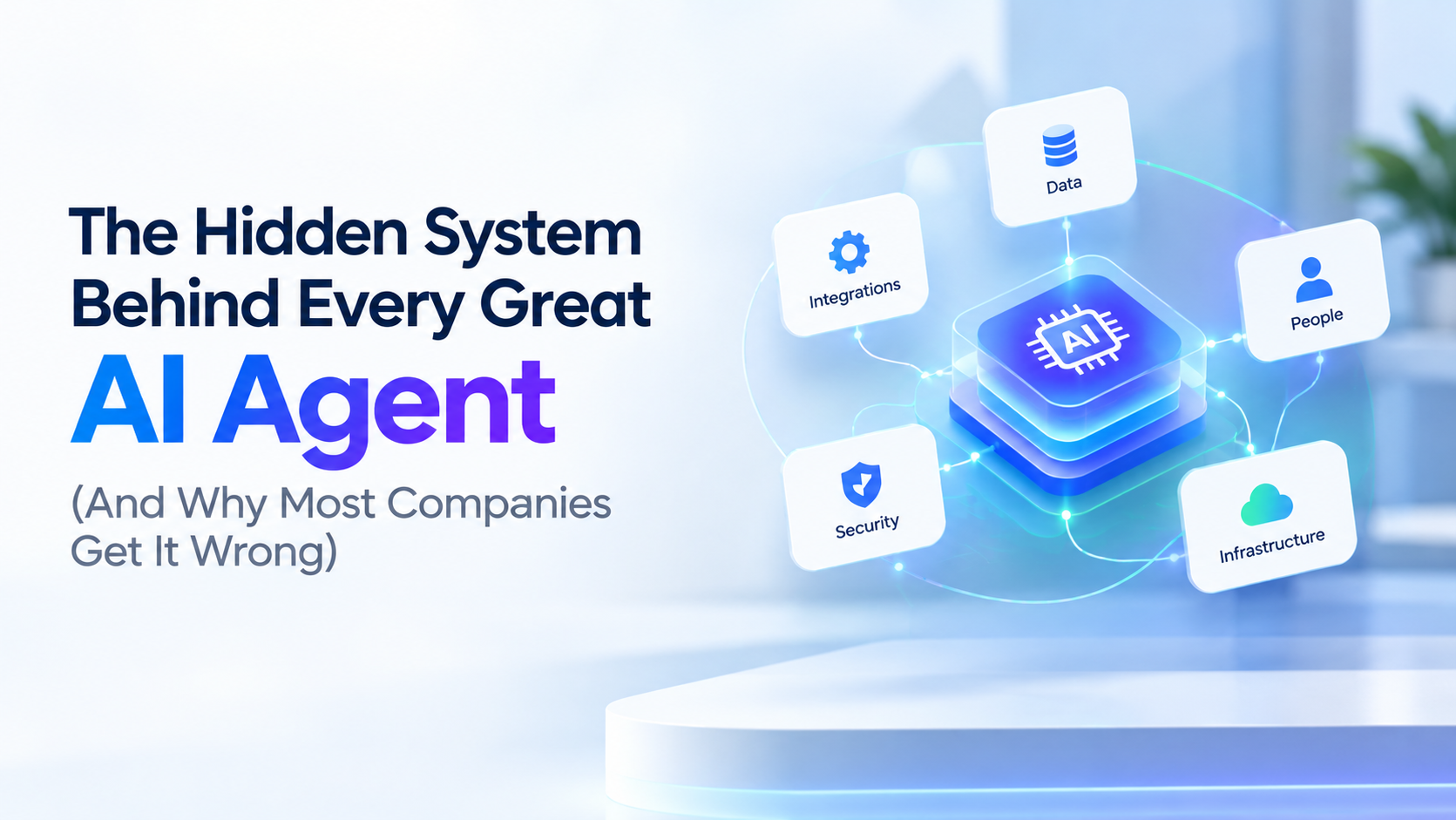
Most AI agents fail beyond the demo. Learn how orchestration, memory, tools, guardrails and observability turn an LLM into a reliable production agent.
A customer submits an insurance claim at 2:17 AM. Within seconds, an AI agent verifies the customer's identity, retrieves policy documents, checks payment history, scans uploaded images, detects potential fraud signals, estimates claim eligibility, updates the CRM, schedules a surveyor, and sends a personalized confirmation on WhatsApp.
The customer experiences one seamless conversation. Behind the scenes, dozens of decisions happen before the AI generates its first response. This is the difference between an AI chatbot and an enterprise AI agent. A chatbot is designed to answer questions. An AI agent is designed to achieve outcomes. That distinction is reshaping enterprise automation. As organizations move beyond simple conversational AI toward intelligent systems capable of planning, reasoning, and executing complex workflows, the question has changed.
The challenge is no longer, "Can AI understand language?"
The real challenge is:
How can AI make accurate business decisions while remaining transparent, secure, and aligned with enterprise policies?
The answer lies in architecture.
Not larger language models.
Not better prompts.
Not more automation.
Architecture.
The organizations leading the next wave of AI transformation understand that intelligence alone is no longer a competitive advantage. Sustainable enterprise AI requires systems that can understand context, retrieve knowledge, plan actions, collaborate with business applications, apply governance rules, and continuously improve through feedback. In other words, modern AI agents are becoming digital decision makers rather than conversational assistants. Understanding how they work is no longer a technical curiosity. It is becoming a business necessity.
The Shift from Language Models to Autonomous Enterprise Systems
The evolution of enterprise AI can be understood in four distinct stages.
Stage 1: Rule-Based Automation
Early chatbots followed predefined decision trees. Every response depended on manually created rules. They worked well for predictable interactions but failed whenever customers deviated from expected flows.
Stage 2: Generative AI
Large Language Models introduced natural conversations. Instead of selecting predefined answers, AI could generate contextual responses dynamically. Customer experience improved dramatically. Execution did not.
Stage 3: AI Agents
Modern AI agents combine language understanding with planning, memory, knowledge retrieval, reasoning, and tool execution. Rather than simply answering questions, they can retrieve customer information, interact with enterprise systems, trigger workflows, collaborate with humans, and complete multi-step business tasks. The conversation becomes the starting point of execution rather than the final destination.
Stage 4: Agentic AI Ecosystems
The newest generation of enterprise AI extends beyond individual agents. Multiple specialized AI agents collaborate across departments, applications, and workflows. One agent retrieves customer information. Another validates compliance requirements. Another schedules appointments. Another communicates updates.
Together, they operate as a coordinated digital workforce while remaining aligned with organizational policies and human oversight. This shift represents one of the most significant architectural changes in enterprise software over the past decade.
Why Most AI Agent Projects Fail
Many organizations assume deploying an advanced language model automatically creates an intelligent AI agent. It doesn't. The majority of unsuccessful AI projects share a common misconception. They invest in the model. They neglect the architecture. A powerful model without memory quickly loses context. A model without planning cannot solve multi-step problems. A model without business tools cannot complete real work. A model without governance creates unacceptable business risk. A model without evaluation cannot improve over time.
This explains why two companies using the same foundation model often achieve completely different business outcomes. The difference is rarely the model itself. The difference is everything surrounding it. The architecture determines whether AI becomes an intelligent employee or simply a sophisticated chatbot.
The Enterprise Agent Stack: The Eight Layers That Transform Intelligence into Action
Every enterprise AI agent appears simple on the surface. A customer asks a question. The AI responds. The task is completed.
Behind that seemingly effortless interaction lies a sophisticated architecture where multiple intelligence layers work together in milliseconds. Unlike traditional chatbots that simply generate text, modern AI agents continuously collect context, evaluate possible actions, interact with enterprise systems, apply governance policies, and verify outcomes before responding.
Think of an enterprise AI agent as a highly skilled employee rather than a search engine. Before taking any action, that employee gathers information, recalls previous interactions, consults company policies, decides the best course of action, collaborates with internal teams, completes the task, and finally learns from the outcome.
Enterprise AI follows the same principle.
Layer 1: Perception - Understanding More Than Words
Every autonomous decision starts with perception.
The perception layer captures everything the customer communicates, not just the words they type or speak. Modern AI agents interpret language, conversation history, uploaded documents, images, voice signals, customer sentiment, channel context, and behavioral patterns simultaneously.
For example, when a customer says,
"I still haven't received my refund."
the AI agent doesn't simply recognize the word refund. It understands frustration from the tone, identifies that the customer has contacted support twice before, retrieves the previous conversation, recognizes the customer is using WhatsApp after first contacting the business via voice, and establishes the complete context before generating a response. Without accurate perception, every subsequent decision becomes weaker.
Layer 2: Memory - The Foundation of Personalized AI
One of the biggest misconceptions in enterprise AI is that larger language models automatically provide better customer experiences. In reality, memory often matters more than model size. A language model can generate intelligent responses, but it doesn't inherently remember every customer's interaction across days, weeks, or months. Enterprise AI agents overcome this limitation by combining multiple memory systems.
Working memory preserves the context of the current conversation, allowing the AI to understand references like "the previous order" or "the same issue as yesterday." Long-term memory stores customer preferences, historical conversations, previous purchases, support tickets, consent records, and business relationships to create continuity across interactions. Instead of treating every conversation as a new beginning, AI agents build on everything they already know about the customer. This transforms conversations from transactional to genuinely personalized.
Layer 3: Knowledge Retrieval - Connecting AI with Enterprise Intelligence
Even the most advanced language model cannot know your company's pricing policies, internal documentation, product catalog, warranty rules, or customer-specific agreements. That information changes constantly. Instead of relying solely on what the model learned during training, enterprise AI agents retrieve knowledge dynamically from trusted business sources whenever a decision is required.
This retrieval layer connects the AI with knowledge bases, CRM systems, product documentation, FAQs, policy documents, enterprise search platforms, and operational databases.
Imagine a customer asking,
"Can I upgrade my current subscription before renewal?"
Rather than guessing, the AI retrieves the latest pricing policy, verifies the customer's current contract, checks eligibility conditions, reviews promotional offers, and then generates an accurate answer based on live business data. The result is significantly higher accuracy, lower hallucination risk, and responses that remain aligned with changing business information.
Layer 4: Planning - Where AI Stops Reacting and Starts Thinking
This is the layer that separates an AI chatbot from an AI agent. Chatbots typically answer one request at a time. AI agents first determine how they should accomplish the objective. Planning involves breaking complex goals into smaller executable tasks, determining dependencies, selecting the appropriate sequence, and adapting when conditions change.
Consider a customer requesting,
"I need to reschedule my medical appointment and update my insurance details."
Instead of treating this as a single request, the planning engine automatically creates a structured workflow. First, verify patient identity. Then retrieve appointment availability. Next, validate insurance eligibility. Update patient records. Send confirmation. Notify the physician. Generate reminders.
Each action depends on the successful completion of the previous step. This ability to decompose objectives into coordinated workflows enables enterprise AI agents to complete sophisticated business processes autonomously rather than merely responding conversationally.
Layer 5: Reasoning - Choosing the Best Decision, Not Just the Next Response
Reasoning is where enterprise AI evaluates multiple possible actions before selecting the one that best aligns with business objectives.
Rather than asking,
"What should I say?"
the AI asks,
"What should I do?"
Modern reasoning engines evaluate customer intent, enterprise policies, historical interactions, retrieved knowledge, operational constraints, and potential outcomes simultaneously. For example, if a customer requests a refund outside the standard policy period, the AI doesn't simply reject the request. Instead, it considers purchase history, loyalty status, previous exceptions, applicable business policies, available retention offers, and escalation rules before recommending the most appropriate course of action. Reasoning transforms conversations into business decisions. It allows AI agents to balance customer satisfaction with organizational policies instead of blindly following predefined scripts.
At this point, the AI agent has understood the customer, remembered previous interactions, gathered business knowledge, created an execution plan, and determined the optimal decision.
The next question becomes even more important:
How does the AI safely execute those decisions inside enterprise systems without compromising security, compliance, or governance?
That's where the remaining layers of the Enterprise Agent Stack become critical.
Layer 6: Execution - Where Intelligence Delivers Business Outcomes
Understanding a customer's request is only half the job. The real value of an AI agent lies in its ability to translate decisions into actions. This is where the execution layer comes into play.
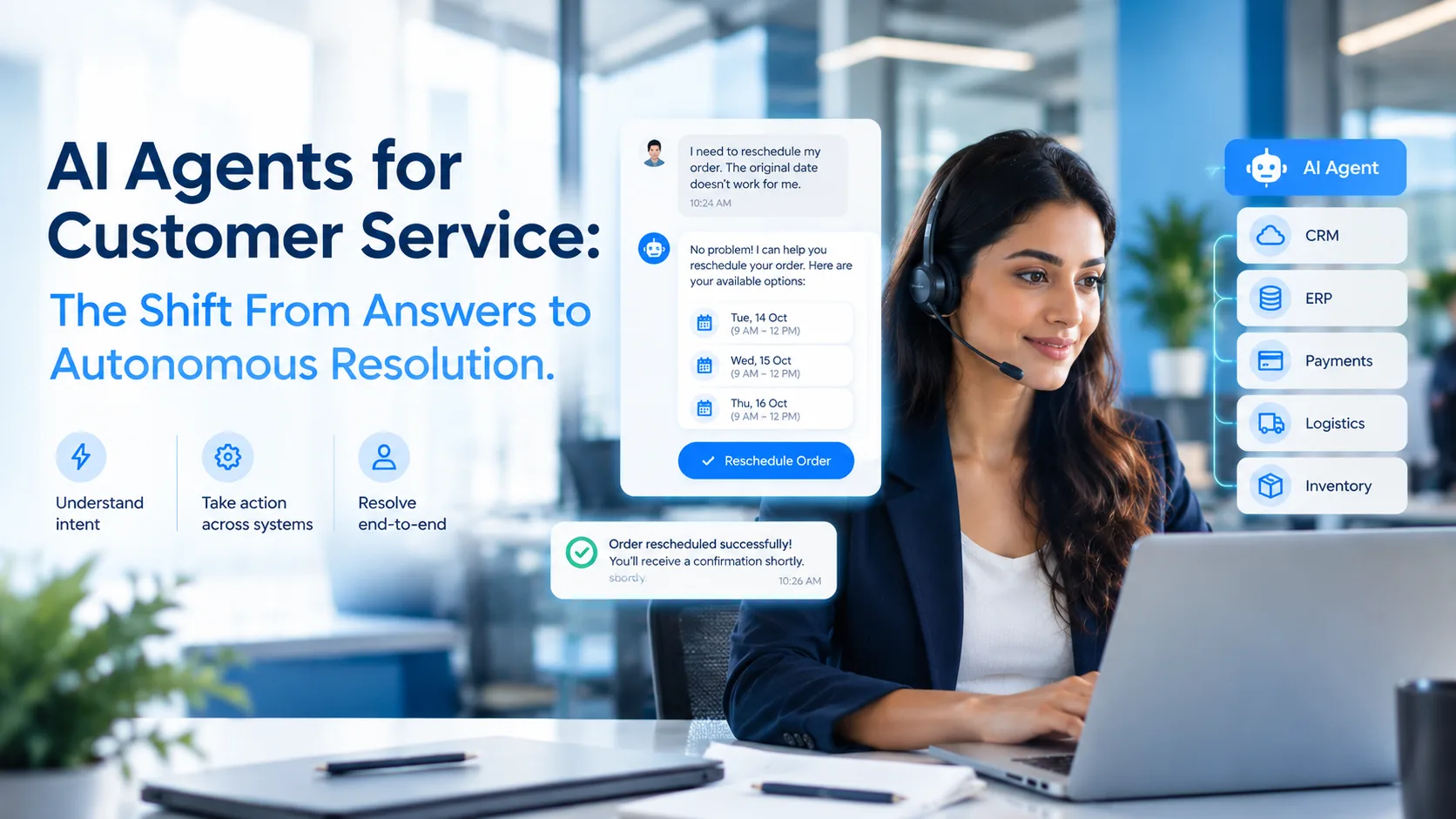
Unlike conventional chatbots that end every interaction with a response like "Our support team will contact you shortly," enterprise AI agents can complete the task themselves by securely interacting with business applications and enterprise systems.
Depending on the use case, an AI agent may:
Update CRM records
Schedule appointments
Process insurance claims
Create support tickets
Generate invoices
Trigger payment workflows
Send WhatsApp notifications
Initiate Voice AI calls
Update ERP systems
Verify inventory availability
Generate personalized offers
Instead of asking employees to manually move information between disconnected systems, the AI agent becomes the orchestration layer connecting conversations with business execution. For enterprises, this dramatically reduces operational delays while improving consistency and customer satisfaction.
Why Tool Orchestration Is the Real Superpower of Enterprise AI
Large Language Models generate text. Enterprise AI agents use tools. This distinction is fundamental. Modern AI agents interact with dozens of enterprise applications during a single customer journey.
For example, imagine a customer says:
"I'd like to renew my health insurance policy."
The AI agent doesn't simply explain the renewal process. It orchestrates multiple systems simultaneously. First, it retrieves customer information from the CRM. Next, it validates policy status from the insurance platform. It checks pending payments through the billing system. It verifies eligibility against underwriting rules. It generates the renewal quote. It processes payment. It updates internal records. Finally, it sends the renewed policy via WhatsApp and email. To the customer, it feels like one seamless conversation. Behind the scenes, the AI agent has coordinated multiple enterprise systems without requiring manual intervention. This ability to orchestrate tools transforms conversational AI into operational AI.
Layer 7: Governance - The Difference Between Intelligent AI and Trusted AI
As AI agents become capable of making increasingly complex decisions, enterprises face a new challenge. How do you ensure autonomous systems remain aligned with organizational policies, regulatory requirements, and ethical standards?
The answer is governance. Governance acts as the decision boundary within which AI operates. Rather than allowing unrestricted autonomy, enterprise AI agents execute every action within predefined guardrails. Before completing any sensitive action, the AI evaluates questions such as:
Does the user have permission?
Does this action comply with company policy?
Does confidence meet the required threshold?
Is human approval necessary?
Could this action create regulatory risk?
Has similar behavior previously triggered fraud detection?
Only after these checks are satisfied does execution continue. This layered governance model allows organizations to embrace automation without sacrificing accountability.
Human-in-the-Loop: Why the Best AI Knows When Not to Decide
One of the biggest misconceptions surrounding Agentic AI is that complete autonomy eliminates human involvement. In reality, enterprise AI succeeds because it knows when to collaborate with humans. Certain situations demand judgment, empathy, or regulatory oversight that should never be fully automated. For example:
High-value financial approvals
Medical recommendations
Insurance claim disputes
Fraud investigations
Legal escalations
Customer complaints involving exceptions
In these scenarios, AI prepares the work instead of replacing the expert. It gathers relevant information, summarizes previous interactions, recommends the next best action, and routes the case to the appropriate employee. This dramatically reduces handling time while ensuring critical decisions remain under human control. The future of enterprise AI is not human versus machine. It is a human plus machine.
Layer 8: Continuous Learning - Why Great AI Agents Improve Every Day
The most valuable AI agents are not those that start perfect. They are the ones that continuously become better. However, enterprise learning differs significantly from consumer AI. Contrary to popular belief, production AI agents do not automatically retrain themselves after every conversation. Instead, continuous improvement happens through structured evaluation and optimization. Organizations analyze conversation quality, task completion rates, customer satisfaction, escalation patterns, failed workflows, retrieval accuracy, and policy compliance.
These insights are then used to refine prompts, improve knowledge sources, optimize workflows, strengthen guardrails, and enhance business logic. This feedback loop allows AI agents to become more reliable over time without introducing uncontrolled behavioral changes. Learning becomes measurable, governed, and aligned with enterprise objectives.
The Future of Enterprise AI: From Individual Agents to Autonomous Digital Workforces
For years, businesses have viewed AI as another software capability, something that could answer questions, automate repetitive tasks, or assist employees. That mindset is rapidly changing. The next generation of enterprise AI is no longer being built around individual models. It is being built around intelligent systems capable of collaborating, making decisions, and executing complex business processes across departments.
In the coming years, enterprises won't ask,
"Which chatbot should we deploy?"
Instead, they'll ask,
"How many AI agents should collaborate to complete this business process?"
The conversation is shifting from automation to orchestration. From isolated intelligence to connected intelligence. From responding to customers to running business operations. This is the foundation of Agentic AI.
Five Trends That Will Define Enterprise AI Agents Beyond 2026
1. Multi-Agent Systems Will Replace Single AI Assistants
Today's AI agents are becoming specialists. One agent may qualify leads. Another verifies customer identity. Another retrieves enterprise knowledge. Another processes payments. Another monitors compliance.
Rather than forcing one AI system to solve every problem, enterprises are increasingly orchestrating multiple specialized agents that collaborate toward a shared objective. This approach improves reliability, scalability, and decision quality while allowing organizations to evolve individual agents without disrupting the entire system. The future enterprise won't deploy one AI. It will manage an intelligent workforce of AI agents.
2. Omnichannel AI Will Become the Default Customer Experience
Customers no longer think about channels. They start a conversation on a website, continue it on WhatsApp, receive a Voice AI callback, respond through email, and expect every interaction to retain context. Unfortunately, many organizations still operate disconnected communication channels where every new interaction starts from scratch.
Modern Agentic AI changes this completely. An enterprise AI agent maintains conversation memory, customer preferences, business context, and workflow state across every touchpoint. Whether the customer switches from voice to chat, from mobile to desktop, or from WhatsApp to email, the AI continues the conversation instead of restarting it. For enterprises, Omnichannel Agentic AI isn't simply about supporting more channels. It's about creating one continuous customer journey regardless of where the conversation happens.
3. Voice AI Will Become a Primary Enterprise Interface
For decades, IVR systems forced customers to navigate rigid menus before speaking with a human. Enterprise Voice AI is replacing that experience with natural conversations. Modern AI voice agents understand intent, interruptions, pauses, multilingual conversations, sentiment, and conversational context in real time. More importantly, Voice AI is no longer operating independently. It is becoming another execution layer within the broader Agentic AI ecosystem.
Imagine a customer calling a bank. The Voice AI agent authenticates the customer, retrieves account history, verifies recent transactions, checks fraud indicators, updates the CRM, sends supporting documents through WhatsApp, and schedules a relationship manager only if human intervention is genuinely required. Voice becomes another intelligent interface into the Enterprise Agent Stack rather than a separate customer service channel.
4. Enterprise Governance Will Become a Competitive Advantage
As AI agents become increasingly autonomous, governance will become just as important as intelligence. Organizations will differentiate themselves through their ability to deploy AI responsibly. Successful enterprises will implement:
Role-based permissions for AI actions
Policy-aware decision engines
Human approval workflows
Continuous AI evaluation
Enterprise audit trails
Regulatory compliance monitoring
Prompt injection protection
Model observability and performance monitoring
Customers don't simply trust AI because it is intelligent. They trust AI because it behaves consistently, transparently, and responsibly. Governance transforms intelligence into trust.
5. Business Success Will Be Measured by Outcomes, Not Conversations
The first generation of conversational AI focused on response speed. The second generation measured customer satisfaction. The next generation will measure completed business outcomes. Instead of asking,
"How many conversations did the AI handle?"
Organizations will measure:
Claims processed
Loans approved
Revenue influenced
Leads converted
Appointments scheduled
Customer retention
Resolution time
Operational cost savings
Employee productivity
Customer Lifetime Value
This represents one of the biggest mindset shifts in enterprise AI. The conversation is no longer the product. The completed business outcome is.
Common Mistakes That Prevent AI Agents from Delivering Business Value
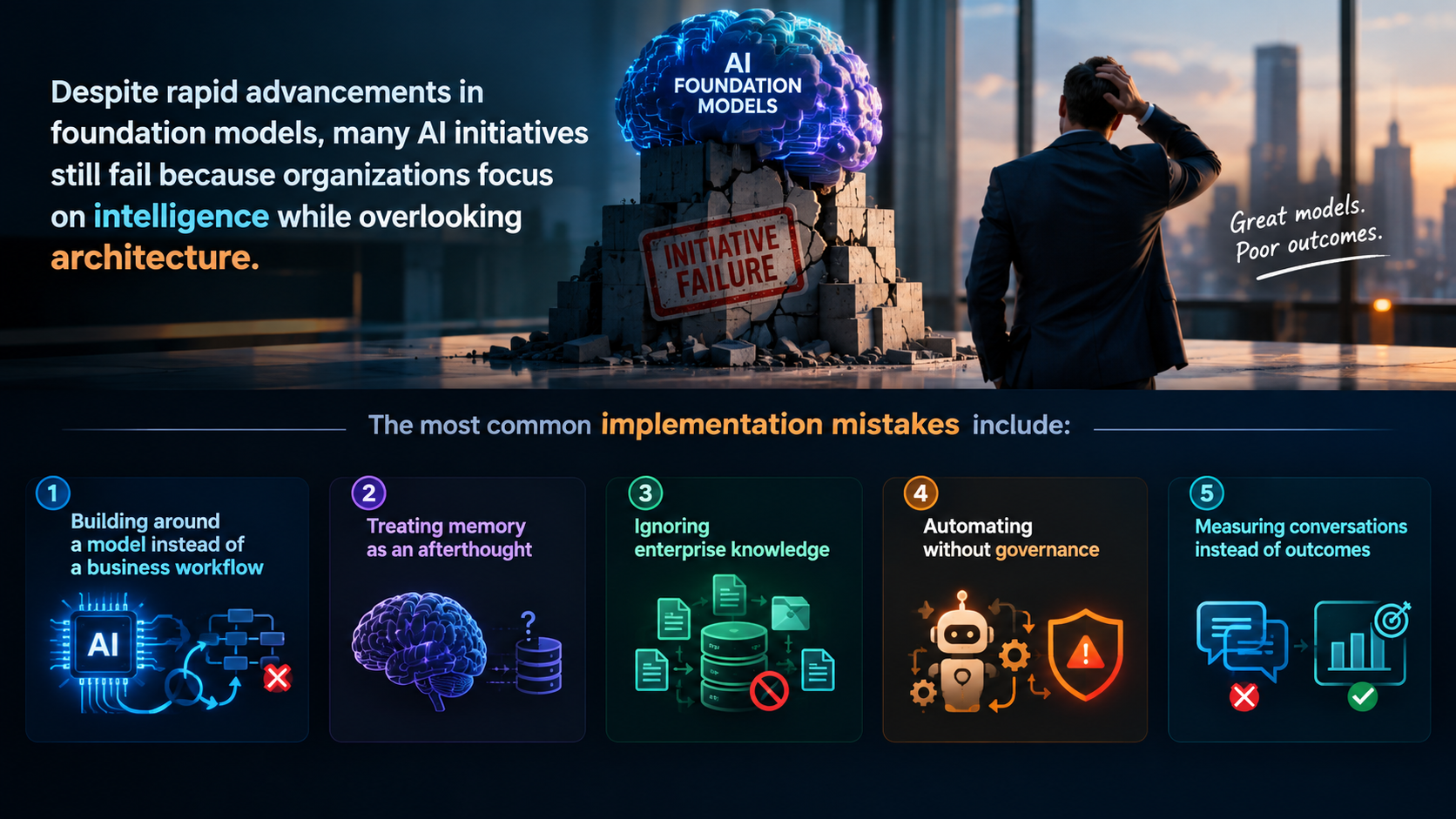
Despite rapid advancements in foundation models, many AI initiatives still fail because organizations focus on intelligence while overlooking architecture. The most common implementation mistakes include:
Building around a model instead of a business workflow
Organizations often begin by selecting a language model instead of identifying the customer journey or operational challenge they want to improve.
Treating memory as an afterthought
Without persistent memory, every conversation becomes isolated, reducing personalization and increasing customer effort.
Ignoring enterprise knowledge
An AI agent is only as reliable as the information it can access. Outdated or disconnected knowledge sources lead to inaccurate responses and poor decision-making.
Automating without governance
Autonomy without guardrails introduces unnecessary business and compliance risks. Governance should be embedded into every decision, not added after deployment.
Measuring conversations instead of outcomes
The true value of Agentic AI lies in business execution. Success should be measured by completed workflows, customer outcomes, and operational efficiency.
Organizations that avoid these mistakes are far more likely to realize measurable value from enterprise AI.
The New Enterprise Competitive Advantage
Over the past decade, businesses competed on digital transformation. Over the next decade, they will compete on decision intelligence.
Every customer request, every support interaction, every sales opportunity, and every operational workflow will increasingly begin with an AI agent capable of understanding intent, retrieving enterprise knowledge, reasoning through complex scenarios, collaborating with business systems, and executing work autonomously within clearly defined governance boundaries.
The organizations that simply deploy larger language models will automate conversations. The organizations that invest in robust AI agent architecture will automate outcomes. That difference will determine which enterprises scale efficiently, deliver exceptional customer experiences, and build lasting competitive advantage.
Final Thoughts
Enterprise AI has entered a new phase. Success is no longer determined by the sophistication of an individual model but by the architecture that surrounds it.
Modern AI agents combine perception, memory, knowledge retrieval, planning, reasoning, execution, governance, and continuous learning into a unified decision-making system capable of solving real business problems. When these capabilities work together, AI evolves from a conversational assistant into an autonomous business partner.
At Chat360, this architectural philosophy is at the heart of every AI-powered customer interaction. Our Agentic AI platform combines Omnichannel AI, Voice AI, enterprise integrations, governance, and intelligent orchestration to help organizations move beyond isolated automation and toward truly autonomous customer engagement. The future of enterprise AI won't be defined by who has the largest model. It will be defined by who builds the smartest architecture. Because in the age of Agentic AI, intelligence starts the conversation. Architecture delivers the outcome.
Frequently asked questions
A production AI agent should have controls that detect repeated actions, excessive tool calls, timeouts and lack of progress. Instead of continuing indefinitely, the orchestration layer can stop the task, retry with a different strategy, roll back an action where possible, or escalate to a human. Loop detection and bounded execution are important because autonomous agents can fail through repeated or cascading actions rather than a single incorrect response.