The Airport Is Moving. But Is Its Information Moving With It? Why Agentic AI In Airports could become the next operational advantage for airport leaders at Airports Innovation Barcelona 2026
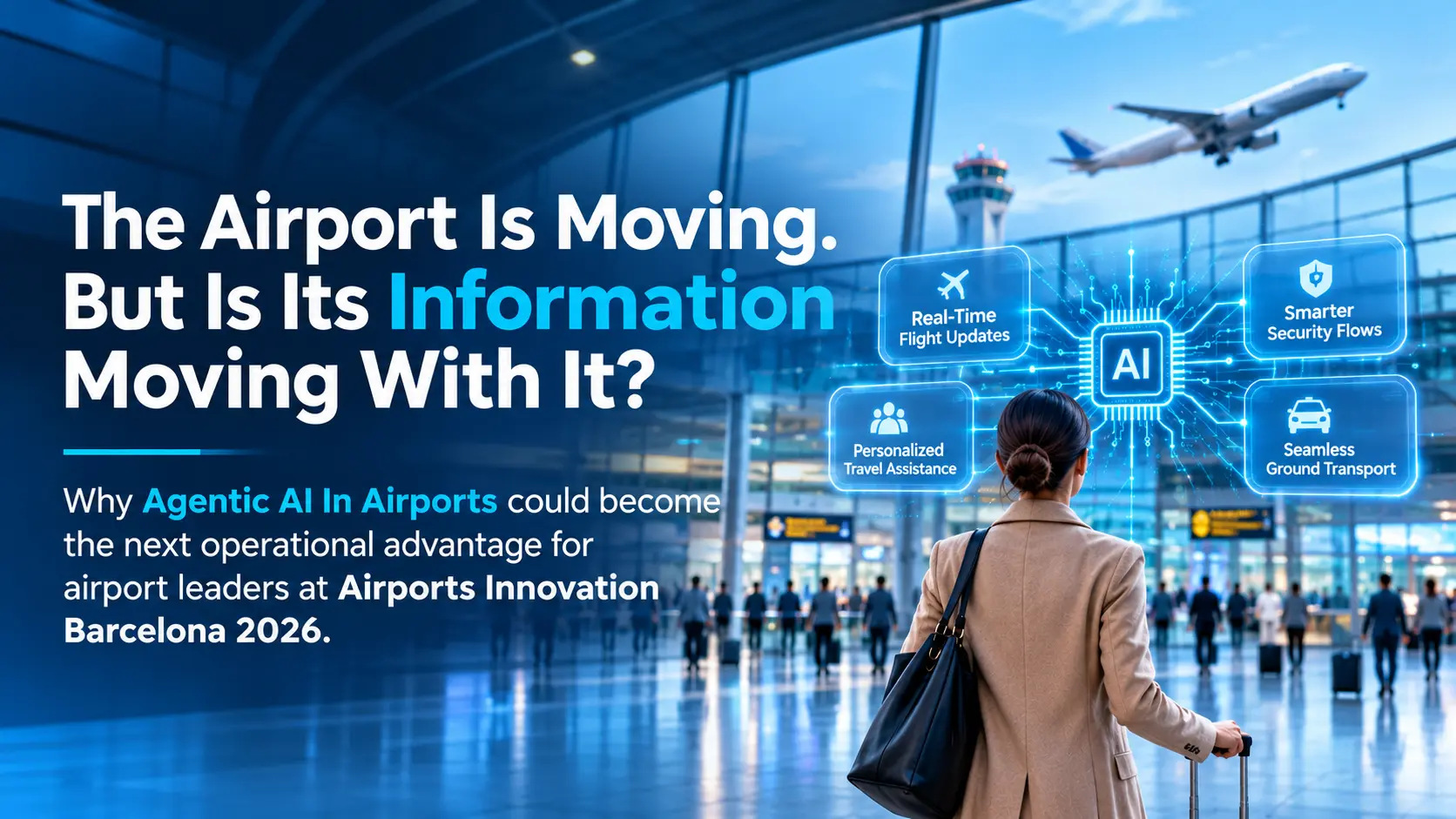
Airports are investing in smarter infrastructure, but disconnected systems still slow down decisions and operations. Discover how Agentic AI in Airports connects existing technology, automates workflows and transforms passenger assistance, workforce readiness and airport operations.
7:42 AM. An escalator stops working in a busy departure terminal.
A passenger approaches an airport employee for help. Another traveller, unaware of the disruption, continues towards the same escalator. A maintenance team needs to be notified. The terminal operations team needs visibility. Passengers may need alternative directions.
The airport has systems to manage facilities. It has channels to communicate with passengers. It has employees responsible for resolving operational issues.
But here is the question:
How quickly does information move between all the people and systems that need to act?
The escalator is only one problem. The bigger challenge is everything that happens after the problem is detected. This is the operational gap that airports increasingly need to address. Not simply a lack of technology, but a lack of coordination between information, teams, decisions, and actions.
As airport technology leaders prepare for Airports Innovation Barcelona 2026, this deserves a much bigger conversation. Because the next generation of intelligent airports will not be defined by how many digital systems they operate. It will be defined by how effectively those systems work together.
10.2 Billion Passengers. Can Airport Operations Keep Up?
The pressure on airports is not hypothetical. According to Airports Council International (ACI) World, global passenger traffic is forecast to reach 10.2 billion in 2026, representing 3.9% year-on-year growth. By 2045, passenger traffic is projected to reach 18.8 billion, more than doubling from 2024 levels.
But passenger growth is not the only challenge. ACI also highlights infrastructure capacity constraints, uneven regional growth and increasing operational complexity.
For airport operators, this creates a difficult equation:
More passengers require more efficient passenger processing.
More activity increases pressure on terminal facilities and services.
More operational dependencies create additional coordination requirements.
More digital systems require better information sharing.
Building additional infrastructure remains essential in many markets. But airports also need to improve how effectively existing infrastructure, employees and technology are used.
That is where Airport Operations Automation becomes an important part of the conversation. The objective is no longer just to automate individual tasks. It is to connect the operational processes surrounding those tasks. An automated airport can perform more activities digitally. A connected airport can coordinate those activities more intelligently.
The Airport Technology Paradox: More Systems, More Coordination Challenges
Consider how a modern airport operates.
An Airport Operational Database provides operational information. Building Management Systems monitor facilities. Computerized Maintenance Management Systems support maintenance. Queue sensors provide passenger-flow signals. Human Resource Management Systems maintain workforce information. Enterprise Resource Planning systems support business processes.
Each system has a purpose. Yet an operational issue rarely stays within one system. A queue begins to build. The relevant operations team needs to know. Passenger-facing teams may need updated information. Resources may need to be reassigned. A service-level expectation may need to be monitored.
The airport does not necessarily need another standalone dashboard to display one more alert. It needs a reliable way to connect that alert with the appropriate response. Industry research reinforces this shift.
SITA's 2025 Air Transport IT Insights reports that:
73% of airports plan to invest in AI for prediction and automation.
48% plan to implement cross-silo data streaming, sharing, or synchronization by 2028.
SITA's subsequent industry reporting also highlights that 89% of airports consider data-driven decision-making a strategic priority. The direction is clear: airports are investing in intelligence, but the value of that intelligence depends on how well operational information can be shared and used. This is precisely where Agentic AI In Airports becomes more interesting than another chatbot deployment.
The Difference Between an AI That Answers and an AI That Helps Get Things Done
Imagine two situations.
Situation one: A passenger asks where the nearest accessible route is.
A conventional chatbot might provide a standard answer from its knowledge base.
Situation two: A passenger reports that the accessible route they were directed to is unavailable.
Now the requirements are different. The airport may need to identify the location, understand the request, route it to the appropriate team, provide an alternative using authorized information, and ensure the request reaches the right person.
The value of AI is no longer limited to generating a response. It is about helping the airport move from a request to an appropriate next action. This is the distinction between traditional conversational automation and Agentic AI.
Traditional automation generally follows predefined rules to execute specific tasks. Agentic AI can interpret context, identify an appropriate next step, initiate approved workflows, coordinate follow-up and maintain process visibility within defined permissions.
For airports, that can mean connecting passenger assistance, terminal service exceptions, workforce processes and enterprise requests through a governed intelligence layer. It does not mean giving an AI system unrestricted control over airport operations. It means allowing AI to support defined activities while keeping operational authority, approvals and safety-critical decisions with authorised people and systems.
One Terminal Disruption. Six Steps Between Detection and Resolution.
Return to the escalator scenario.
The problem has been identified. But how does the airport ensure it reaches the right team and remains visible until it is resolved?
This is where Airport Operations Automation needs to move beyond alerts and notifications.
A connected exception-management workflow can follow six stages.
01. Detect: Identify the signal
An authorized signal arrives from a building management system, maintenance platform, queue sensor, or staff report. The system identifies the source and relevant context.
02. Raise: Create an accountable exception
The issue is recorded with a timestamp, location, category, and available supporting information. Instead of remaining buried in a message or conversation, it becomes a structured operational exception.
03. Assign: Give the issue an owner
The exception is routed according to approved rules to a responsible team or named role, such as the Terminal Duty Manager. Ownership becomes visible.
04. Act: Initiate the approved workflow
The assigned team receives the task, relevant context, and applicable SLA expectations. Permitted reminders, tasks, and escalation rules can be initiated.
05. Update: Keep the right teams informed
Status changes and follow-ups are recorded. Relevant stakeholders receive updates according to their responsibilities.
06. Close: Verify the outcome
The responsible human confirms that the issue has been resolved. The workflow retains its history, including the source of the exception, assignment, actions, and closure. This last step matters.
An alert being acknowledged does not necessarily mean the issue has been resolved. A task assigned does not mean it has been completed. The operational outcome is not notification. It is a verified resolution. This is the type of workflow that can make Agentic AI In Airports meaningful to airport operators.
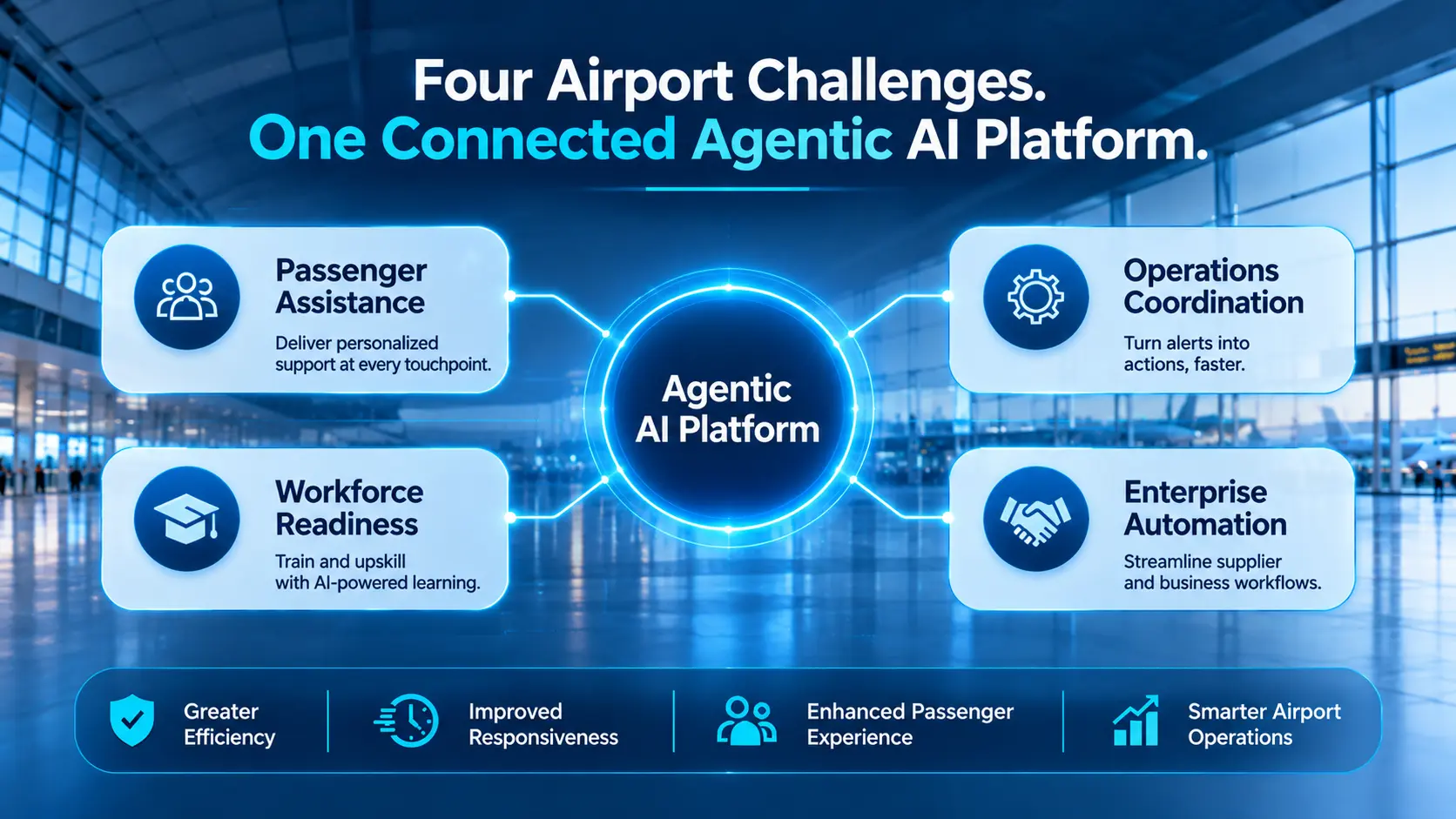
Four Airport Challenges. One Connected Agentic AI Platform.
Airport technology is often evaluated through individual use cases. But passenger experience, terminal operations, workforce readiness and enterprise processes influence one another. Chat360 approaches these requirements through four connected airport solutions.
1. AirportAssist AI: When Passengers Need More Than Another FAQ
A passenger arrives at an unfamiliar terminal. They need to locate a gate, understand airport services, find parking information, or request accessibility assistance. They should not have to search through multiple pages, download another application, or wait unnecessarily for basic guidance.
AirportAssist AI helps airport operators provide multilingual passenger assistance across WhatsApp, web, voice and AI Avatar interfaces.
It can support:
Passenger queries about airport facilities and services.
Gate and flight information through authorized data feeds.
Terminal navigation and wayfinding guidance.
Accessibility assistance requests.
Proactive passenger notifications.
Live agent handover for complex requests.
The important distinction is that the AI should use approved airport information and recognize when a request requires human assistance. A passenger should receive a useful, reliable next step, not an answer that simply sounds convincing.
2. AirportFlow AI: Turning Operational Signals Into Owned Actions
On a maintenance issue, an overcrowded queue or a facility of disruption can involve multiple teams. AirportFlow AI connects authorized operational signals, and staff reports to structured exception workflows.
It supports:
Issue identification and classification.
Priority-based assignment.
Named operational ownership.
SLA monitoring and escalation.
Action history and event provenance.
Human-confirmed closure.
Operational visibility and reporting.
For airport operations teams, this provides a more structured way to manage terminal exceptions.
The objective is to reduce the coordination effort between detecting an issue and ensuring that the responsible team has acted on it.
3. AirportLearn AI: Workforce Readiness Is an Operational Requirement
An airport's ability to deliver consistent service depends on the people working across its terminals and operational environment. Training completion is only one part of workforce readiness. Managers also need visibility into role-specific learning, certification validity, upcoming renewals, and access to approved procedures.
AirportLearn AI supports:
Role-based learning paths.
AI tutoring grounded in approved airport procedures.
Certification expires on tracking.
Automated training reminders.
Supervisor dashboards.
Compliance and training evidence.
This connects workforce learning with the ongoing requirements of airport operations.
4. EnterpriseFlow AI: The Airport Runs on More Than Passenger Movement
Behind every airport terminal is a large enterprise ecosystem. Suppliers, concessionaires, contractors, finance teams, and commercial stakeholders generate requests, approvals, documents, and service dependencies. When these workflows rely heavily on disconnected emails and manual follow-ups, visibility becomes difficult.
EnterpriseFlow AI supports:
Supplier and concessionaire portals.
Request management and automated routing.
Contract and policy document intelligence.
Invoice exception identification.
ERP-connected workflows.
Process history and audit visibility.
This extends airport automation beyond passenger-facing services and into the business processes that support the airport ecosystem. Together, the four solutions connect passenger engagement, terminal operations, workforce enablement, and enterprise workflow automation through one Agentic AI platform.
The Question Airport CIOs Should Ask: Does AI Fit Around Our Existing Infrastructure?
An airport operator has already invested in systems, integrations, processes, and operational expertise. Replacing those foundations to introduce AI would create an unnecessary starting point for many use cases. A more practical architecture is to connect AI around existing systems of record.
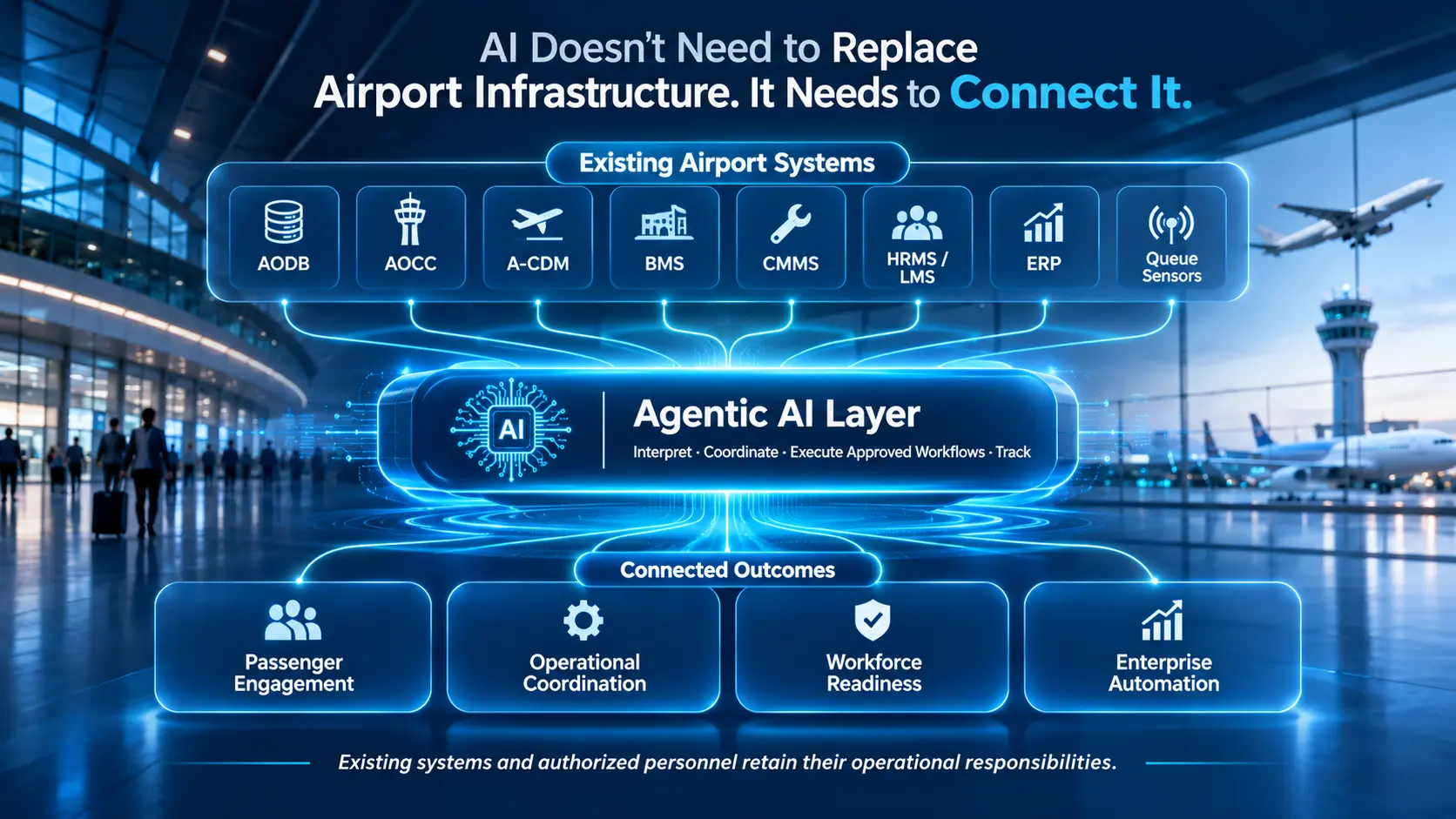
Chat360 is designed to operate as an engagement, knowledge, and workflow layer around these systems. It does not replace AODB, AOCC, A-CDM, BMS, CMMS, or ERP. It does not control runways, aircraft movement, or safety-critical operations.
The distinction is fundamental. The AI layer can interpret approved information, support conversations, initiate permitted workflows, and coordinate follow-up. Existing systems and authorized personnel retain their operational responsibilities.
This is also why Agentic AI In Airports must be designed with governance from the beginning, rather than added after deployment.
Trust Is Not a Feature You Add After Deploying Airport AI
Imagine a passenger asks an AI Agent whether a gate has changed. If the system does not have access to an authorized, current flight information feed, it should not invent an answer.
Imagine an employee asking for a safety-related procedure. The AI should use approved, current content, and direct the employee to the appropriate authorized process.
Imagine an operational exception is raised. The workflow should preserve who received it, which actions were taken, and who confirmed its closure.
These examples illustrate why airport AI requires more than conversational accuracy.
A trustworthy deployment should establish:
Approved knowledge: Defined content owners, authorized information sources and content freshness.
Role-based access: Appropriate access for passengers, employees, suppliers and operational teams.
Human oversight: Defined approvals, escalation paths and human-confirmed closure where required.
Auditability: Interaction logs, workflow histories, action records and event provenance.
Integration governance: Approved data access, hosting arrangements, tenancy and data-residency requirements.
Bounded autonomy: Clear limits on what the AI can initiate, what requires approval and what must remain outside its control.
The principle is straightforward, airport AI should make operations more coordinated without weakening accountability.
Airports Innovation Barcelona 2026: A Bigger Conversation Than Chatbots
Airports Innovate 2026 takes place in Barcelona from 23–25 November, bringing together airport innovators, operators and technology leaders. The event creates an important opportunity to examine how new technologies translate into practical improvements in airport performance. The conversation around Airports Innovation Barcelona 2026 should go beyond demonstrations of individual AI tools.
Airport leaders should be asking:
Can AI connect passenger requests with the teams responsible for resolving them?
Can terminal exceptions move from detection to verified closure?
Can AI integrate with existing airport systems without replacing operational foundations?
Can workforce and supplier workflows become more visible and accountable?
Can an AI pilot demonstrate measurable value within a controlled scope?
These are the questions that separate an interesting technology demonstration from an operationally relevant innovation.
For airport operators evaluating Agentic AI In Airports, the most important consideration is not how impressive an AI conversation looks. It is what happens after that conversation.
From Connected Conversations to Connected Airport Operations
The airport of the future will not be built by one AI Agent, one dashboard or one automated process. It will depend on how effectively passenger services, operational teams, workforce processes, enterprise systems, and authorized data work together.
Chat360 brings this approach to airport environments through AirportAssist AI, AirportFlow AI, AirportLearn AI and EnterpriseFlow AI.
Its airport engagement includes a live Chat360 AI Agent at Adani Airports for passenger assistance. The wider platform opportunity is to connect passenger interactions with operational workflows, workforce enablement, and enterprise processes.
Every airport will have different systems, priorities, permissions, and deployment requirements. The right starting point is therefore not a universal promise, but a clearly defined operational problem and a measurable path to solving it.
At Airports Innovation Barcelona 2026, the most valuable discussion may not be about how many airport processes can be automated. It may be about how many disconnected processes can finally work together. Because the next airport advantage will not simply be smarter conversations. It will be better-coordinated operations, clearer ownership, and outcomes that can be verified.
Frequently asked questions
Existing airport systems manage specialized operational information and processes. The challenge is often connecting that information to passenger requests, staff actions and cross-department workflows. An Agentic AI layer can work around authorized systems of record to interpret requests, initiate approved workflows and coordinate follow-up. It should complement existing infrastructure rather than duplicate or replace it.