WhatsApp API pricing changes on 1 October 2026. Understand service-message charges, utility replies, Meta Business Agent token pricing, free entry points, and cost implications.
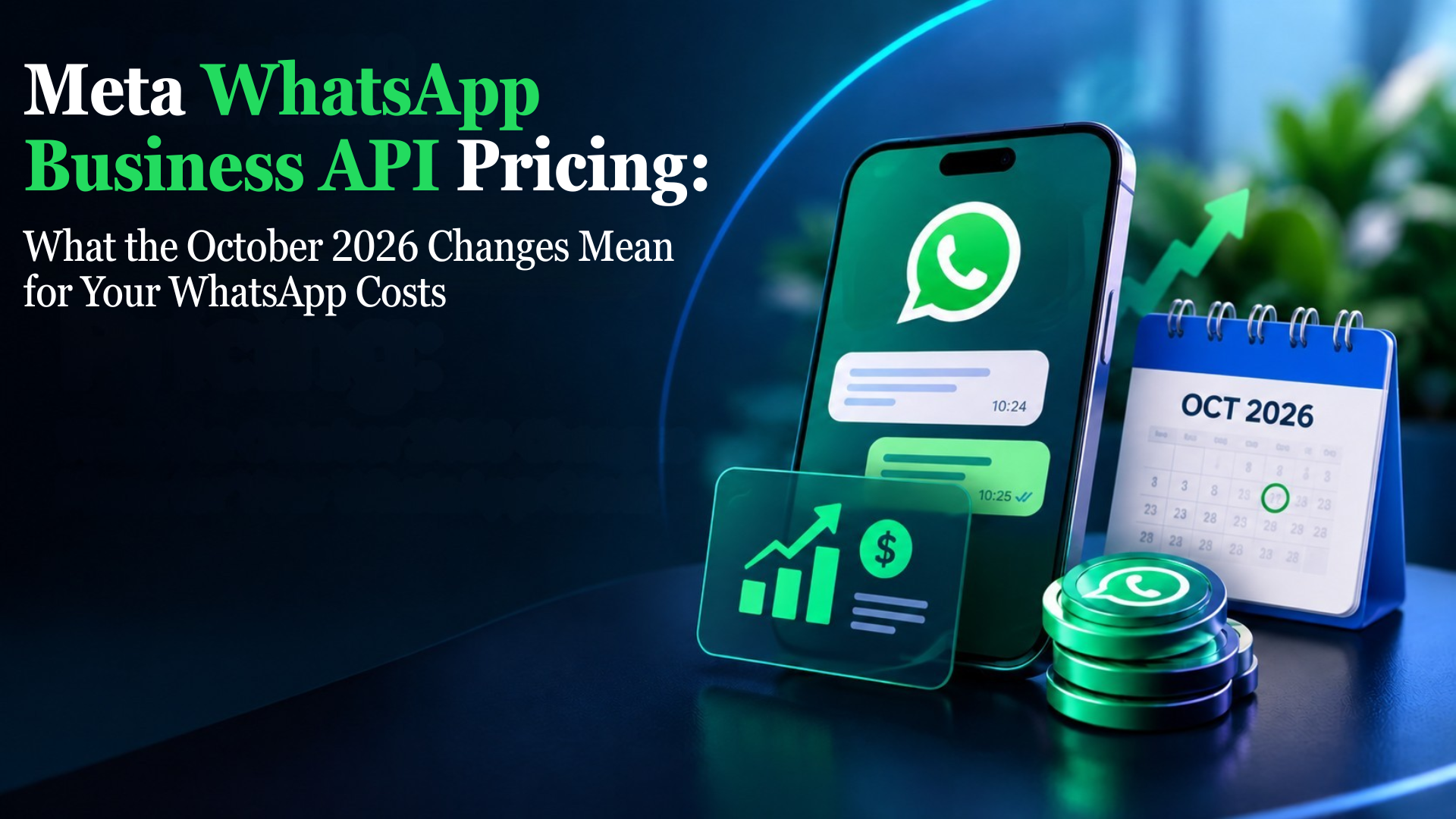
WhatsApp API pricing is changing on 1 October 2026, and businesses using the Meta WhatsApp Business API need to understand exactly what will become billable.
From 1 October 2026, Meta will begin charging for service messages and utility messages sent in response to customers within an open 24-hour customer service window. Both were previously free under the applicable rules.
There is another important change already in effect. Since 1 August 2026, Meta Business Agent, Meta's own AI agent for business conversations, has been billed separately at US$2.00 per 1 million tokens. Meta's pricing guide estimates that a typical Meta Business Agent message can use around 20,000 to 25,000 tokens, equivalent to approximately 4–5 US cents per message.
That means the economics of the Meta WhatsApp Business API are changing from a model where customer-service replies could remain free to one where businesses need to actively manage the cost of every billable response.
Quick answer: What changes in WhatsApp API pricing on 1 October 2026?
| WhatsApp pricing change | Effective date | How Meta charges |
|---|---|---|
| Meta Business Agent | 1 August 2026 | US$2.00 per 1M tokens |
| Service messages | 1 October 2026 | Per delivered message |
| Utility replies within an open 24-hour window | 1 October 2026 | Per delivered message |
| Customer messages to businesses | After 1 October | Remain free |
| Eligible 72-hour free entry-point messages | After 1 October | Delivery remains free under the stated conditions |
Meta's pricing documentation distinguishes five categories: Marketing, Utility, Authentication, Service, and Meta Business Agent. Each category has a different billing mechanism.
WhatsApp API Pricing 2026: The Timeline You Need to Know
The 2026 WhatsApp API pricing changes are easier to understand when viewed chronologically.
1 July 2026: Meta Business Agent launches
Meta launched the Meta Business Agent Platform on 1 July 2026. Businesses can connect to the platform through APIs, either directly or through a partner.
1 August 2026: Meta Business Agent becomes billable
From 1 August 2026, Meta began charging businesses for Meta Business Agent messages based on token usage. The published rate is: US$2.00 per 1 million tokens. Meta says this charge includes both AI processing and message delivery.
1 October 2026: Service messages become billable
This is the major WhatsApp API pricing change for customer support. Service messages, which had previously been free, become billable on a per-delivered-message basis.
1 October 2026: In-window utility replies become billable
Utility messages sent in response to users inside an open 24-hour customer service window also become billable from 1 October 2026.
31 December 2026: India INR billing deadline
The source also identifies a separate India billing requirement: eligible India-billed businesses must move their WhatsApp Business Accounts to INR billing by 31 December 2026.
What Is the Meta WhatsApp Business API?
The Meta WhatsApp Business API, part of the WhatsApp Business Platform, allows businesses to communicate with customers at scale using WhatsApp. Businesses can use it for:
- Customer support
- Order updates
- Transaction notifications
- Authentication and OTPs
- Marketing campaigns
- AI-powered customer conversations
- Human-agent conversations
- Automated workflows
- Conversational commerce
The key point for WhatsApp API pricing is that Meta does not treat every message identically. A message category determines how it is billed.
WhatsApp API Pricing: The 5 Message Categories Explained
| Category | Example | Message format | Billing |
|---|---|---|---|
| Marketing | Promotions, offers, cart reminders | Template | Per message |
| Utility | Order updates, transaction alerts | Template | Per message; in-window replies charged from 1 Oct |
| Authentication | One-time passwords | Template | Per message |
| Service | Human or third-party AI replies | Non-template | Per message from 1 Oct |
| Meta Business Agent | Replies generated by Meta's AI | Non-template | Per token from 1 Aug |
The critical distinction
A service message is not the same as a Meta Business Agent message. If a customer receives a non-template response generated by:
- a human agent,
- an in-house bot, or
- a third-party AI agent,
the message falls into the service category.
If the Meta Business Agent generates the response, Meta applies to its separate per-token pricing model. This distinction is critical when calculating your actual WhatsApp API pricing.
How Much Does WhatsApp API Pricing Cost?
There is no single universal WhatsApp API price. The amount you pay depends on:
- Message category
- Recipient market
- Whether the message is delivered
- Whether Meta Business Agent is generating the response
- Whether a qualifying free entry point applies
- For third-party AI, the AI provider's usage charges
For service messages, Meta states that the rate in each market is the same as the applicable utility or authentication rate for that market. Service messages do not have volume tiers. Meta charges are based on delivery.
Meta Business Agent Pricing: US$2 Per 1 million Tokens
The Meta Business Agent has a fundamentally different pricing model.
Instead of charging per message, Meta charges according to token usage.
Meta Business Agent pricing at a glance
| Metric | Meta's published figure |
|---|---|
| Pricing unit | Tokens |
| Rate | US$2.00 / 1M tokens |
| Typical message | 20,000–25,000 tokens |
| Approximate cost | 4–5 US cents/message |
| Billing | Monthly |
| AI processing + delivery | Included in the token charge |
This means that a simple customer question may consume fewer tokens than a complex product recommendation or troubleshooting conversation.
Meta's examples illustrate the relationship between conversational complexity and cost.
Example 1: Simple question
A conversation such as:
“At what time do you open?”
— Meta's example
Meta's example uses approximately:
- 4 replies
- ~80,000 tokens
- ~16–20 cents estimated cost
Example 2: Complex support
A more complicated interaction such as:
“I’m stuck on step 3 of this assembly...”
— Meta's example
Meta's example uses approximately:
- 10 replies
- ~250,000 tokens
- ~40–50 cents estimated cost
Third-Party AI Agent vs Meta Business Agent: Which Costs What?
Businesses already using an AI agent through the Meta WhatsApp Business API need to understand an important difference. With a third-party AI agent, there can be two cost layers:
AI provider cost + Meta WhatsApp delivery cost
With the Meta Business Agent, Meta presents the model as a single charge covering AI processing and delivery. Meta's own comparison uses 10,000 AI-powered replies in Brazil and a delivery rate of 0.68 US cents per message for that market.
Meta's illustrative comparison
| Cost component | Lower-complexity third-party AI | Higher-complexity third-party AI | Meta Business Agent |
|---|---|---|---|
| AI cost/message | ~2¢ | ~9¢ | Included |
| Delivery/message | 0.68¢ | 0.68¢ | Included |
| Total/message | ~2–3¢ | ~9–10¢ | ~4–5¢ |
| 10,000 messages | ~$268 | ~$968 | ~$400–$500 |
Therefore, there is no universal answer to which AI architecture costs less. For a meaningful business comparison, calculate:
AI cost + WhatsApp delivery cost + number of messages per resolution + quality of resolution.
What Remains Free in WhatsApp API Pricing?
The October change does not make every WhatsApp interaction paid. According to the supplied source, several important elements remain free.
1. Customer-initiated messages
Messages sent by customers to businesses remain free.
2. Qualifying 72-hour free entry-point window
When a customer reaches a business through a Click-to-WhatsApp ad or Facebook Page call-to-action button, delivery can remain free for 72 hours under the stated conditions, including the requirement that the business responds within 24 hours. Meta Business Agent token usage remains chargeable during this window.
3. No double billing
A message has one category and one charge. A non-template response containing promotional content does not automatically receive an additional marketing charge.
How to Reduce WhatsApp API Costs After 1 October
The biggest opportunity is not necessarily sending fewer messages.
It is solving customer requests with fewer unnecessary billable messages.
1. Measure service-message volume
Use Meta's Pricing Analytics API and examine the volume associated with the SERVICE pricing category.
2. Separate utility replies from other messages
Track utility messages sent while a customer-service conversation is open because those replies become billable under the October change.
3. Reduce messages per resolution
If you can solve a customer problem in one clear response instead of three fragmented responses, you reduce billable message volume.
The objective should be:
Lower messages per resolution, not lower customer-service quality.
4. Use free entry points strategically
Click-to-WhatsApp advertising and qualifying entry points can create a 72-hour free delivery window under Meta's stated conditions.
5. Compare AI on cost per resolved conversation
A chatbot that costs less per message is not necessarily less expensive per successful resolution.
Track:
Cost per resolution = AI cost + WhatsApp cost ÷ successfully resolved conversations
The supplied source specifically recommends comparing third-party AI and Meta Business Agent using actual conversation lengths rather than message price alone.
6. Reconcile billing data
Businesses should update their billing systems to identify service messages through the relevant billing information in status webhooks.
7. Monitor Meta's pricing calendar
Meta's pricing changes follow its published pricing calendar. Businesses should monitor rate-card updates rather than relying on old WhatsApp for API pricing articles or outdated “per conversation” explanations.
Conclusion
1 October 2026 is a major billing milestone for businesses using the Meta WhatsApp Business API. The change can be summarized in four numbers:
1 August
Meta Business Agent billing begins.
US$2
Meta Business Agent's published rate per 1 million tokens.
1 October
Service messages and qualifying in-window utility replies become billable.
72 hours
The qualifying free entry-point delivery window described by Meta remains an important cost-management opportunity.
The winning strategy is not simply to send fewer WhatsApp messages. It is to build more efficient customer conversations.
Businesses should know how many messages it takes to resolve a customer request, which message categories generate charges, how much AI processing costs, where free entry points apply, and how those numbers change by market.
For companies already using third-party AI agents, the calculation becomes particularly important because the total cost can include AI usage plus Meta’s service-message delivery charge.
And for businesses evaluating Meta Business Agent, the relevant metric is not just the headline of US$2 per million tokens. The real cost depends on token consumption and conversation complexity.
The businesses that understand their message mix before 1 October will have a much clearer view of their WhatsApp messaging costs after the pricing change.
If you want to model your own WhatsApp API costs, Chat360 can help you evaluate your message mix, Agentic AI conversations, and WhatsApp Business Platform requirements.