AI Agent Architecture: How Autonomous AI Agents Really Work
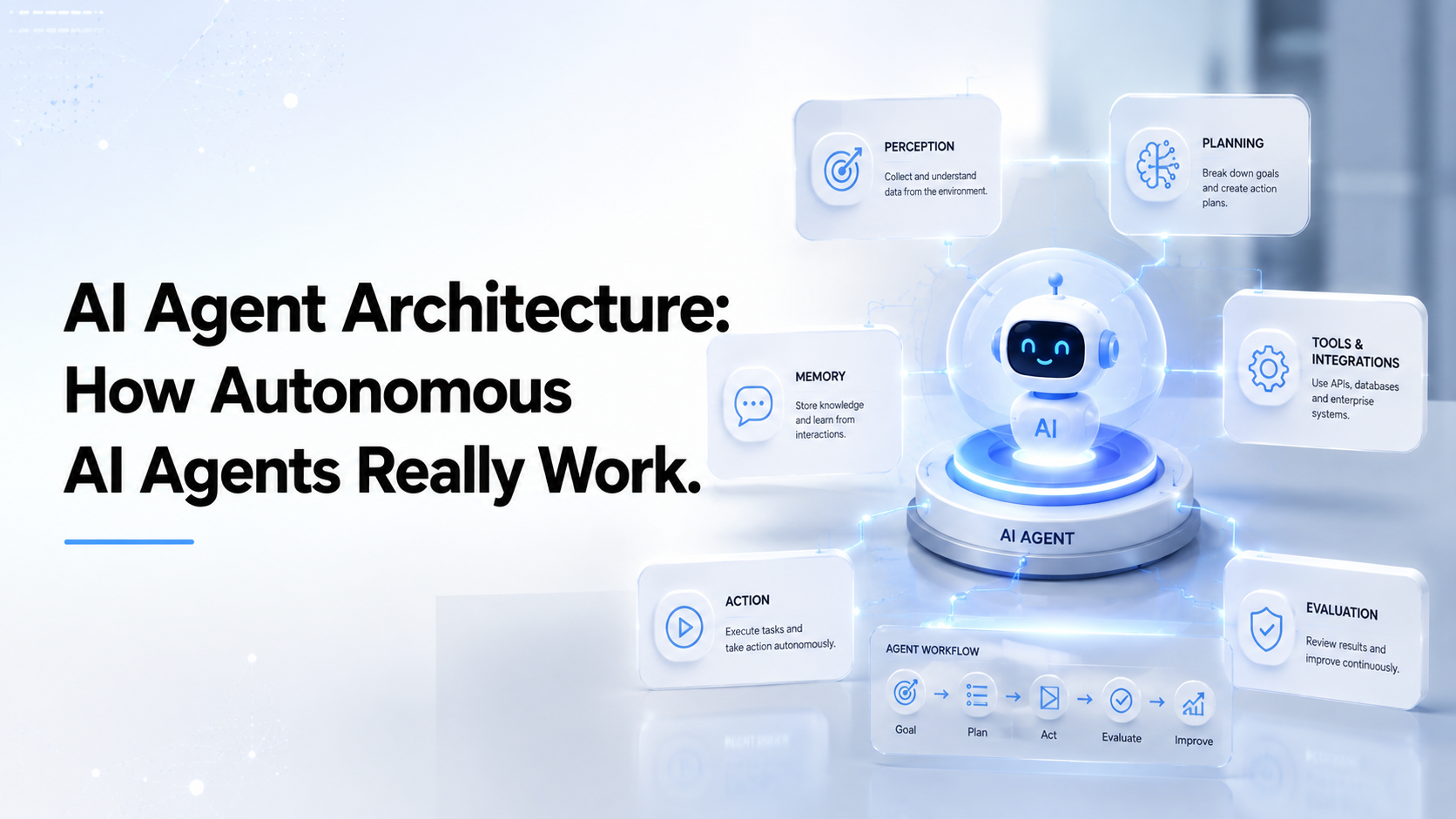
Explore the complete architecture of autonomous AI agents, including perception, reasoning, memory, planning, tools, and learning. Discover how enterprises use agentic AI to automate complex workflows.
AI agent architecture is the structure that enables autonomous AI agents to collect data, make decisions, access memory, interact with enterprise tools, and execute tasks with minimal human intervention. In business, this framework allows AI to automate real-world workflows.
And as enterprises embrace AI at a breakneck pace, customer expectations are changing, too. Gartner predicts that 33% of all enterprise software applications will be using agentic AI by 2028, up from less than 1% in 2024. Agentic AI will be expected to make at least 15% of daily work decisions autonomously. (Source: Gartner Predicts More Than 40 Percent of Agentic AI Projects Will Be Abandoned by Year-End 2027). This rapid change highlights the importance of AI architecture to integrate and scale securely across different business functions.
This is why businesses increasingly view Agentic AI architecture as a competitive advantage, as it directly aligns AI capabilities with business outcomes.
Unlike conventional chatbots that only answer questions, agentic AI systems understand intent, plan and execute actions across business applications, and learn from every interaction. For decision-makers considering AI solutions, it’s important to know this architecture, as it impacts the AI’s ability to deliver desired business outcomes.
AI Agent Architecture: How autonomous agents operate
The AI agent architecture outlines the functional structure of an autonomous AI agent. It integrates perception, logic, memory, action, learning, and orchestration into a unified system, allowing the agent to always act towards business goals without the need for human supervision. Think of it as the foundational operating system that powers a highly capable digital employee.
An AI agent behaves like a human employee. It collects information, assesses the situation, draws on experience, uses company resources, and acts. The difference is that an AI agent does all of these tasks in real time and at a far greater scale.
This architecture enables organizations to automate complex customer journeys across sales, customer support, operations, marketing, and service with consistency, speed, and governance.
Agentic AI learns with changing customer wants, company policies, and operational context, unlike rule-based automation. It’s not just responding to prompts; it has a goal, a business goal that it needs to meet, and that’s why the architecture is so critical to the outcome.
The Main Components of an AI Agent
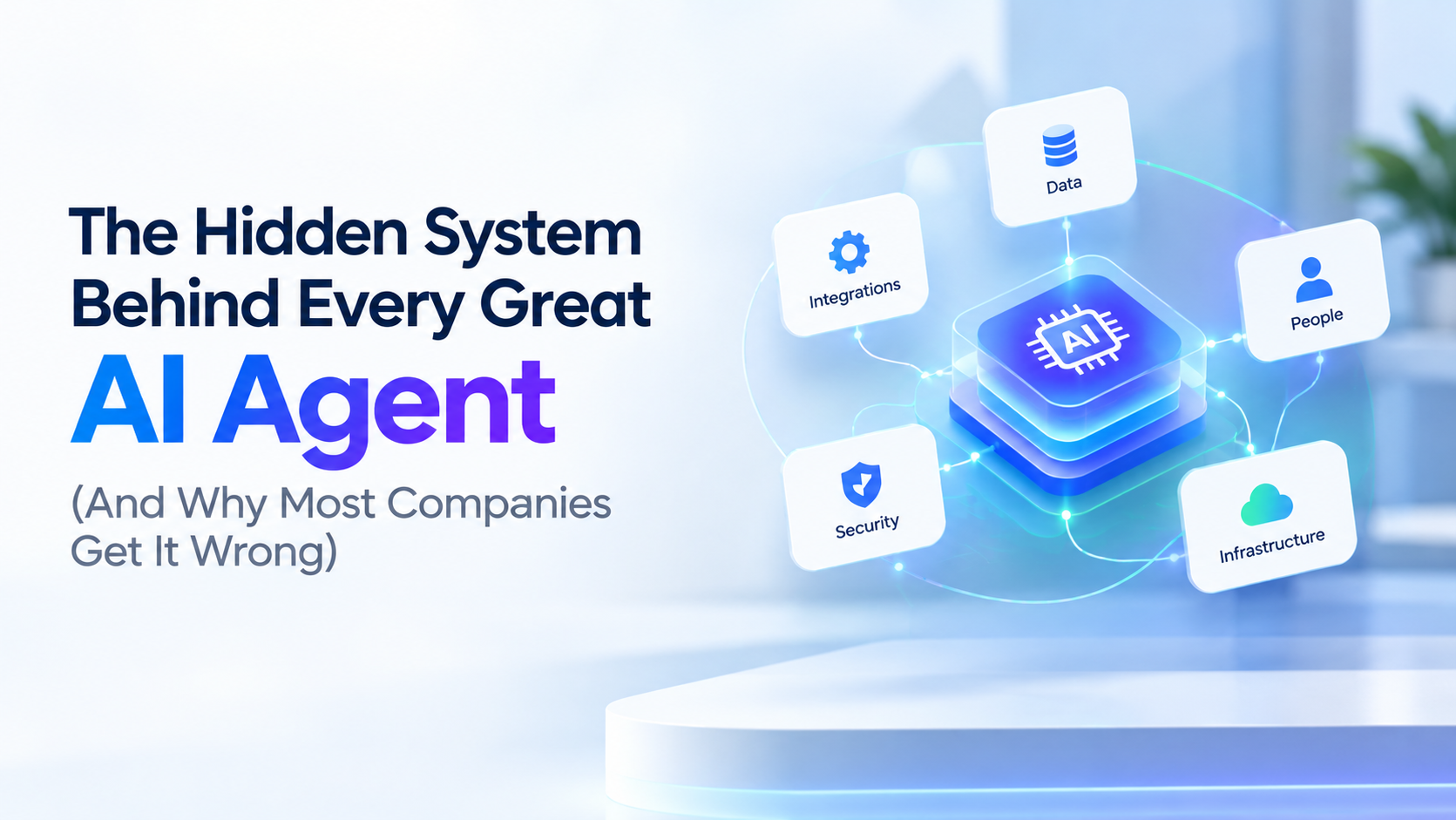
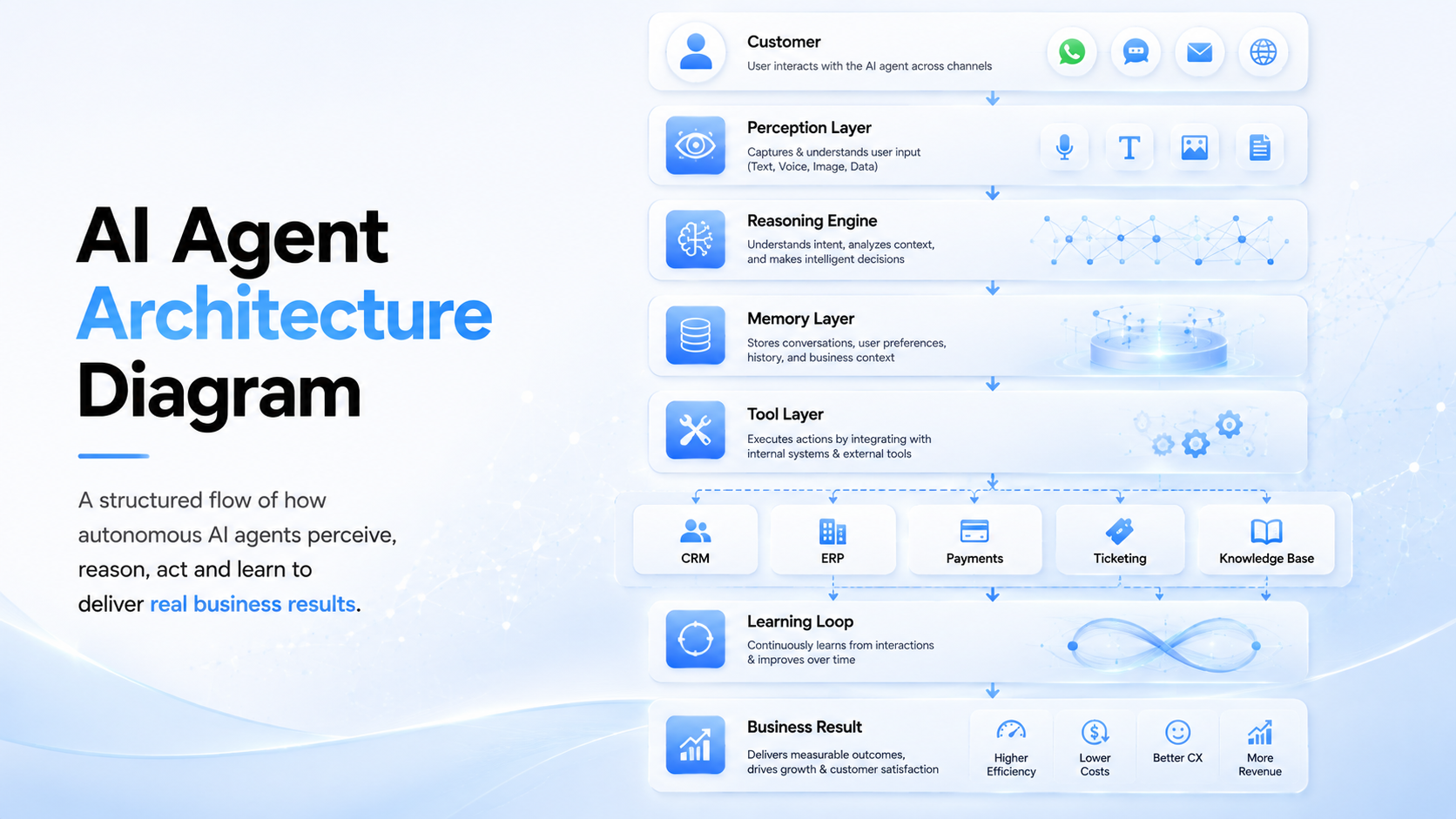
Each enterprise-grade AI agent is built up from several connected architectural layers. Each layer plays a different role to allow the agent to understand, decide, and act intelligently.
Perception Layer: Context Awareness
Perception is the beginning of all interaction. This layer consumes user input from numerous sources, such as WhatsApp, Voice AI, websites, Google RCS Messaging, email, and social platforms, and transforms the user input into organized information that the AI can understand.
Today, perception is far more than keywords. It can determine customer intent, detect sentiment, recognize language, extract entities, and interpret conversational context.
The perception layer senses the customer’s words as well as the customer’s intent, e.g., if a customer says, “I need to reschedule my delivery." The more an AI “knows” about customer intent, the better it can automate the next step. Then comes reasoning to decide what to do next.
Reasoning Layer: Deciding the Next Best Action
Understanding a request is merely the initial step. This layer analyzes available information, business rules, customer history, business policies, and operational limitations to determine the next appropriate action.
The AI doesn’t use pre-defined scripts but instead evaluates several viable actions and picks the one that will most likely lead to the desired business outcome.
For example, when a customer requests a refund, the reasoning engine verifies:
● Eligibility to order
● Refund policy
● Customer purchase history
● Signs of Fraud
● Service-level agreements
Based on these inputs, it determines whether the refund can be automatically approved, whether an exchange can be offered, or whether the request should be escalated to a human representative.
That ability to reason is what makes conversational AI intelligent business automation. Then the agent also needs memory to carry context across interactions.
Memory Layer: Powering Connected Customer Experiences
Customer journeys don’t happen in one conversation for enterprises. Customers move across channels, devices, and interaction modes. No memory. Each conversation is a fresh start.
The memory layer maintains context across the customer lifecycle. All effective AI agent architectures have various types of memory in them:
● Short-term memory maintains context for the current interaction.
● Episodic memory. Keeps track of previous conversations and interactions with customers.
● Semantic or vector memory allows the AI to recall relevant business knowledge, policies, FAQs, and documentation based on meaning rather than specific keywords.
By leveraging these memory systems, AI agents are able to deliver personalized, context-aware experiences across all touchpoints.
Tool Use and Action Layer: Making Decisions and Achieving Results
An AI agent is useful when it does work, not just when it generates responses. The action layer connects AI to enterprise systems, such as CRM platforms and ERP systems.
● CRM platforms
● ERP systems
● Payment gateways
● Knowledge bases
● Order management systems
● Ticketing applications
● Scheduling software
No need for employees to do everything manually. The AI agent can then do things securely.
● Creating support tickets
● Updating customer records
● Making appointments
● Handling refunds
● Sending out notifications
● Routing conversations
● Triggering workflow automation
This capability allows companies to transcend conversational AI to realize autonomous business execution.
Learning and Feedback Loop: Constant Improvement
Enterprise AI should get smarter over time. The learning layer learns from feedback from completed interactions, customer outcomes, business metrics, and human reviews to improve future decisions. The AI reviews successful resolutions and looks for areas of improvement, which helps it to understand intent better, select actions, and execute workflows.
This feedback loop allows organizations to increase automation rates while still achieving high levels of customer satisfaction and functional accuracy.
Single-Agent vs. Multi-Agent Architecture
One of the architectural decisions is whether to create a single AI agent or a network of specialized agents that collaborate. The answer is business complexity. When that complexity is low, one AI agent might be enough.
When Single Agent Is Sufficient
A single AI agent is good for focused, well-defined tasks like
● Answering FAQs
● Setting up appointments
● Lead capture
● Tracking orders
● Basic customer support
For small teams or narrowly scoped workflows, a single-agent architecture offers faster deployment and simpler governance. However, as responsibilities expand among departments, performance can decline. When that happens, multi-agent orchestration becomes more appropriate.
Multi-Agent Orchestration Patterns
Large enterprises are moving towards a multi-agent architecture where specialized AI agents cooperate under an orchestration layer.
This architectural pivot reflects how enterprises are scaling AI beyond one-off use cases. McKinsey’s latest State of AI research found that organizations are increasingly deploying AI across multiple business functions, with the highest value created when AI supports end-to-end business processes rather than standalone tasks (Source: The state of AI: How organizations are rewiring to capture value). Multi-agent architectures fit this approach, with specialized AI agents working together across customer service, sales, operations, and support, delivering greater efficiencies and improving the customer experience.
For instance:
● The sales agent qualifies and nurtures leads.
● The Support Agent resolves customer issues.
● The billing agent handles invoices and payments.
● Incoming and outbound calls are handled by the Voice AI Agent.
● The supervisor agent is responsible for task coordination, context sharing, and conversation routing between specialized agents.
Model Context Protocol (MCP) for AI Agents to Connect to Data and Tools
The value of an AI agent is only as good as the systems it can talk to.
Even the most advanced reasoning model won’t be able to solve the customer issue if your CRM, ERP, payment gateway, knowledge base, or ticketing platform is not available. Enterprise AI’s value comes when it connects intelligence to business systems.
For each integration, custom APIs and middleware were required. As organizations' technology stacks grew, these integrations became increasingly difficult to maintain, slowing innovation and increasing operational costs.
Here’s where Model Context Protocol (MCP) is revolutionizing enterprise AI. It provides a common way for AI agents to interface with external tools, apps, and data sources. The Model Context Protocol is a newly introduced open standard that establishes a uniform interface, enabling AI agents to interact with external tools, applications, and data sources. Organizations don’t have to build a unique integration for every enterprise application; instead, they can use a uniform approach to connect AI agents with the systems they use every day.
Think of MCP as a common communication layer between AI and enterprise software. Organizations can ask “How fast can we roll out new capabilities?” instead of “Can this AI work with our systems?
For enterprises, the platform provides several benefits:
● Quicker deployment of AI initiatives
● Easier integration
● Cost reduction of maintenance
● Improved interoperability between enterprise applications
● Freedom to evolve technology stacks while not needing to rebuild AI workflows
As agentic AI architectures mature, standards like the Model Context Protocol will be critical to enabling scalable, future-proof agentic AI architectures. A common misunderstanding regarding agentic AI is the belief that utilizing a powerful language model automatically yields an intelligent AI agent.
It doesn’t.
LLMs generate language. Reasoning models determine how an AI thinks, evaluates options, and decides on actions to achieve a goal. This is an important difference. It also explains why prompts and reasoning models play different roles in agent behavior.
A prompt is a question for an AI to answer. A reasoning model assists an AI in determining what to do next. Say a customer wants to change an insurance policy, for example. A classic chatbot would answer questions about the policy.
An AI agent powered by a reasoning model assesses customer eligibility, checks policy rules, verifies regulatory requirements, updates internal systems, and determines whether human approval is required before completing the request.
Reasoning includes planning, weighing alternatives, applying business policies, and coordinating activities across enterprise systems. It’s not just a prompting technique; it’s an architectural feature.
When enterprises think about AI platforms, they need to look beyond model size and benchmark scores. “The real differentiator is the platform’s ability to effectively combine reasoning with memory, orchestration, governance, and enterprise integrations to automate business outcomes.”
AI Ethics, Governance, and Guardrails
With AI agents becoming more autonomous, governance is a business requirement, not a technical feature. Enterprise AI needs to be smart enough to make decisions, but the decisions need to be transparent, secure, and accountable.
A strong AI agent architecture incorporates governance across every layer of the system. The key capabilities for governance are
● Explainability: All decisions should be traceable and understandable.
● Human-in-the-loop controls: Actions that are sensitive or critical, such as approvals for financials or procedural changes, should require human approval as needed.
● Role-based access controls: AI agents should only be able to access systems and data that are relevant to the roles they perform.
● Audit trails: All actions should be logged for compliance and operational review.
● Data privacy and security: Customer data should be protected by enterprise-grade security practices and comply with applicable regulations.
● Continuous measurement: Measure AI performance for accuracy, safety, compliance, and business impact.
With these guardrails, organizations can scale AI responsibly while maintaining trust with customers, employees, and regulators. Governance is crucial for managing compliance in innovation in industries like healthcare, banking, insurance, and automotive.
Chat360 weaves governance into its Agentic AI platform with transparent decision flows, enterprise-grade security, and compliance-ready architecture. When you combine these capabilities with omnichannel orchestration, organizations can automate customer engagement while retaining visibility, control, and accountability across every engagement.
A Practical Example: AI agent architecture in action
Let’s say a customer bought a product online and then contacted the company on WhatsApp to ask about the status of the delivery. The perception layer identifies the customer’s intent and fetches the order details from the order management system.
The reasoning layer takes into account the shipping information, delivery policies, and the available fulfillment options and decides the next best action. The memory layer knows that the customer had reported a delivery preference previously, so it carries that context forward.
The action layer updates the delivery schedule, updates the CRM record, notifies the logistics system, and sends a confirmation message to the customer. The customer calls the support center on Voice AI later.
The AI agent takes over the conversation with all of the context, instead of asking the customer to repeat the issue. It acknowledges the preceding WhatsApp chat, verifies the revised delivery schedule, and gives a tailored reply.
Beneath the hood, a collection of specialized AIs collaborate to generate a single harmonious experience. The customer sees a single conversation, but the architecture handles perception, reasoning, memory, enterprise integrations, and automation across multiple systems.
Learn how Chat360’s integrated Agentic AI platform helps enterprises create intelligent customer journeys across WhatsApp, Voice AI, Google RCS Messaging, websites, CRM platforms, and enterprise applications.
Architecture of Future AI Agents
Enterprise AI is evolving from conversational automation to autonomous execution. Organizations that invest in scalable AI agent architecture today will be better positioned to automate customer engagement, improve business efficiency, and deliver personalized experiences across every touchpoint.
Success will depend on more than just picking the right language model. It will boil down to selecting a platform that integrates reasoning, memory, orchestration, governance, enterprise integrations, and open standards like Model Context Protocol into one unified architecture.
And that’s what makes it possible for AI to go from answering questions to driving business outcomes. For enterprise leaders, the question isn’t whether to adopt Agentic AI but whether the architecture behind it is built to scale with your business.
Frequently asked questions
AI agent architecture is the framework that allows autonomous AI agents to perceive information, reason through decisions, access memory, use enterprise tools, and carry out tasks with limited human intervention.