7.3 Billion Cyber Week Interactions: Will Your Customer Support Survive the Rush?
With 7.3 billion brand-customer interactions projected during Black Friday and Cyber Monday 2026, retailers face a growing customer support challenge. Discover how AI Agents and Omnichannel Marketing can help businesses manage conversation surges, reduce response delays, prevent lost sales, and deliver seamless customer experiences during Cyber Week.
Your biggest Cyber Week campaign could bring thousands of customers to your business. But what happens when they all need an answer at the same time?
It is 8:00 PM on Black Friday.
Your discount campaign is performing better than expected. Website traffic is climbing. Orders are coming in, but WhatsApp notifications keep appearing.
Then the questions begin.
"Is this offer still available?"
"Why has my payment been deducted but my order is not confirmed?"
"Can I get this delivered tomorrow?"
"Where is my order?"
Your support team is already handling hundreds of conversations. New enquiries keep arriving. Customers are waiting. Some are sending the same question across WhatsApp, email, and your website because nobody has answered them.
And somewhere in that queue is a customer who was ready to spend money but is now considering another brand. You won the click. You attracted the customer. But can you handle the conversation?
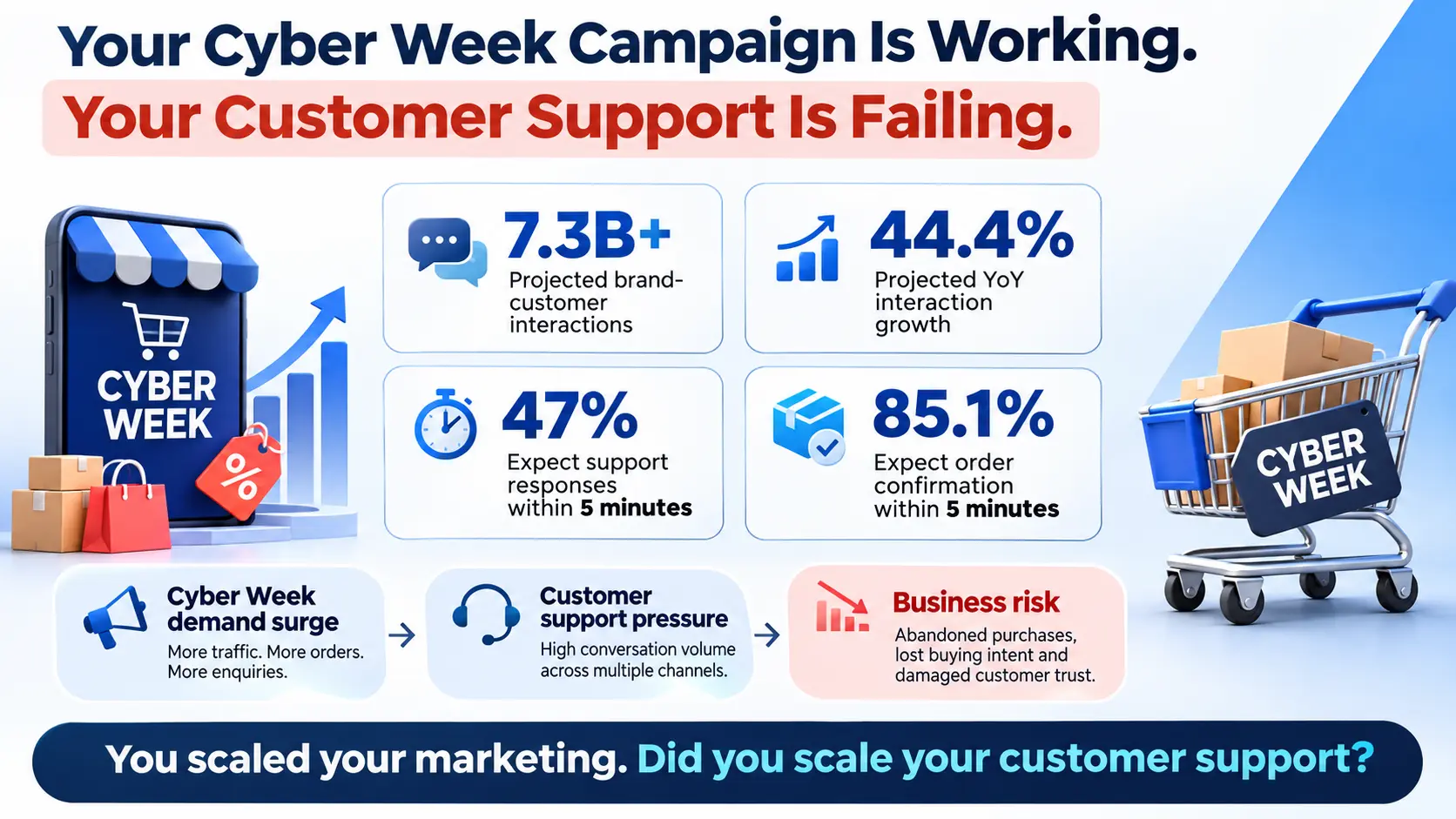
This is the customer support challenge retailers need to prepare for during Cyber Week 2026. Infobip forecasts more than 7.3 billion interactions between brands and customers across Black Friday and Cyber Monday, representing a 44.4% increase year over year. That is not 7.3 billion support tickets. It is a forecast of brand-customer interactions across supported messaging channels. But it signals the scale of communication businesses must prepare to manage.
And the pressure is not coming from message volume alone. Customers are becoming more comfortable using AI to shop, expect faster answers, and move between channels throughout their buying journey. The brands that prepare only for more sales may find themselves unprepared for the conversations that come with them.
7.3 Billion Interactions. One Question: Can Your Support Team Keep Up?
Black Friday and Cyber Monday are no longer isolated shopping days. They are part of a much longer buying journey. Customers discover products, compare prices, ask questions, look for offers, place orders, track deliveries, and request assistance. Every stage creates another opportunity for a business to win or lose trust.
The latest research makes the pressure difficult to ignore.
2026 data point | What it means for retailers |
7.3 billion+ projected brand-customer interactions | More conversations to manage |
44.4% projected year-on-year growth | Communication demand is increasing |
47% of consumers expect a support answer within five minutes | Customers have limited patience |
85.1% expect an order confirmation within five minutes | Transactional communication matters |
63.2% have used an AI assistant or chatbot for shopping | AI is becoming part of shopping behavior |
83% of surveyed Indian consumers have used AI for shopping | The shift is especially relevant to Indian retailers |
76.5% of surveyed Indian consumers chose WhatsApp for order and shipping updates | Messaging is central to the post-purchase experience |
Here is what these numbers mean in practice. Customers are not simply buying more. They are asking more questions before and after buying them. They expect useful information quickly, and they are increasingly comfortable using conversational tools to get it.
A retailer may have enough stock, an attractive discount, and a high-performing advertising campaign. But if customers cannot get answers about delivery, payment, product availability, or returns, the buying experience starts falling apart. The next Cyber Week competitive advantage may not be the biggest discount. It may be the most useful answer.
The Hidden Cost of a Customer Support Meltdown
Let's follow one customer through a typical Cyber Week purchase. A shopper sees an advertisement for a laptop at a limited time price. They visit the website, compare two models, and want to confirm whether the advertised offer includes an extended warranty.
They open the website chat. No useful answer. They try WhatsApp. They receive an automated acknowledgement but no resolution. They send emails. The response arrives hours later. By then, the customer has purchased it from another retailer.
The business did not necessarily lose this customer because its product was expensive. It lost the opportunity because the customer could not get the information needed to make a decision. Now multiply that situation across thousands of enquiries.
The damage can extend beyond missed purchases:
1. Abandoned purchases: Customers who cannot get quick answers may leave before completing checkout.
2. Repeated enquiries: Customers contact multiple channels because they do not know whether anyone is responding.
3. Overloaded support teams: Employees spend valuable time answering the same questions instead of resolving complex cases.
4. Poor post-purchase experiences: Delayed order confirmations and delivery updates create anxiety after payment.
5. Lost customer trust: Conflicting answers across channels make a brand appear disorganized.
The real danger is that businesses often measure campaign performance through clicks, conversions, and revenue while overlooking how much customer demand their support operation can handle. A successful campaign can expose a weak support system.
The 5-Minute Expectation: Customers Are Not Waiting in Your Queue
One finding from Infobip deserves particular attention: 47% of surveyed consumers globally expect a customer support response within five minutes. That expectation becomes difficult to meet when thousands of customers ask questions during the same shopping period.
Consider what happens when a retailer receives a sudden increase in enquiries:
A customer needs help with a failed payment.
Another wants to change the delivery address.
Someone else wants to know whether an offer applies to their order.
A potential buyer is comparing products.
A customer wants to return an item purchased earlier.
These are different problems. They should not all be forced into one support queue. Yet that is exactly what happens when businesses rely heavily on manual responses and disconnected communication channels. Hiring temporary support staff may help, but it does not automatically solve repetitive enquiries, inconsistent information, or fragmented customer histories. Retailers need a way to handle predictable requests quickly while protecting human support capacity for situations that require judgement. This is where an AI Agent becomes important.
AI Agents: The Difference Between Answering Questions and Getting Things Done
A traditional chatbot can answer a predefined question such as "What is your return policy?"
But what if the customer asks:
"I ordered a laptop yesterday. Can you check whether it has shipped, tell me when it will arrive, and help me change the delivery address if it has not been dispatched?
That is not just a question. It is a sequence of tasks. An AI Agent can understand the request, identify the required information, and support the relevant workflow when connected to authorized business systems.
For example, during Cyber Week, an AI Agent can help retailers:
Answer product and offer questions: Provide approved information about prices, features, availability, and promotional terms.
Support order enquiries: Retrieve order information through authorized integrations and share relevant updates.
Assist with common requests: Guide customers through suitable delivery, cancellation, and return workflows.
Support purchase decisions: Help shoppers compare products and find options that match their requirements.
Escalate complex cases: Recognize when a customer needs a human representative and transfers the conversation with relevant context.
The difference is important. An AI Agent is not simply another automated reply system. It can help move customer interaction towards a defined outcome. However, the capabilities depend on the systems it can access, the workflows configured, and the permissions granted. Sensitive actions may still require customer confirmation or human approval. For retailers, this creates an opportunity to manage high-volume interactions without making every customer wait for a human employee.
The $75.8 Billion AI Shopping Opportunity Retailers Cannot Ignore
There is another reason Cyber Week 2026 is different. AI is no longer influencing customer support. It is changing how people discover products, compare offers, and decide what to buy.
According to Salesforce's November 19, 2026, Cyber Week forecast:
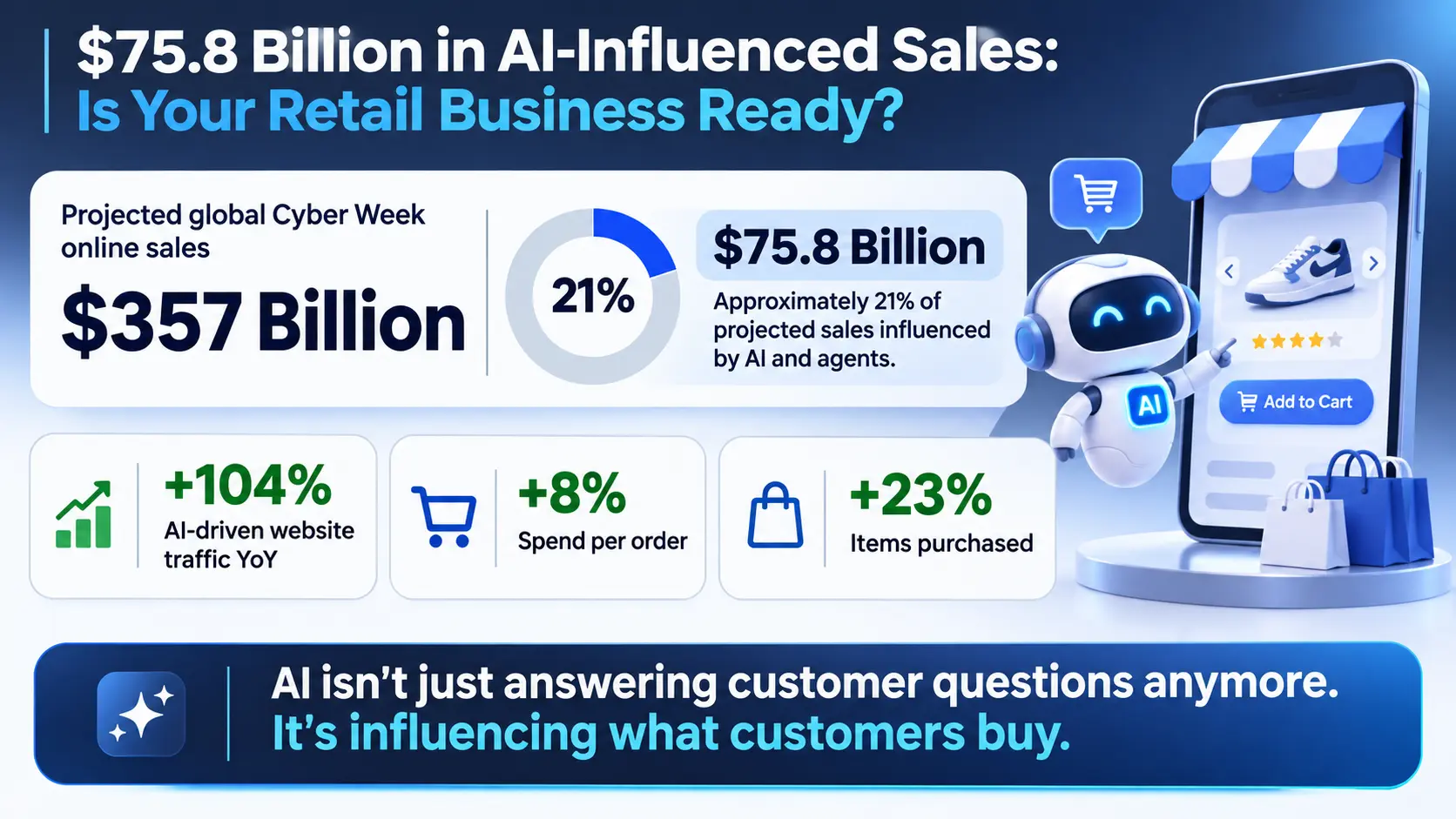
Global online Cyber Week sales are expected to reach $357 billion.
An estimated $75.8 billion, or 21% of sales, will be influenced by AI and agents.
AI-driven traffic to retailer websites has increased 104% year over year.
Shoppers engaging with a retailer's agent spend 8% more per order and purchase 23% more items, according to Salesforce's analysis.
These are Salesforce forecasts and reported platform findings, not confirmed for final Cyber Week results. The message for retailers is clear: AI is influencing the buying journey before a customer even reaches the support team.
A shopper may use an AI assistant to compare products, arrive at a retailer's website with specific requirements, and expect immediate help. If the retailer cannot provide relevant information, the customer can continue looking elsewhere.
This is why businesses should not treat AI customer support as a tool that is useful only after checkout. An AI Agent can support discovery, product questions, purchase consideration, and post-purchase service, provided with the necessary capabilities and integrations available. The opportunity is to connect these stages rather than automate them separately.
Omnichannel Marketing: Stop Making Customers Repeat Themselves
Imagine a customer journey during Cyber Week. A shopper discovers a product through an advertisement, visits your website, asks a question on WhatsApp, receives an order confirmation, and later contacts support about delivery.
From the customer's perspective, this is one relationship with one brand. But inside the business, these interactions may sit across different platforms, teams, and systems.
That is where the customer experience breaks. An effective Omnichannel Marketing strategy connects these touchpoints so customers can continue their journey without repeatedly explaining who they are or what they need.
Consider how a connected journey could work:
Customer interaction | Channel | Possible AI-powered support |
Discovers a product | Website | Answers questions and explains product features |
Compares offers | Shares relevant, approved offer information | |
Receives a promotion | RCS | Delivers rich, interactive campaign information |
Places an order | Website or app | Provides confirmation and transaction updates |
Tracks delivery | WhatsApp or voice | Retrieves available order information |
Reports a problem | Human support | Receives the conversation with relevant context |
This is where Omnichannel Marketing becomes a business advantage rather than simply a channel strategy. Customers should not have to start again every time they switch from a website to WhatsApp or from messaging to voice. When supported by connected systems and shared customer context, an AI Agent can help maintain continuity across these interactions. For retailers, the goal is simple: make every customer touchpoint feel like part of the same experience.
Your Cyber Week Customer Support Readiness Checklist
Before your next campaign goes live, ask these seven questions.
What to check | What a prepared business should have |
Repetitive enquiries | A tested automation strategy for common questions |
Product information | Accurate and approved product, pricing, and offer details |
Order updates | Reliable access to relevant order information |
Communication channels | Connected website, WhatsApp, RCS, and voice experiences |
Human escalation | Clear rules for complaints and complex requests |
System readiness | Tested integrations and realistic peak-load simulations |
Performance tracking | Response time, resolution time, escalation, satisfaction, and conversion metrics |
Do not wait until Black Friday to discover that your support process cannot handle a sudden increase in conversations. Test real customer scenarios before the campaign begins. Check whether the right information is available, whether the workflow completes successfully, and whether a human can take over when needed.
An AI Agent should be tested against real customer requests, not just a list of simple demonstration questions. Likewise, an Omnichannel Marketing strategy should be measured by how well customers move between channels, not by how many platforms a brand has activated.
How Chat360 Helps Businesses Prepare for High-Volume Customer Conversations
When Cyber Week demand rises, businesses need more than another inbox. They need a way to understand customer intent, manage repetitive interactions, connect communication channels, and move customers towards the right outcome.
Chat360 is an Enterprise Agentic AI Platform designed to help businesses automate customer engagement and workflows across WhatsApp, Voice, RCS, Web, and other channels.
Through AI Agents and connected business integrations, enterprises can:
Automate common sales and customer support enquiries.
Respond to customer questions with relevant context.
Support lead qualification and purchase-related conversations.
Connect customer interactions with CRM, ERP, and other business systems.
Build connected customer journeys through Omnichannel Marketing.
Route complex conversations with human teams when required.
For retailers, this means a more coordinated way to manage customer conversations before, during, and after peak shopping events. An AI Agent can take care of suitable routine interactions, while human teams focus on complaints, exceptions, and decisions that require personal attention.
The objective is not to remove the human side of customer service. It is to make sure customers get help without unnecessary delays. Explore Chat360 to see how Agentic AI can help businesses turn customer conversations into automated journeys and measurable business outcomes.
The Biggest Cyber Week Mistake Is Winning the Sale but Losing the Customer
A discount can attract attention. An advertisement can bring a customer to your website. A great product can convince them to buy it. But none of that guarantees good customer experience.
During Cyber Week, a delayed answer can turn buying intent into frustration. An unanswered WhatsApp message can send a customer to a competitor. A missing delivery update can turn a successful order into a support complaint.
The 7.3 billion projected interactions are not just a message-volume forecast. They are a warning about the scale of customer conversations businesses must be ready to manage. Retailers that combine AI Agent capabilities with a connected Omnichannel Marketing strategy can prepare more than the rush of incoming messages. They can create customer journeys that continue from discovery to purchase and support.
Because Cyber Week is not won when a customer clicks "Buy Now." It is won when the customer gets the experience they expected, even when everyone else is shopping too.
Frequently asked questions
As per the research, more than 7.3 billion interactions between brands and customers across supported messaging channels during the 2026 Black Friday and Cyber Monday shopping period. This represents a projected 44.4% year-on-year increase.