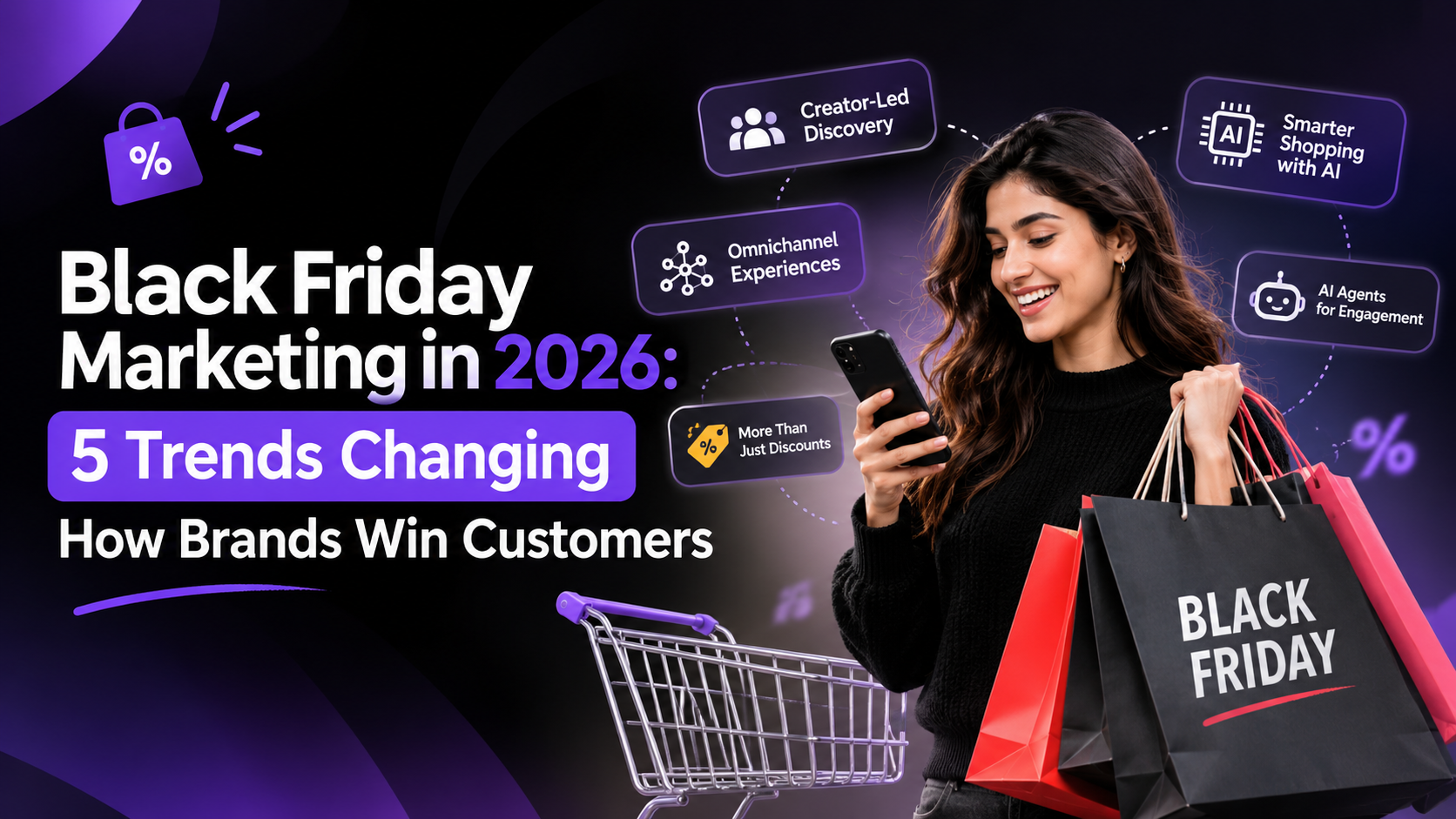
Black Friday Marketing in 2026: 5 Trends Changing How Brands Win Customers
Black Friday 2026 is changing how customers discover, compare and buy. Explore five marketing trends shaping the season, including AI-powered shopping, creator-led discovery, omnichannel customer experiences and AI Agents, and learn how brands can turn customer interest into measurable conversions.
Your Black Friday campaign can generate thousands of clicks and still lose the sale. Not because your offer was weak, but because a customer could not get an answer when they were ready to buy.
Imagine someone discovering a product through an Instagram creator, comparing alternatives using AI and visiting a brand's website. They send a WhatsApp message to check availability, but the response arrives too late. The customer moves on and buys elsewhere.
The advertisement did its job. The customer experience did not.
This is the challenge shaping Black Friday marketing in 2026. Brands must do more than attract attention. They need to turn interest into useful conversations, confident decisions and completed purchases. An effective omnichannel marketing strategy helps connect these interactions across the buying journey.
With Black Friday falling on November 27 and Cyber Monday on November 30, here are five trends changing how businesses attract and convert customers.
Black Friday 2026: What the Latest Research Reveals
Black Friday is no longer limited to a single weekend. Consumers are researching products earlier, discovering offers across more platforms and continuing to shop beyond the main sale period.
Experian's analysis of the 2025 holiday season found that 45% of consumers planned to start shopping before November, 84% had started by Thanksgiving weekend and 62% expected to continue shopping into December. The National Retail Federation reported 202.9 million shoppers during the 2025 Thanksgiving weekend.
Upfluence analysed 1.2 million Black Friday creator posts across Instagram, TikTok and YouTube. It found that 64% of TikTok posts and 46% of Instagram posts published during November 2025 appeared before Cyber Week.
AI is changing product discovery too. Adobe reported a 693.4% year-over-year increase in traffic from generative AI sources to US retail websites during the 2025 holiday season.
These findings point to a shift: Black Friday is becoming a connected buying journey rather than a short promotional event.
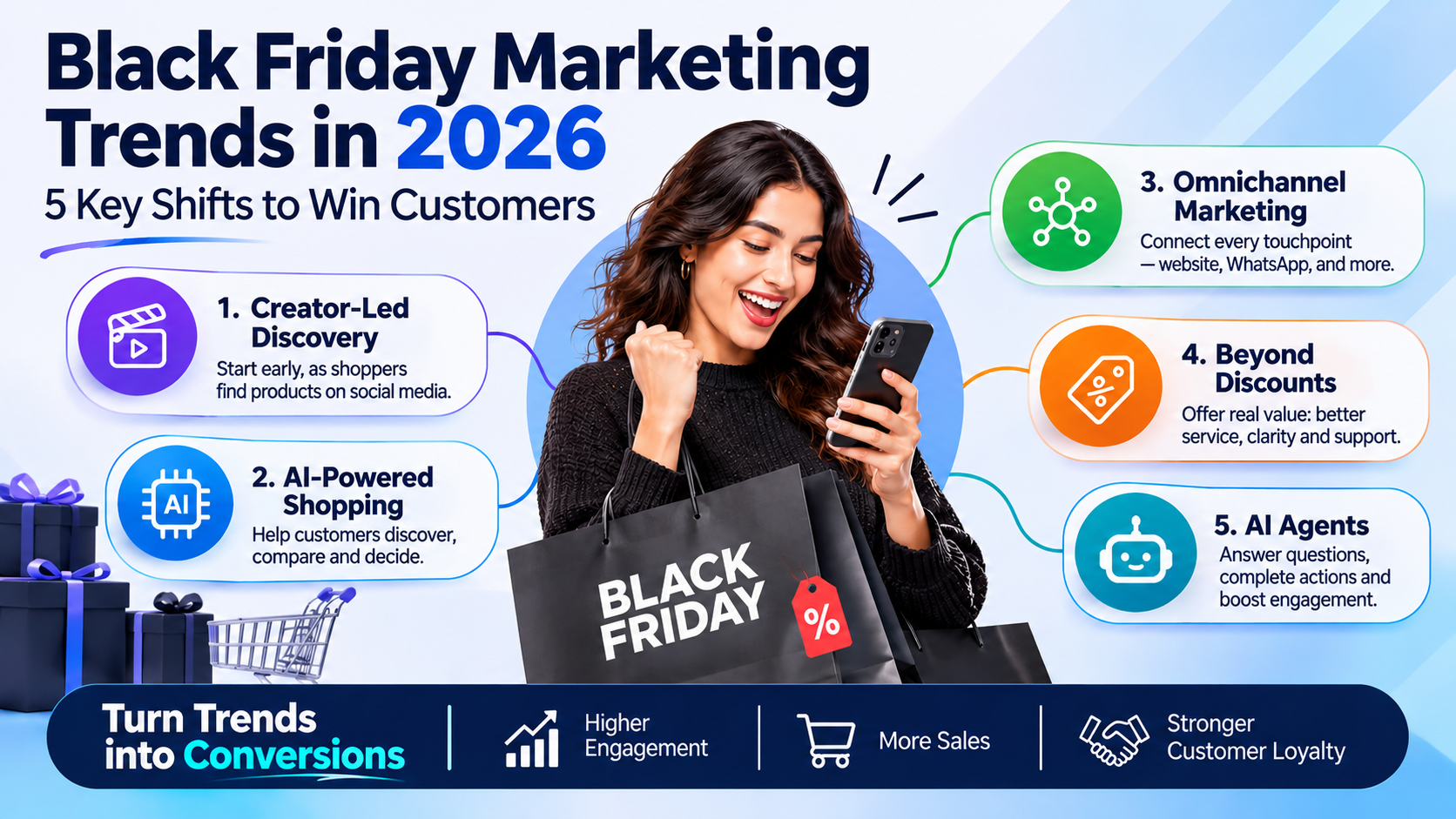
5 Black Friday Marketing Trends Brands Cannot Ignore in 2026
1. Creator-Led Discovery Is Starting Earlier
For many shoppers, the path to a Black Friday purchase begins on social media rather than a brand's website.
Creator videos, product demonstrations and recommendations introduce products while customers are still exploring their options. By the time the main sale begins, some shoppers may already have shortlisted what they want.
Upfluence found that Instagram posts mentioning Black Friday doubled by October 20, 2025, and reached ten times their early-October level by November 3. Its research also found that 64% of TikTok Black Friday posts published during November appeared before Cyber Week.
Waiting until Black Friday week to build awareness can therefore mean missing shoppers who have already evaluated competing products.
What brands should do: Start creator campaigns early. Use demonstrations and reviews to communicate product value, answer common questions and direct interested audiences towards useful product information. Measure referral visits, product enquiries and attributable conversions, not just views and likes.
The opportunity is not simply to get more people talking about a product. It is to make their interest easier to act on.
2. AI Is Changing How Customers Discover and Evaluate Products
Product discovery is no longer limited to search engines, marketplaces and social media feeds. Consumers increasingly use AI-powered tools to compare products, understand features and explore alternatives.
Experian's 2026 analysis reports that 42% of consumers used AI to help shop for gifts during the 2025 holiday season. Adobe separately recorded a 693.4% increase in generative AI traffic to US retail websites.
These figures measure different aspects of AI-assisted shopping, but both indicate that AI is becoming part of product discovery.
This changes what brands need to communicate online. Product descriptions, specifications, pricing, policies and FAQs must be accurate and easy to understand. Missing information makes it harder for customers to evaluate an offer and for AI-powered tools to interpret what a business provides.
What brands should do: Maintain consistent product information across websites and communication channels. Publish useful comparisons, explain product benefits and answer common purchase questions. AI Agents can also help customers move from product enquiries to relevant next steps, provided their responses are grounded in approved business information.
The goal is not to add AI everywhere. It is to make discovery and decision-making easier.
3. Omnichannel Marketing Is Becoming a Customer Experience Requirement
A customer may discover an offer on Instagram, research it on a website, ask about availability on WhatsApp and complete the purchase through an online store or physical outlet.
For the customer, these are touchpoints in one buying journey. For a business, they can become disconnected interactions when every channel operates independently.
Consider someone interested in a laptop advertised during Black Friday. They visit the website and send a WhatsApp enquiry to confirm store availability. The response arrives several hours later. By then, they have purchased from a competitor.
The campaign generated interest. The breakdown happened during the conversation that followed.
This is why omnichannel marketing matters. It connects customer interactions across channels so communication remains consistent and easier to continue. Customers should not have to repeat their requirements every time they switch platforms.
What brands should do: Connect the channels customers already use. Keep campaign information, product details and follow-up communication consistent. Use available customer context responsibly to make interactions more relevant and avoid repetitive conversations.
An omnichannel marketing strategy is not about sending the same promotion everywhere. It is about helping customers move between channels without losing context.
For enterprises, this also means aligning marketing, sales and support teams. A connected experience can reduce duplicate conversations, delayed responses and missed opportunities.
4. Discounts Alone Are No Longer Enough to Win Customers
Black Friday is strongly associated with discounts, but a lower price does not automatically make an offer more attractive.
Customers also consider product quality, availability, delivery, payment flexibility, after-sales support and confidence in the seller. When several brands promote similar discounts, the overall buying experience can become the deciding factor.
Upfluence found that 29.7% of Instagram Black Friday posts mentioning a percentage discount included the discount figure. Its research also found that 69.5% of TikTok Black Friday posts carried a shoppable signal, compared with 10.9% on Instagram.
Promotional content is therefore not just about communicating a lower price. The path from discovering an offer to exploring a product matters too.
What brands should do: Explain what an offer includes, highlight relevant product benefits and make delivery, returns and payment terms easy to find. Help customers compare suitable options instead of promoting the same offer to everyone.
Make it easy to ask questions about availability and offer conditions. A customer who cannot get clarity may abandon a purchase even when the discount is attractive.
A strong Black Friday campaign makes the purchase decision easier, not simply cheaper.
5. AI Agents Are Moving Customer Engagement Beyond Basic Chatbots
Black Friday campaigns can generate sudden increases in product questions, availability checks, order enquiries and support requests. If every interaction depends on a human team, response delays can affect the buying experience.
Traditional chatbots generally rely on predefined questions and scripted responses. AI Agents can understand customer intent, retrieve relevant business information and execute permitted workflows through connected systems.
For example, a customer responding to a promotional message may ask whether a product is available, request an alternative and then ask how to complete the purchase. AI Agents can use the available conversation context to provide relevant information and carry out approved actions. Complex or sensitive requests can be escalated to human representatives.
What brands should do: Identify repetitive, high-volume interactions that can benefit from automation. Connect AI Agents to approved product information and relevant business systems, define the actions they can perform and establish clear human escalation paths.
The value is not simply automating conversations. It is reducing the effort between a customer's question and the next useful action.
Connecting Black Friday Campaigns With Customer Engagement
Marketing campaigns can generate views, clicks and enquiries, but those numbers do not necessarily translate into purchases. The gap often appears when customers cannot get timely answers or have to repeat information across channels.
A connected omnichannel marketing experience can help businesses support customers through:
WhatsApp: Answer product questions, explain offers and share updates through a familiar messaging channel. Explore Chat360 WhatsApp solutions.
Voice AI: Assist customers who prefer speaking to a business. Explore Chat360 Voice AI Agents.
RCS: Deliver richer, interactive messaging experiences. Explore Chat360 RCS solutions.
Web: Assist visitors researching products or looking for support.
AI Agents: Understand intent, retrieve information and execute permitted actions through connected workflows. Explore Chat360 AI Agents.
Chat360 is an omnichannel Enterprise Agentic AI Platform connecting customer engagement across WhatsApp, Voice, RCS and web. Its AI Agents are designed to understand customer intent and context, support conversations and execute permitted workflows through connected business systems.
This helps enterprises connect customer enquiries with sales and support processes instead of treating every interaction as an isolated exchange.
The objective is not to automate every interaction. It is to make the next interaction more useful, timely and relevant.
What Should Brands Measure This Black Friday?
Reach, impressions and clicks show how effectively a campaign attracts attention. They do not explain what happens after a customer responds.
Businesses should also monitor:
Conversion rate: How many interested visitors or enquiries become customers?
Enquiry-to-purchase rate: How many conversations lead to a purchase?
Response time: How quickly are customer questions answered?
Abandoned enquiries: How many interested customers fail to complete the next step?
Repeat purchases: How many campaign-acquired customers return?
Connecting campaign data with conversation and sales outcomes gives businesses a clearer view of where customers lose momentum.
Conclusion: Black Friday Success Is About the Entire Customer Journey
Black Friday marketing in 2026 is being shaped by earlier creator-led discovery, AI-assisted shopping, value-conscious customers and buying journeys that move across multiple touchpoints.
Brands need more than attractive discounts. They need clear product information, timely responses and connected experiences that help customers move from discovery to purchase.
An effective omnichannel marketing strategy brings those interactions together, while AI Agents can help businesses respond and act at scale.
The brands that stand out will not necessarily be the ones making the loudest offers. They will be the ones making it easiest for customers to discover, understand, engage and buy.
Frequently asked questions
The key trends include earlier creator-led discovery, AI-assisted shopping, connected customer experiences, value-focused promotions and the growing use of AI Agents. These developments make the complete buying journey more important than the promotional weekend alone.