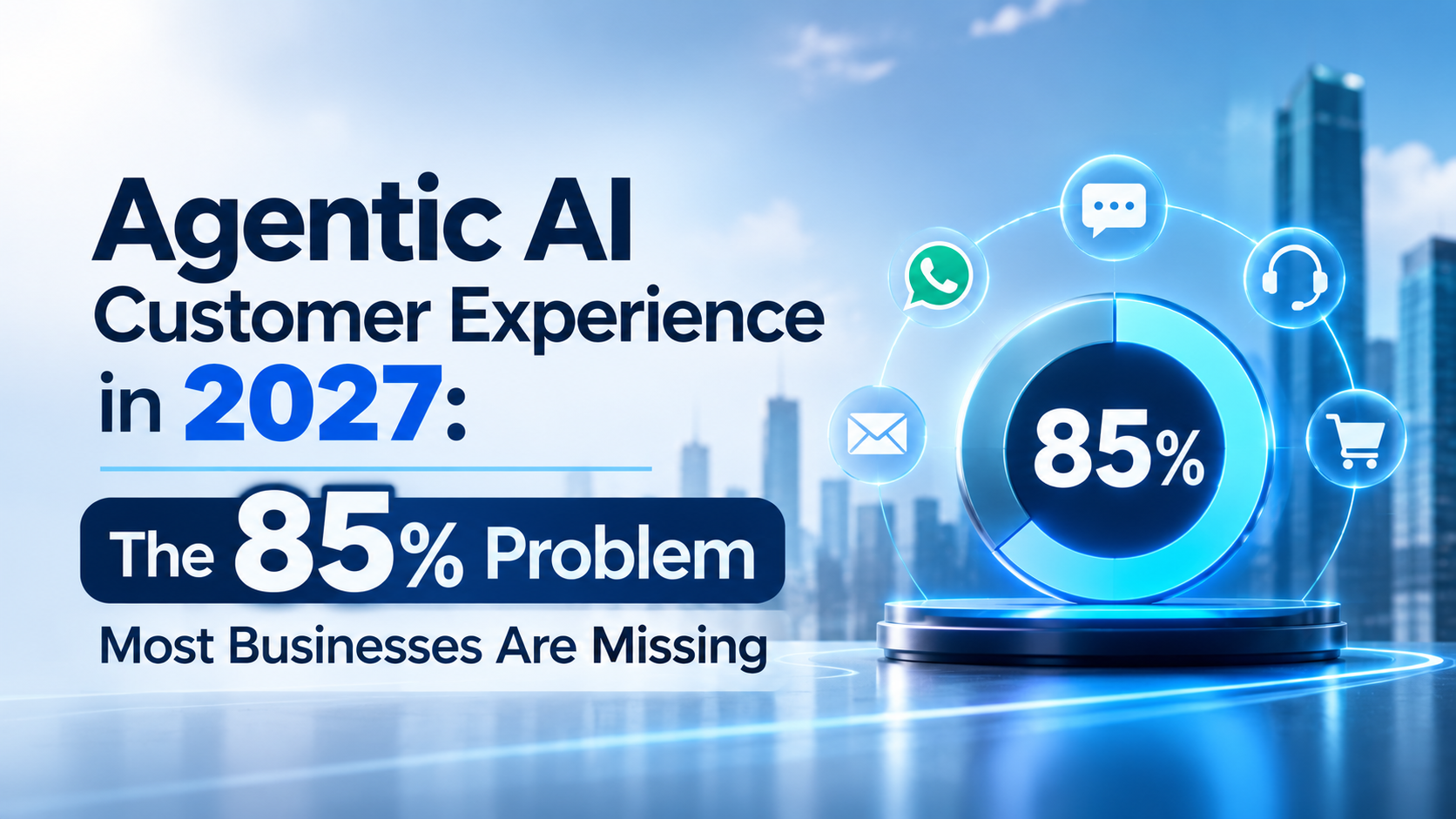
Agentic AI Customer Experience in 2027: The 85% Problem Most Businesses Are Missing
Most businesses are investing in AI to improve customer experience. But deploying more chatbots will not solve disconnected customer journeys, repeated interactions or fragmented workflows. In 2027, Agentic AI will change the equation. Intelligent AI agents will understand customer intent, retain context across WhatsApp, voice and web, coordinate enterprise systems and execute multi-step workflows. Discover why the next era of customer experience will be defined by AI that doesn't just respond to customers, but gets things done.
Your business has WhatsApp automation. A website chatbot. Voice AI. A CRM full of customer records. So why does a customer still have to explain the same problem three times before someone resolves it?
Here is the uncomfortable truth about the future of customer experience: businesses are getting better at deploying AI, but many are still struggling to get AI to finish the work.
In August 2026, Talkdesk reported that 98% of surveyed organizations had deployed AI somewhere in their customer journey. Yet only 15% combined Agentic AI with cross-departmental orchestration to resolve customer needs from end to end. More importantly, only 5% could quantify AI's impact on business outcomes.
That is an 83-percentage-point gap between AI deployment and end-to-end orchestration. This is where the next competitive advantage will emerge. In 2027, the question will no longer be how many conversations a business can automate. It will be how many customer journeys it can successfully complete.
Agentic AI Customer Experience is about connecting customer intent to business execution, across every channel, system, and team involved in delivering the outcome.
Why Is AI Adoption Not Translating into Better Customer Experience?
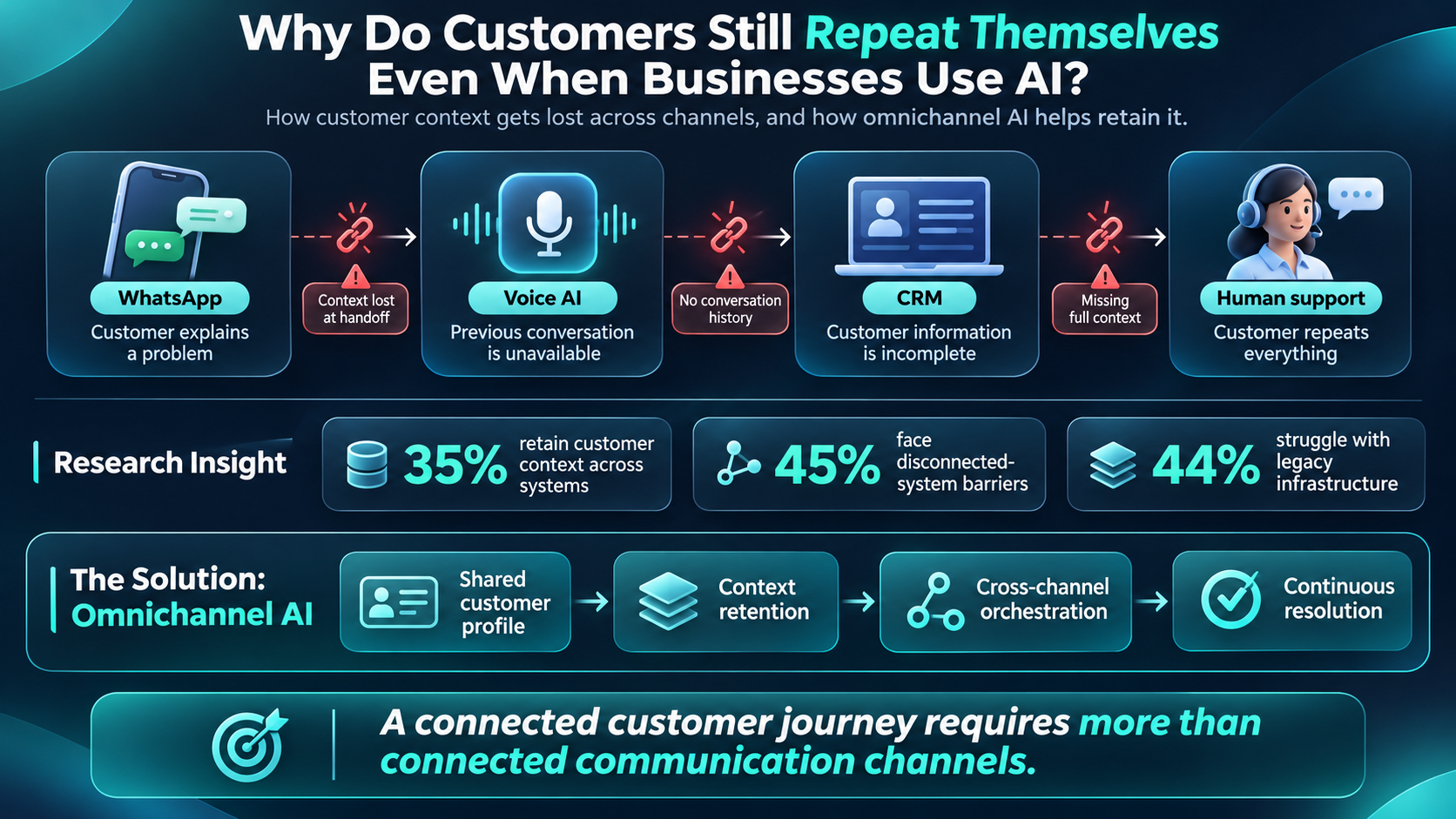
Imagine this situation. A customer contacts a financial services company on WhatsApp to ask about a loan application. The AI assistant collects the details and checks the application status. The customer then calls the support team because a document is missing. The voice system cannot access earlier conversation. An employee searches the CRM, asks the customer to repeat the information, and creates a manual follow-up.
The company has automated two channels. But the customer still experiences one broken journey. The problem is not a lack of AI. It is the absence of coordination between AI, customer data, business systems, and human teams.
Talkdesk's 2026 research reveals why this matters:
Only 35% of surveyed organizations retain customer context when interactions move between systems.
45% face technical barriers from disconnected systems.
44% struggle with legacy infrastructure.
Human agents lose an average of 28% of their time switching systems, re-entering information, and searching for customer context.
These are not simply technology problems. They create additional work, delay resolutions, and increase the cost of serving customers. The next generation of omnichannel customer experience must solve the handoff problem, not just automate the first response.
2027 Will Reward Businesses That Orchestrate AI, Not Just Deploy It
The most important shift is from individual AI tools to coordinate AI agents. A traditional chatbot responds to a question. An Agentic AI system can understand the desired outcome, determine the next steps, access authorized systems, execute permitted actions, and coordinate with other agents or employees.
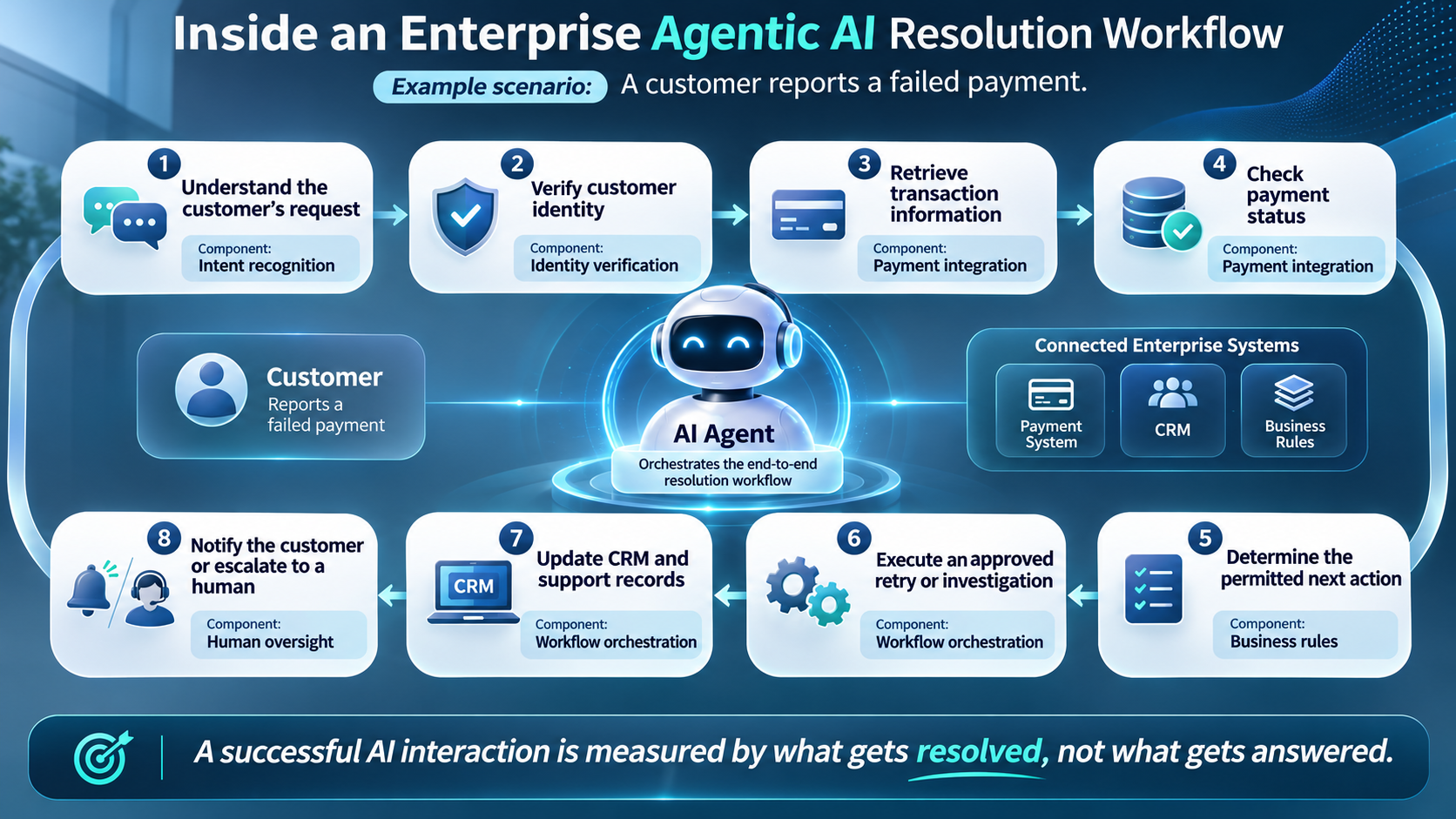
Consider a customer reporting a failed payment. An agentic workflow could:
Identify the customer using an approved verification process.
Retrieve the transaction from the payment system.
Check whether the payment failed, is pending, or completed.
Determine the appropriate next action under business rules.
Initiate an approved retry or create a payment investigation.
Update the CRM or support case.
Notify the customer through WhatsApp or voice.
Escalate the case if the issue requires human approval.
The customer does not need to coordinate these steps. The system does. This is the difference between automating a conversation and orchestrating a customer outcome.
Zendesk's November 2026 CX Trends 2027 research reinforces this direction: 90% of business leaders say effective orchestration across AI agents, data, and systems is essential. Yet 78% say coordinating multiple specialized agents working on a single customer issue is already a major operational challenge.
The future is not about adding another chatbot to every channel. It is about making all the agents, systems, and people work together.
How Will Agentic AI Transform Omnichannel Customer Journeys in 2027?
1. Customer Context Will Become More Valuable Than Channel Reach
A business can be available on ten channels and still deliver a poor omnichannel experience if each channel has a different view of the customer.
Salesforce's 2026 India State of Marketing research found that 71% of Indian marketers struggle to respond promptly because they cannot access the customer context they need. Only 60% reported complete access to service data, 61% to sales data, and 58% to commerce data.
This is a major limitation for AI-powered personalization. In 2027, AI agents will need access to relevant, permission-based customer context across CRM, service, sales, commerce, and communication systems. A conversation should continue with the information already available, rather than restart with every channel to change.
What changes: Businesses move from channel-based engagement to context-driven customer journeys.
2. AI Performance Will Be Measured by Resolutions, Not Replies
A chatbot handling 10,000 conversations may look successful on a dashboard. But how many customers actually got their problems resolved?
Zendesk's 2027 research reveals that 77% of business leaders are replacing traditional time-based metrics with AI quality measures such as first-contact resolution and autonomous resolution rates. Another 85% believe AI vendors should be evaluated on verified outcomes rather than interactions processed.
This changes the economics of customer experience. Businesses will need to measure:
Resolution rate without human intervention.
First-contact resolution across channels.
Repeat contact rates for the same issue.
Average cost per successful resolution.
Revenue generated or protected through AI-assisted journeys.
Customer satisfaction after AI-led interactions.
What changes: AI success becomes a business outcome, not a conversation count.
3. AI Agents Will Become a Managed Digital Workforce
Businesses are moving towards specialized agents for different responsibilities: lead qualification, customer support, payments, appointment scheduling, retention, and service operations.
But more agents can also mean more complexity. Zendesk reports that 74% of business leaders expect the AI agents they operate to outnumber human agents within two years. It also found that 87% believe managing an AI workforce will become as important as managing human teams.
This creates a new requirement: businesses must assign clear roles, permissions, performance targets, and escalation paths to AI agents.
What changes: Customer experience leaders begin managing AI agents as part of the service workforce, not merely as software features.
4. Human Escalation Will Become a Competitive Advantage
Autonomous AI does not mean every customer request should be handled without people. Medallia's 2026 State of CX research found that 68% of consumers were comfortable using AI or automation alone to check an order status. However, 73% wanted a person for complex technical support, and the same proportion wanted human assistance for formal complaints.
This distinction matters. An AI agent should resolve routine requests efficiently, but recognize when a customer needs empathy, judgment, or an accountable human decision.
What changes: Businesses design journeys around the right balance of AI autonomy and human intervention.
5. Trust Will Depend on What AI Is Allowed to Do
The moment an AI agent can access customer records, update information, initiate transactions, or communicate on behalf of a business, governance becomes part of the customer experience.
Zendesk's 2027 research found that 78% of business leaders say verifying the identity of AI agents acting on customers' behalf is a challenge for which they currently have no solution. It also found that 75% of consumers are uncomfortable with behavioral analysis being used for verification without explicit consent.
In practical terms, businesses will need verified identities, role-based access, customer consent, action logs, approval controls, and clear escalation rules.
What changes: Trust is built into every AI action, not added as a policy after deployment.
The Biggest Opportunity Is Closing the Gap Between AI and Business Results
The data points to a clear conclusion. AI adoption is accelerating. But disconnected systems, incomplete customer context, and weak orchestration are preventing many businesses from realizing their full value.
Talkdesk found that organizations combining Agentic AI with cross-departmental orchestration were four times more likely to report major improvements in customer satisfaction or Net Promoter Score. Among the most mature organizations, 38% autonomously resolved more than 40% of customer issues. None of the organizations in its lowest maturity group reached that level.
These findings suggest that the competitive advantage will come from the operating model around AI, not simply the AI model itself.
For enterprises, the practical starting point is to identify one high-volume customer journey, map every system and team involved, establish a resolution baseline, and connect the workflow with appropriate permissions and human oversight. Then measure whether the customer reaches the intended outcome with fewer handoffs and less effort.
How Chat360 Helps Build the Next Generation of Omnichannel Customer Experience
Chat360 helps enterprises connect customer conversations with intelligent workflows through its omnichannel Enterprise Agentic AI Platform.
Across WhatsApp, Voice, RCS, and web channels, Chat360 enables businesses to deploy AI agents that understand customer intent, maintain relevant context, and support actions across connected business systems.
This creates opportunities to move beyond isolated chatbots and build coordinated journeys for sales, support, customer engagement, and business operations. With integrations, workflow automation, and human oversight, businesses can work towards a customer experience where interactions do not end with an answer. They progress towards a resolution.
The 2027 CX Divide: More AI or More Outcomes?
By 2027, having AI will not be the differentiator. Most businesses will have it. The real divide will be between organizations that automate isolated interactions and those that coordinate AI agents, data, employees, and systems to complete customer journeys.
Customers will not measure your AI adoption rate. They will remember how many times they had to repeat themselves, how long it took to resolve their problem, and whether your business delivered what it promised.
The next era of customer experience will not be won by businesses that talk to customers faster. It will be won by businesses that get things done.
Discover how Chat360 can help your enterprise move from disconnected conversations to coordinated, outcome-driven customer journeys with Agentic AI.
Frequently asked questions
AI adoption often fails to improve end-to-end customer experience because businesses automate individual interactions without connecting the systems and departments needed to resolve customer requests. A chatbot may answer a question, but completing a transaction can require CRM access, payment verification, and operational approvals. Agentic AI addresses this gap through cross-system workflow orchestration.